philosophy – Nick Grant

Tag: philosophy

  • Wrong Time, Wrong Place

    This is a story about fitting in…

    Shoes

    I’m on holiday now. This required a very considerable amount of effort, including a hasty dash to the airport two days earlier than planned, and a couple of very expensive COVID-19 tests: one PCR and one LAMP.

    Anyway, with all my COVID-19-free credentials in place, I was able to travel and reach my destination. The stress about whether or not the winter second wave [of COVID-19] would overwhelm the hospitals, and necessitate more lockdowns and travel bans, was almost unbearable, given how hard I’ve been working, for such a prolonged period. Although you might say it was foolish, I was pinning a lot of hopes on a Christmas getaway, as a reward.

    Who am I to get a reward when so many people have lost their jobs, can’t pay their rent/mortgage and/or bills, are using food banks and are otherwise suffering dreadfully?

    Nobody. I’m a nobody. I’m not entitled to it. I just have it and that’s the way it is. I’m a have and most people on the planet are have nots, and it really sucks. I didn’t choose the time and place of my birth. I didn’t choose my parents. I didn’t choose most of the important stuff, which yielded this result: I am on holiday, in a hot and sunny location, with a few dollars in my pocket and no particular worries about keeping a roof over my head or food on the table.

    I did ask for this. I did want this. Did I feel entitled to it? Only as much entitlement as is proportional to the effort and emotional energy expended, I think. Only as much entitlement as is proportional to the psychological damage which would have been inflicted.

    There are people who’ve had their life savings wiped out. There are people whose lifelong dream business has been bankrupted. There are, of course, many people who’ve lost loved ones, who they had planned to spend many more happy years in the company of. Entire industries – like cruise liners – and their ancillary businesses, have been wiped out. Hospitality was pretty much wiped out. Cinemas, theatres… the performing arts, like theatres and live music venues… wiped out.

    I can’t speak for those people, who have suffered those misfortunes and hardships. I can empathise with them, sure, but I have my own unique situation.

    I’ve been writing “the world’s longest suicide note” for five and a half years. That time period has included no fewer than four life-threatening suicide ‘attempts’… I write the word “attempts” in inverted commas, because none were particularly well planned or executed, but instead they were provoked by circumstances beyond my control.

    This year, I decided, things were going to be different. My preparations have far exceeded anything I’ve done before.

    Some years before I started writing this “suicide note” I had obtained some potassium cyanide, which comforted me, knowing I had the option of a reliable exit method. Then, during an acrimonious divorce, I made the decision to safely dispose of it, believing that a clean break and a fresh start, would lead me away from suicide. I was wrong.

    I’ve had some difficulty obtaining potassium cyanide again, but the synthesis of sodium cyanide is not beyond the abilities of a keen amateur chemist, with a decent budget to purchase some very specific pieces of equipment. Dealing with molten salts at 600 degrees centigrade, and indeed, any handling of an extremely potent poison, outside of a laboratory, and without professional training and supervision, was bound to be extremely dangerous, but it seemed viable.

    Somewhat daunted by the task of synthesising my own sodium cyanide, I then explored the more obvious route: although there were challenges, obtaining compressed inert gas was, comparatively, easy. I have resolved never to detail the precise paraphernalia and method, because the “barrier to entry” is a useful obstacle for the impulsive… I am alive, because my impulsive suicidal acts were far less likely to succeed.

    It comforted me to know that, whatever happened, I would not have a repeat of previous years when I have found myself hospitalised; surviving. It comforted me to know that I had control, no matter what circumstances arose: if I was blocked from travelling to somewhere hot and sunny, then I would have everything I needed to end my life, already in place.

    It seems a bit like a childish temper tantrum, when I write it down, but if you’ve followed the story, then you’ll know that I’ve spent a very long time bordering on suicide, and it should not be seen – in this context – as a rash or tantrum-like act, to end my life, due to a “final straw” being too much to bear.

    Thinking about it now, lying on a sun lounger, drinking an ice cold beer, enjoying gorgeous hot weather and clear blue skies, looking at the sea… it seems unthinkable that I would have the paraphernalia to swiftly, painlessly, and reliably commit suicide, sitting at home, ready to be used whenever it’s needed. As thought experiment, I asked myself “how would I kill myself, right here, right now?” and the answer was easy: there are some really massive cliffs I could throw myself off. However, unsurprisingly, the positive psychological effect of a long-overdue holiday finally arriving, has completely changed my mindset: why shouldn’t I enjoy a nice rest, and go back to the UK feeling refreshed, and keep working for as many years as I feel able to, before I ‘retire’ by killing myself? For sure, sitting in the sun, drinking ice-cold beer, I put an optimistic upper-bound estimate of 10 or even 15 more years, before it’s time to go. I had probably not got 10 or 15 weeks, or even 10 or 15 more days left in me, when I attempted to leave the UK.

    Having lost 12kg (26 pounds… the best part of 2 stone) in weight and substantially improved my fitness through regular exercise, plus spent almost half of 2020 completely sober, it gladdens me greatly to drink beer and wine, and stuff my face with french fries smothered with cheese & bacon. If you don’t think I have paid for what I am enjoying, you are a fool. Am I entitled to it? No. Of course not. I was prepared to die for it, but that’s all; nothing much. And of course, I never forget, that 97% of the world will work much harder and risk much more for their shot at happiness, and most will fail… but I’m not them, am I? I’m me.

    Exceptionalism and individualism, exemplified by the idea that “the rules don’t apply to me”, is writ large at the moment, with Brexit and the COVID-19 pandemic showing just how idiotic the nations of the USA and UK can behave, thinking that they can go it alone, and that through Ayn Randian “rational self-interest” anything other than a hellscape will emerge, has now been proven, beyond all reasonable doubt, to be wrong; unbelievably wrong. I’m well aware that my words are full of hypocrisy, but I actually don’t care: my plans are different from yours. You are attempting to make copies of your genes, via breeding, and I am resigned to my fate: suicide.

    I probably won’t write again for a while. My routine now involves sun loungers and ice-cold beers, so my need for this coping mechanism has been almost eliminated.

    In my concluding comments, I should at least make this unambiguously clear: I feel very fortunate to have been able to slip the bonds of the plague-infested United Kingdom, and make my way to a hot and sunny country, where I am enjoying fine fare; relaxing and otherwise somewhat unencumbered by the weight of my responsibilities, temporarily. A holiday is probably not a universal cure for major depression, but it fucking helps. If you had any worries that you would learn that I was in hospital or dead, at some point over the festive period, you should be reassured that I’m 99% certain to be sipping cold beer in the sun, in a relaxed mood.

    It was a 50:50 coin flip, but things turned out just fine.


    Tags:

  • Nasty

    This is a story about being unpleasant…

    Greenwich

    We like to think that niceness, and conversely, nastiness, are innate inherent personality traits, which are fixed immutably at birth. We like to think that the world divides neatly into the nice and the nasty. We might, for example, lazily assume that all criminals are nasty, and that all nurses are nice… to take two very simple examples of commonplace simplified thinking.

    While we might all agree that the world would be better if we all aspired to be as nice as possible, and that the world would be better if we all vowed to never be nasty.

    Sorry. Nope. Won’t work.

    Less than one month from now, every gym in the western world will be crammed full of fat people, who aspire to be thin, and who have vowed to lose weight; who aspire to eat less and who have vowed to get fit. Almost all of those people will fail. They will fail, not because they are bad people but because the circumstances around them, exert such a great force pushing them towards being fat and unfit, and away from being thin and fit, that their limited willpower will not last very long. The short-lived nature of their willpower is not a character flaw, but something which is integral to all of us, psychologically.

    Imagine that I am very fat. Imagine also that I am unhappy about being very fat. Then, create a single hypothetical day of the year, where everyone in the western world all decides, en masse, to join a gym and start getting thin. Most of the reasons for becoming thin always existed: to be more attractive, to be healthier, to live a longer life, to be able to be more fit and active; able to exert more energy doing fun stuff, and not just shifting blubber from one place to another. So, what’s different about New Year’s Day? Nothing. Nothing except that millions of other idiots are all having exactly the same idea, at the same time, so there is an immense social movement, carrying a fat person on a wave of delusional euphoria: “this year I’m going to lose weight!” they all declare, as their New Year’s resolution.

    Why almost all of them fail, is not due to personality flaws, weakness, laziness or even because they are nasty people. They did intend to lose the weight, but if it was easy then they wouldn’t have waited so long to do it, would they? If it was easy, then there wouldn’t be smug thin people, rubbing everybody’s faces in the fact that they’re so thin, would there? Being thin would be nothing to be proud of, and to parade around, if it was easy.

    We might then, re-evaluate the way we think about fat people. Fat people are nice, because they are just minding their own business, doing what comes naturally to them: eating. We cann’t ever say that eating is a nasty act, because we all have to eat, otherwise we die. There is no malice in eating.

    Equally, we should re-evaluate the way we think about thin people. Thin people are nasty, because they are deliberately doing unpleasant things, like dieting and exercising, which are not at all natural, in order to feel superior to everybody else. Thin people are maliciously motivated to parade their thin bodies around, figuratively screaming “look at me you fat fucks… I’m so much better than you are, you bunch of lazy porky cunts”. That’s pretty nasty.

    Looking around, we can find other examples of niceness in unlikely places. Crack and heroin addicts who only steal from rich people and/or from large corporations, like retail chains, in victimless crimes like shoplifting. Ethically, there is no difference between shoplifting from a multinational corporation, or buying their products: neither one harms or benefits anybody. In fact, if anything, the presence of shoplifters creates many jobs, for security guards, police and the manufacturers of anti-theft devices. We can think of crack and heroin addicts who commit acquisitive crime, so long as it’s just shoplifting, as an essential part of a healthy economy; job creators. What about the crack and heroin addicts who have sex with ugly men? How would those ugly men get sex otherwise?

    As you can see: so called ‘nasty’ people can actually turn out to be very ‘nice’, and vice-versa. Anybody who’s ever had to deal with somebody who actively thinks of themselves as a saint, will know that they’re invariably an insufferable cunt… like a doctor who likes to think of themselves as “saving lives” when actually they work as a GP and all they do is make the process of accessing medication into a slow and painfully bureaucratic process, adding zero value and costing everybody a lot of time and money, plus meanwhile preaching holier-than-thou bullshit about how slightly overweight people should lose some weight, unsolicited, to all of their patients, who have no other choice but to listen to the nasty person give their lecture, lest they be refused a handful of pills they could’ve just bought from a pharmacist, cutting the nasty full-of-themselves so-called doctor out of the loop altogether.

    I was going to write, also, about how nice or nasty you are is dictated by how rich you are, and how much pressure and stress you’re under… but that will have to wait for another time. Meanwhile, fuck off.


    Tags:

  • Stock Footage

    This is a story about creativity…

    Shave

    If you were to ask 100 people “can you draw?” most of them would answer that they cannot. If you were to ask 100 people “can you paint?” I expect that more would answer that they cannot. If you were to ask 100 people “can you compose and play music?” then most would say that they could not.

    However.

    If we asked 100 people if they could do a dot-to-dot picture, or paint-by-numbers, or indeed play a piece of music which had already been composed, then most people would say that they could do all of those activities.

    What’s the difference?

    I suppose it must be self-confidence. Since smartphones became ubiquitous, most people would consider themselves to be professional photographers, curating their Instagram pages full of their ‘art’. What happened, to change photography from an art into something which the masses think they’re brilliant at, and would have no problem answering “yes” if they were asked if they can take photographs. It seems to me, that having taken away the complexities of shutter speed, aperture, film speed, lux levels, considerations about depth-of-field and whether the subject is moving… now that photography is point-and-shoot, everyone thinks that they’re brilliant at it.

    Why not painting?

    I suppose we take photographs all the time. If you have children and/or pets, your phone will be filled with photos of your progeny and/or your fur babies. If you are a youth, your phone will be full of selfies and suchlike. We are, perhaps because of the social changes which have occurred due to technology, getting a lot of practice taking photos, but we are still getting almost no practice painting, unless you are a professional fine artist.

    Why not writing?

    I find it unusual that, given how much screen time we all have now, writing isn’t going in the same direction as photography. For sure, I suppose that people have a Twitter account, but not a blog. People have a blog, but don’t write for a newspaper or magazine. People write for a website – like Buzzfeed – but don’t have any published books. Perhaps everyone is writing more, which – like photography – makes it seem like people are still rubbish at it; amateur (myself included, of course).

    An interesting thing happens when you make a piece of art and put it into the public domain: people who lack the confidence to be creative, connect with that artwork; they are moved by the artwork. If you love a particular song, why don’t you learn to play the instruments so that you can make more of that music? It seems a little mad, to think that we each possess the ability to scratch our own itch, but perhaps it isn’t true: maybe the world really does divide into creators and consumers.

    I wonder why I don’t include more quotations and references in my work. It’s not because I’m not well read, or I can’t think of where my thoughts and ideas came from: I know my source material, almost without exception. However, while my influences are well known to me, I don’t see any value in parroting the authors whose work I admire. For sure, I could write a lot about other people’s ideas, but it’s the amalgamation of the accumulated wealth of knowledge in my mind, which is interesting. I’m not here to masturbate the dicks of the academics who had the good fortune to be afforded the time and space to formulate their own ideas, and publish. No, I already paid for their books; they already got my money. I took the best bits – cherry picked – and used that knowledge to build my own worldview.

    I think to attempt to be original is foolish; a childish mistake. When we are young and immature, we choose unusual hairstyles and wear atypical clothes, in an attempt to achieve originality. Of course, there’s nothing original about red trousers or a leather skirt studded with metal spikes: those superficial and pathetic attempts at originality are, in fact, the very opposite; the classic clichéd attempts of immature insecure people, to appear original.

    I often worry that perhaps I’m trying too hard to be original, making the same immature insecure attempts to deliberately avoid the typical; the common; the ordinary.

    I hope that what I’m achieving, is a kind of beautiful simplicity. The authors who I admire the most are the ones who have mastered the English language to such a great extent, that they don’t feel the need – driven by insecurity and pomposity – to pepper their prose with long and obscure words. As [George] Orwell wrote: Never use a long word where a short one will do. I know it’s a fucking cliché to quote Orwell, which is why I’m fucking doing it: because to deliberately avoid quoting him, in a desperate attempt to appear like more of an original thinker, ironically achieves the opposite.

    Of course, there’s always a danger whenever we start thinking “I know enough now” and that we can stop reading; stop looking around for influential figures. My worldview is, however, difficult to substantially influence now that I’m older. My mind isn’t closed, but don’t expect me to suddenly U-turn on some views which are quite integral to my personality and identity, such as being a socialist; a scientist. Don’t expect me to suddenly find God, or start writing about how poor people are lazy and we should kill them (or at least let them die; same difference).

    To write about writing is a self-indulgence which I too frequently embark upon. Apologies.


    Tags:

  • Some Of My Problems Are My Own Fault

    This is a story about responsibility…

    Suction cup

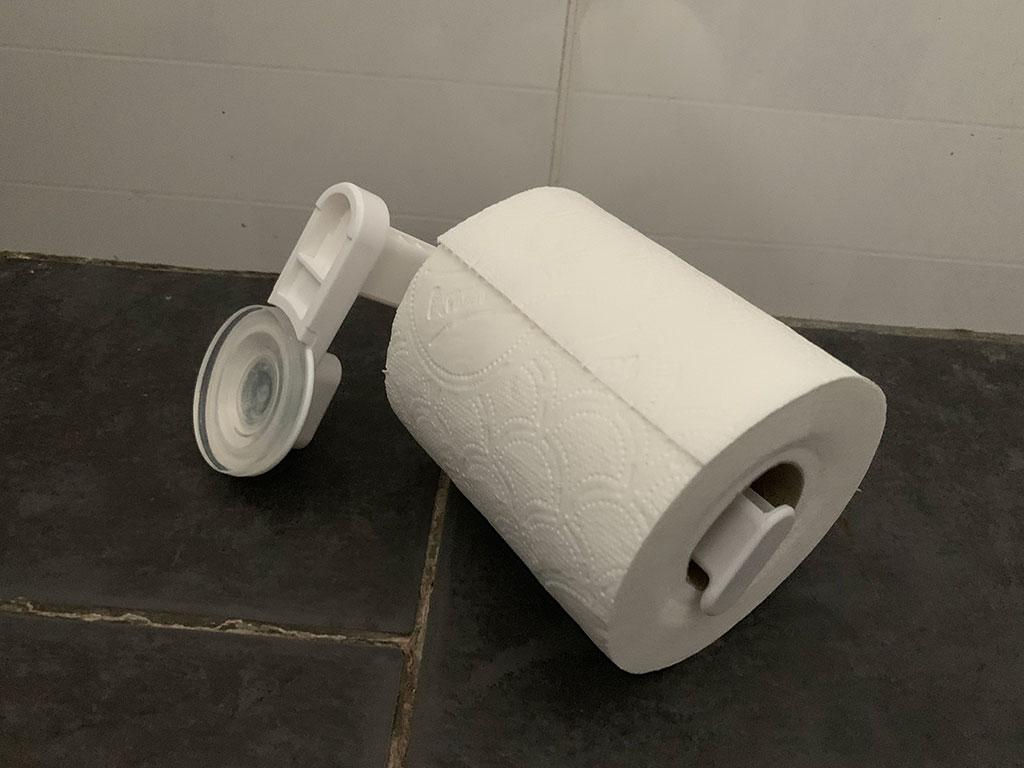
    Why does it matter that the toilet roll holder in my house is held onto the wall with a suction cup? Why does it matter that somebody cut some corners somewhere? Why does it matter that somebody did a sloppy, careless job? Why does it matter that people act without concern for the consequences? Why does it matter that some of us want to be idle?

    We bring up our children on a diet of propaganda about everybody having to pay their way in society – nobody getting a free ride – when our intention all along was to propagate sufficiently to be idle in our old age. We imagined that the older children would raise the smaller ones. We imagined that the more mature and adult members of our family would feel some responsibility towards their DNA donors, as they reached the end of their lives.

    I guess we hope that our children won’t know any different. If they’re born into a terrible world, they won’t be able to imagine a better one, so they’ll accept their terrible fate. Is that the logic? Somebody needs to explain it to me, because I don’t understand.

    My life lacks meaning and purpose.

    What if I met someone so amazing and beautiful that they convinced me it was a good idea to have children, because I knew how much happiness and satisfaction – peace – it would bring me as an animal, although very much in conflict with my own human consciousness.

    My body was evolved for the propagation of my genes. My body’s sole purpose for existence – in evolutionary terms – is for sexual reproduction. To act in defiance of my basic instincts is physically painful, like putting my hand in a fire.

    I stopped following the instructions at some point.

    I’ve lost my way.

    Loneliness and isolation should drive me to be social. Horniness and reproductive instincts should drive me to impregnate. Fear of death and extinction of my genes should drive me to seek to protect and replicate as many copies of my genes as possible. All the many millions of years of animal evolution have led to this point. Everything in my genetic programming tells me to carry on doing what every ancestor has ever done, since the dawn of life itself.

    However.

    I’ve gone off-script.

    I think that filial affection, sibling bonding, family ties, clan association and a genetic predisposition towards hostility directed at those of significantly differing DNA makeup – a wish to see those who don’t share common genes perish – somehow bypassed me. The thing that’s far louder in my head is the conscious voice that sprung into existence, perhaps as an evolutionary accident, but which has managed to narrate things to the point where that voice directs my behaviour far more than my bestial instincts.

    I suppose I’m what you’d call anti-social. Perhaps criminal and deviant. Society has generally decided that I’m dangerous and should be shunned and marginalised.

    Born into a household full of addiction and alcoholism, not feeling planned or wanted and not seeing any good role model in my parents, I found myself always somewhat the odd-one-out at school and in other social situations. I think I decided very early on that I’m unlovable. My life goals were always confused. The hedonism I saw my parents practice, with no regard for societal norms, conflicted with the nonsense they spouted in their state of intoxication, which claimed to be motivated by higher ideals: Values. I never saw any values, but I came to understand – conceptually – what values there were in the world, and why a person might hold a certain set of values.

    I can simultaneously hold in my head all the various reasons – such as social cohesion – that a group of individuals might subscribe to a common set of values, whilst also knowing the payoff for breaking the rules. I knew, for example, from a very early age that getting a drink or a drug into my system must be worth any amount of societally imposed consequences, for that is what I saw throughout my upbringing.

    My father talked openly about his criminal conviction for drugs, while my mother boasted about drug smuggling and encounters with the police, and both seemed proud and happy to have flouted the law and earned the disdain of wider society. They seemed to revel in their place as societal outcasts, earned because of their deviant behaviour and refusal to change their wicked ways.

    Yet, it seems better if I imagine myself to have been immaculately conceived and have lived my adult life with no unconscious bias left-over from childhood. It seems as if I should be judged on the basis that my values are identical to everybody else’s. It seems that every choice I’ve made should be viewed as having been made with complete free-will, and without the influence of my upbringing.

    I fess up.

    I done it.

    I done a bad thing.

    It’s all my fault and I’ve got nobody to blame but myself.

    There. Happy now?


    Tags:

  • Our Morals: The Ethics of Revolution

    This is a story about sedition and treason…

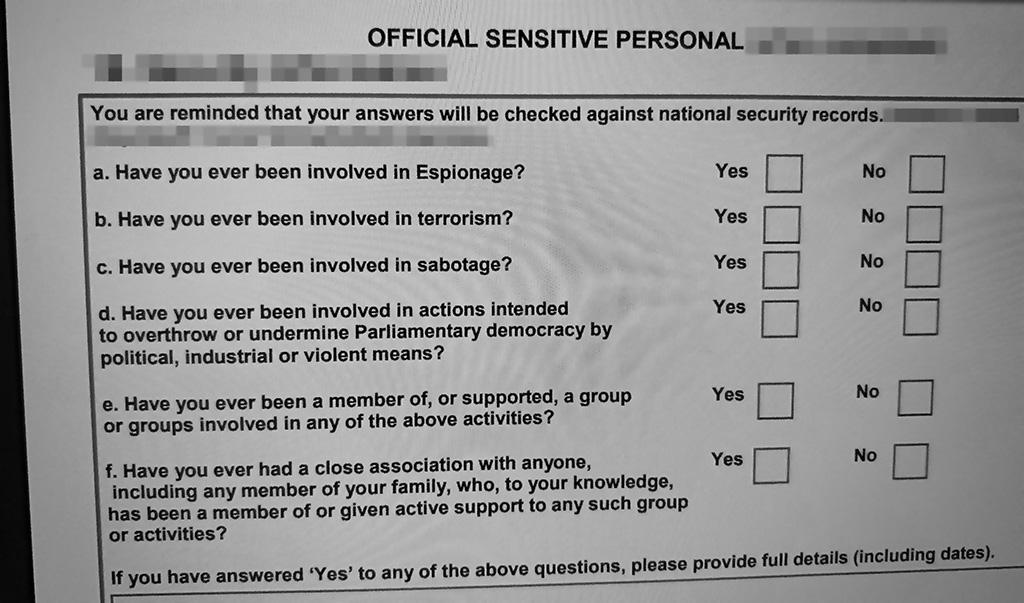
    Security vetting form

    Questions A, B and C seem pretty reasonable to ask. It seems like a good idea to ask people if they’re spies, terrorists or saboteurs, if they’re going to tell you the truth. It seems logical to assume that spies, terrorists and saboteurs are enemies of civilised society. It seems sensible to exclude spies, terrorists and saboteurs from positions where they could be a threat to public safety.

    Upon closer examination, spies and saboteurs could sometimes arguably be said to conduct their actions in a responsible way, in the course of the furtherment of their laudable objectives, in the absence of other available options. Spies exist when diplomacy and co-operation have broken down. Saboteurs exist when tyranny, oppression and exploitation are so great that a worker must throw their clogs into the loom, to save themselves and their kin. Without wanting to fall foul of the nebulous terminology, it would be remiss of me to acknowledge that a person could certainly understand the reasons for spying and sabotage – in a theoretical and academic sense – and perhaps even excuse those acts, where the outcome clearly results in a positive outcome for the greater good, according to utilitarian philosophy.

    Of course, I must tread very carefully.

    I have to watch my words.

    What on earth is question D getting at? I once destroyed my ballot paper as a political protest at the lack of a candidate and a party for whom I wanted to vote. Does that count as “[undermining] Parliamentary democracy by politcal … means”? Should I tick “YES” to this question? Is my spoiled ballot paper recorded in “national security records” which I’m reminded my answers will be checked against? Why even ask me if you already know the answer?

    Of course, the idea of asking people “are you a terrorist?” is pretty ridiculous, so why shouldn’t this same 66-page form ask vague questions which are almost impossible to answer, unless you think of yourself as such a perfect citizen and well-behaved patriotic loyal subject of Her Majesty Elizabeth II, Queen of the United Kingdom of Great Britain, Northern Ireland, its dependencies and its overseas territories.

    Do I believe in the Westminster system of Parliamentary democracy? Do I believe in democracy at all? For the purposes of my rational economic self-interest in the immediate short-term, within the context of filling in this 66-page form, which is of vital importance for the future of my career, the answer is “yes” for sure.

    Why am I using such cautious and measured words? Why am I couching what I say in caveats and disclaimers?

    The question arises: Is it irresponsible, socially destabilising or otherwise contrary to the interests of national security, to discuss the merits of ‘political change’ in a purely academic and theoretical context?

    Do scholars who study, think about, write about and discuss alternative political systems, imply some “intent” to overthrow or undermine Parliamentary democracy. For example, in the instance that a learned professor were to stumble upon compelling evidence that there is a better system for the decision making which is supposed to improve the human condition and the lives of the masses, then is that professor allowed to discuss it; perhaps even to promote the idea? What if other academics take an interest in that professor’s ideas, and they become supporters of the theory? What if this group of academics could be said to be a group of likeminded individuals, similarly swayed by the evidence and the ideas?

    Have I made myself into an enemy of the state by taking an interest in philosophy, politics and economics, which has forced me to consider the question: Is our Parliamentary democracy the best available option, or should we change to a different system? Does posing this innocent question constitute an act of undermining Parliamentary democracy?

    By the time we get to question F, I must surely answer in all truthfulness that I almost certainly would have – at some point in my life – had a close association with somebody who’s been a member of a group or supported a group whose intent could easily be interpreted as ‘offering an alternative’ to Parliamentary democracy. This is about as close as I’m prepared to go, to admitting something which is against my rational economic self-interest in the short-term, for the furtherment of my career objectives.

    Most of my friends are technologists. Many of my friends have created pieces of technology which must surely have undermined Parliamentary democracy. Many of my friends are the original engineers and architects – the visionaries – who are responsible for the birth of social media. What greater threat to the ruling elites has been born, since the invention of the printing press?

    Terrorism and violence are hard to defend; seemingly always unethical. It’s beyond the scope of this essay to discuss the ethics of violent rebellion by the victims of tyranny and oppression. I’m in too much of a vulnerable situation to say something like: “I can understand the reasons why desperate people might resort to violence, in the absence of all other options, like any cornered animal”.

    I may hold unspeakable views, which have no place in a civil position of public servitude. My upbringing in the company of academics, in and around the buildings of Oxford University, may well have scuppered any ambitions I might have of playing a role in the running of the country, and hopefully making a positive difference to as many lives as possible.

    Even within the walls of a British university, an academic may find themselves falling afoul of laws – new and old – which are designed to punish any agitators who might threaten societal stability and the established order. The power of the internet allows compelling academic arguments to be disseminated to vast numbers of people at incredible speed, and for the public’s imagination to be captured. Academic papers are no longer written in Latin and kept safely out of the hands of the hoi polloi, lest any revolutionary ideas they might be harbouring be provoked.

    Do I hold my tongue for the greater good – in support of a paternalistic and elitist establishment – because it will perpetuate the state of unhappy stability, which is at least preferable to civil war? Do I speak my mind, because to do so is a privilege afforded by the unpalatable actions done in the interests of national security? If I don’t take advantage of freedom of speech, am I really a patriotic citizen, loyal subject of Her Majesty and supporter of Parliament, given that wars are waged on my behalf so that I might enjoy the luxury of being able to write essays like this?

    I think I’m just going to tick “no” to all the boxes, because I can’t be bothered to have this conversation a second time, when I’m being interviewed by the thought police.


    Tags:

  • I Work Hard: The Proof

    This is a story about brainwork…

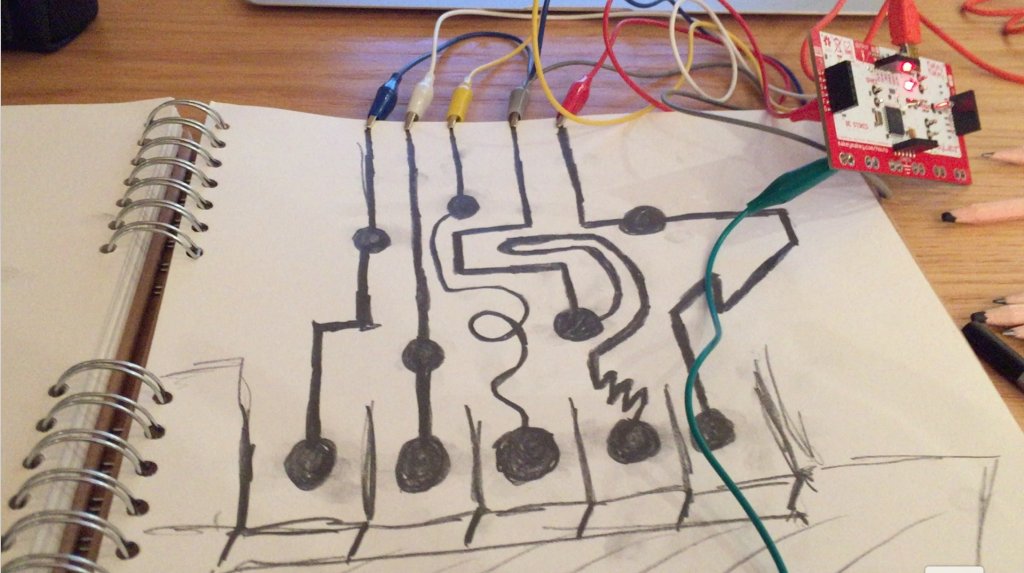
    Graphite piano

    In 2008 I became suicidally depressed. I’d been part of the project which had been at the centre of the global financial crisis: namely the trading of quadrillions of dollars worth of credit default swaps (CDS) which had grown in notional book value to be manyfold greater than the aggregate value of all the tangible things, such as precious metals, rare gemstones, property, factories, oil, gas, coffee, coins, banknotes and anything else which you could point at and say “that’s worth something”.

    The world had lost its mind.

    I knew it was coming of course. I had bought gold in 2005. I had negotiated a great mortgage in 2007 knowing there was a credit crunch on the horizon. In some ways I had tangible proof that I had been doing something valuable because I owned property, cars, boats and other things, as well as considerable amounts of liquid assets. In short: I was rich.

    I got rich from data and software. I got rich off the back of investment banking and derivatives contracts. I got rich off a whole lot of nothing.

    In 2008 it really felt like I’d presided over the most awful crime ever perpetrated against humanity.

    I’d worked hard and I’d done my job very effectively. I thought about the bigger picture and I knew – deep down – that what we were doing at JPMorgan was wrong, but I’m an engineer and I like delivering engineering solutions. If somebody asks me “can you do this?” then I want to be the problem-solving can-do guy who comes up with the solution and delivers a working system. Often times I stop and take a step back, and think about the context of what I’m doing – I consider the ethics – but that’s not really my job. I just design and build software systems.

    The whole “I just work here” or “I was just following orders” thing is how the Nazis managed to kill 6 million jews, so I’m not going to hide behind that flimsy defence.

    I know what I did was wrong.

    So, I decided to completely ditch investment banking. I decided to do something that was the polar opposite of investment banking. I retrained in the building trade.

    Instead of working in an office, I worked in customers’ houses. Instead of working to devise arcane and impenetrably complicated ways of moving imaginary wealth around the globe, I helped build houses for people to live in. Instead of working for a massive faceless global corporation, intent on destroying the worldwide economy and plunging us all into the deepest and longest recession in history, I worked for myself – I was a sole trader; a man with a van.

    I discovered that what I’d always suspected was true: I work hard.

    It’s hard to prove that you work hard, when all your hard work is hidden away behind the scenes. You have no idea how hard it was to build all the websites and apps that you use every day. You completely take for granted all the facets of the modern world, where you can speak to your phone and express your unique special snowflake personality on social media. The geeks and the nerds are derided as autistic-spectrum weirdo scum, who are all potential paedophile predator perverts who deserved to have a miserable childhood getting bullied at school.

    While we celebrate the doctors, nurses, firemen, policemen and suchlike, because their contribution to society is conspicuously obvious and easy to understand – like a game of cops & robbers – questions such as “what is the internet?” belie the hideous complexity of that innocuous 4-word question. If you’re looking for a convenient Google-provided soundbite synopsis that you can parrot to other people, in the vague hope of sounding intelligent, you’re doing a disservice to those geeks and nerds who you persecuted at school, who are the architects of the fourth industrial revolution.

    It’s very hard for me to prove to you that I’ve been working very hard during my 21-year full-time career. You’re quite likely to accuse me of not working very hard at all, because there are people out there who do a lot more physical labour, and what they produce is a lot more tangible and more easily understood in a childlike brain.

    It was immensely frustrating to me that I had no easily understood empirical evidence to prove how hard I work; to prove that I’m a busy bee.

    I started to write.

    I’ve written the equivalent of 22 novels over the course of 3 years.

    Of course a lot of what I’ve written is manic rantings, but one should be mindful that during the course of the 3 years I’ve also written a lot of software, and software doesn’t work if it’s wrong. One missing semicolon in millions of lines of code and the whole thing will be kaput. You should consider the fact that it’s a facet of my profession to write with coherence and attention to detail, because my editor has zero tolerance for mistakes: the computer can’t handle errors.

    It pleases me that I’ve produced 1.1 million words in my spare time as proof that I’m not an idle drug addict loser. It pleases me that I have a tangible asset, which vastly exceeds the length of the King James Bible.

    Would you accuse an author of a bestselling series of novels, as being unproductive and not working for their living?

    I say again: I’ve been writing in addition to my full-time day job.

    It’s true that sometimes I find my day job very easy and unchallenging, but there are other days when there are gremlins in the incomprehensibly huge and complex computer software systems, and those problems are very hard to diagnose and fix. Manual labour is governed by a simple and well understood set of physical laws: the energy requirements to lift and move heavy objects is quite easy to calculate. The amount of brainwork required to fix a problem with one of your beloved apps or websites – to give a facile example – which might affect millions of people, is not an easy calculation at all. If you think what I do is unimportant, you should see the public response every time Instagram stops working or Snapchat introduces a major change.

    My motivation for writing this is, of course, insecurity. I struggle with feelings of inadequacy and guilt. Imposter syndrome asserts itself and I wonder what the hell I’ve been doing with two decades of my life, with nothing to show for it except a lot of crummy software which almost nobody is aware even exists. I would struggle to explain to either of my grandmothers what I do for a living, especially now they’re dead.

    I exist in a strange part of the world. I’m a ‘tame’ geek who can speak plain English. I don’t surround myself with other technologists and I’m cursed with a bleeding-heart liberal streak and an inquiring mind, which causes me to question whether I’m part of the problem or part of the solution.

    Because of my guilt, work ethic and insecurity, I feel like I have to create a very conspicuous and public display of my productivity, which can be easily understood. Here’s the headline: 1.1 million words in 3 years.

    I write because I’m afraid that you’ll write me off as a lazy junkie waste-of-space loser who doesn’t do anything productive or useful. I write because I don’t see much other evidence that I ever existed or did anything notable; that I ever contributed to society.

    “Use your talent and energy for good” I hear you say. Yup. That’s working out really great for the oppressed workers, isn’t it? I’m so glad that charity has been so successful that it’s made itself completely redundant as a concept.

    I write because I haven’t decided what else to do, but I’m still thinking, of course. You might think that thinking is useless, but what is writing except for thinking on a page?


    Tags:

  • Godless

    This is a story about faith…

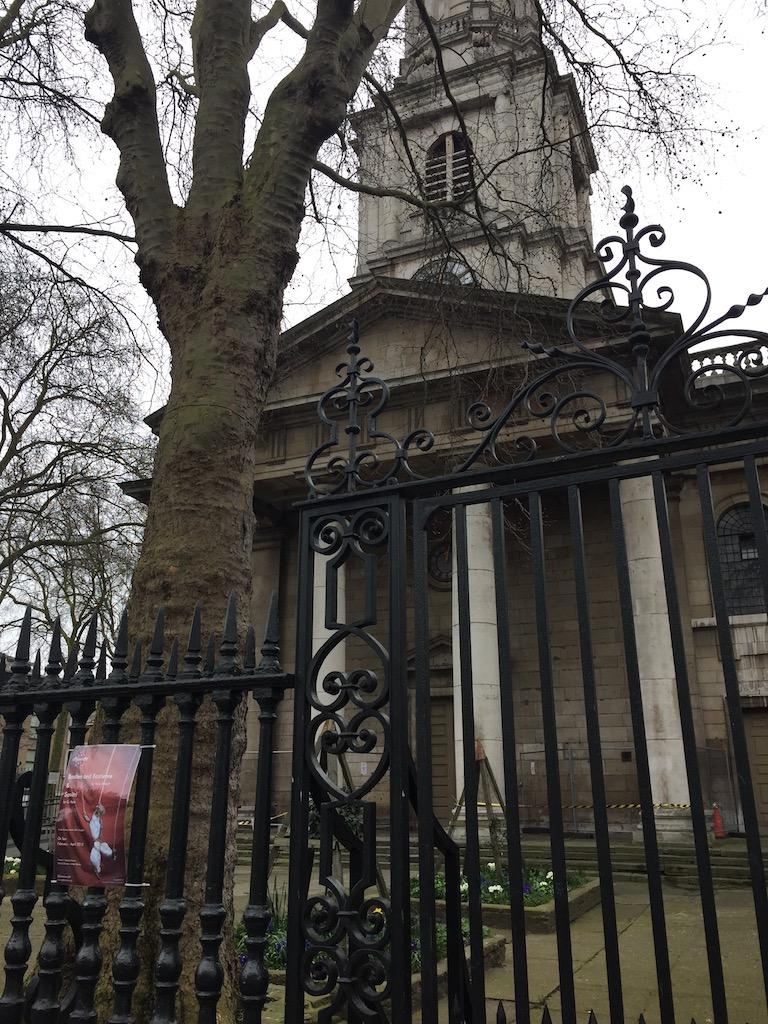
    Church

    I have far too much of a skeptical inquiring mind to foolishly believe that religions are anything other than a terrestrial invention, born in the minds of mortal men who were afraid of death, during unenlightened pre-scientific times. I’ve had access to far too much knowledge and information to ever believe in fairy tales about omnipotent sky monsters. However, it does mean that my existence is pretty absurd and meaningless. Religion gives a sense of community and belonging – those who have chosen to follow a particular faith are able to identify others who believe the same weird things, because of their weird customs, their weird traditions, their weird buildings and the weird books they read. It must be nice to have that sense of belonging, and to strongly believe that there is order, purpose, meaning and easy-to-grasp comforting explanations for everything that happens in our otherwise hostile and chaotic universe… it’s all part of God’s plan.

    I used to pity those who have religious faith as deluded simpletons. I used to want them to wake up and consider the evidence – or lack thereof – and to have a scientific awakening; to become atheists. However, I think it’s those who don’t subscribe to any kind of philosophical or theological framework, who should be pitied. What do you believe in if you know – from the overwhelming weight of empirical evidence – that the universe is nothing more that a cosmic accident; the byproduct of the universal laws of physics and nothing more. Why are we here? What meaning and purpose is there? Humanity will be wiped off the face of the Earth and everything that we ever thought was important will be erased; as if it never existed. We’re not even a microscopic speck in the unimaginably huge – and ever-expanding – universe.

    The author Douglas Adams wrote in one work of fiction, about the worst torture being to be shown the entire universe all at once such that you fully perceive your own insignificance, which would blow your mind and destroy you. So many good novelists are more imaginative than our best scientists, and they foresee the cultural and social problems which the inventors of new technology don’t, because the inventors are too in love with their creations. Our thirst for knowledge, and the invention of the biggest and most complicated machine ever built, which connects most of humanity in a world wide web – the internet – has not brought with it any comfort, unlike religion. Having this incredible information vault accessible anytime, anywhere, along with the ability to communicate and connect with anybody, is something which no engineer who built the internet thought might lead to incredibly awful social and cultural problems. Engineers are utopians, but they invent things not ideas, philosophies and belief systems. Engineers created the internet and they left it up to others to decide what to do with it; they’ve left it to us to make sense of things.

    Google and Wikipedia appear to be unopinionated. In theory, you can use Google and Wikipedia to simply discover the information which you’re looking for, and consume it. In theory, Google and Wikipedia will not tell you that certain ideas are heretical, or ascribe a sinfulness to the pursuit of certain knowledge. You’re free to search “anal fissures” out of pure morbid fascination with the disgusting and depraved, and you won’t be judged – it’s all just between you and the computer. You can ask Google the questions that you would have asked your priest 100 years ago, and Google will give you the information so that you can make up your own mind. In fact Google is giving you the information that the most people clicked on, and some information which has been growth hacked by people with a commercial objective. Wikipedia presents the prevailing consensus of opinion in academia, with some degree of peer-review process, however it’s just the opinion of the handful of people who wrote the particular page you’re reading.

    None of the stuff you read online is informed by an over-arching unified goal of shepherding the flock towards a state of existence deemed better than pure anarchy. Perhaps certain online news sources have editorial leanings which border on the paternalistic, but the vast majority of what’s published online is done so to satisfy the particular individual’s personal goals, and not as part of any master plan.

    You might think it’s the role of the government to think about the future of society and civilisation, and the government will be strongly opinionated about the purpose and meaning of our lives, but in fact governments are simply the victors in a commercial popularity contest, driven by individual egos and the survival needs of the massive party-political organisations. As such, governments simply parrot back whatever the people are demanding.

    Progressive policies which have advanced our society have not come about because people demanded that we drag ourselves out of the dark ages, but in fact as a result of opinionated elites pushing through changes in the law which were not at all popular with the public. The death sentence is not something the public wanted to see repealed. The public are barbaric baboons and the idea that true democracy would lead us towards a progressive liberal utopia is completely wrong – instead we’d legalise xenophobia, racism and the persecution of minorities, if we left it up to the masses; mob rule.

    It’s wrong to assume that we have within us a moral compass; a strong sense of right and wrong and social justice. It’s wrong to assume that people are basically good; they’re not. People are selfish assholes. People are only interested in them and theirs, at the expense of anybody who’s not like them. People are just dirty beasts with fancy clothes.

    Yes, I’m pro paternalistic elitism. I’m pro social engineering. I’m pro giving people what’s good for them, even though they don’t like it and it’s not what they want. Any move towards greater democracy is a move towards barbarism and the collapse of civilised society.

    In my experience, people want simple fables; they want to believe in goodies and baddies; they want to believe in a black and white world, where everything can be simplified into easy to digest nonsense, which strips away all the complexity of reality and replaces it with comforting falsehoods. In my experience, people want to believe in lies, because lies are easier than hard truths. In short, people want religion.

    Nobody much cares about the universal laws of physics and the optical illusion which makes solid objects appear to be solid, when in actual fact they’re made of mostly nothing; a scattering of particles with indeterminate positions. People don’t want to know about the deeply unsettling subatomic world, where things behave in non-intuitive ways. People want to believe that the world is a magical, mysterious and unknowable place, invented by a sky monster, because it’s easier than grasping quantum mechanics.

    Nobody much cares about the complex history of humanity and all the inter-breeding that’s gone on, such that there are no ‘pure blood’ races. People just want to separate into “us” and “them”. People want to belong to clubs, clans, tribes, nations, parties, teams, dynasties and every other conceivable way of slicing and dicing ourselves, such that we feel part of something. People want to hate. People want war and they want to dominate.

    Nobody much cares that there are perfectly viable ways to divide our wealth and peacefully co-exist. Nobody much cares that billions of people could have their standard of living dramatically improved, at the expense of greed and selfishness. People want to live under hierarchies; they want to worship prophets and elevate ordinary mortal men to positions and status which are obscene and unjustifiable. Do you really think that a TV pastor deserves to live in a huge mansion while there are people starving on the streets? That’s what people want – they want the haves and the have-nots.

    Our terrestrial mortal destiny is in our own hands, and we know – in our heart of hearts – that when we die it’s all over. There is no afterlife. There is no promised land. It’s all bullshit that was invented to lessen the fear of death and make our lives of suffering appear to have some meaning in an otherwise ludicrously absurd existence. In the end you. just. die.

    If our destiny is in our own hands, why aren’t we making our existence on Earth into a more pleasant experience? Why aren’t we bothered about making the most of the short time we’re alive? Why are we content to have so much struggle, pain and suffering? We’re quite capable of alleviating that suffering, but there’s no will to change. We busy ourselves with absurdities, like getting jobs as bakers so that we can earn money to afford to be able to buy a slice of bread, from one of the loaves which we baked. We’ve constructed ludicrous inefficient systems which only serve to enslave us and make us desperately unhappy.

    Of course none of this is God’s plan. If there is a God – which there isn’t – then why would He have us punching made-up numbers into a spreadsheet, at a desk, in an office, in the middle of a concrete jungle? Why would He have us exchanging pieces of paper with each other until the day we die? Why would He have made the money lenders into the richest and most powerful people on the planet, when His son was evidently not a big fan of usury when he drove those money lenders out of Herod’s Temple?

    Those who are afflicted with the madness that is religious faith might in fact be onto something, because at least their lives have meaning and they’re looking forward to something, as opposed to enduring awful suffering until the day they die. We end our lives afraid and in pain and we know we’re not going to see our children and grandchildren again. It might be insane to believe in an immortal and everlasting afterlife, but it’s a damnsight better than anything on offer in a world run for the sole benefit of the mega-rich, which we have willingly allowed to come into existence.

    In a godless universe with no afterlife, what’s the meaning and purpose of anything? Nothing has any meaning. You might as well go and commit whatever crimes you want, because we all die anyway. You might as well indulge hedonistic pursuits to the maximum, because none of us are getting out of this alive.

    In a world without religion, what fills that void? It can’t be the pursuit of wealth, because that’s even more insane.


    Tags:

  • Forced to be Free

    This is a story about normality…

    Psych ward garden

    Most people want a secure job, secure housing and to feel prosperous. Most people don’t care about freedom of speech and a free press. Given the choice between security and freedom, most people would choose security every time. It’s only a handful of paternalistic elites who dictate that we the people care a very great deal about freedom, when in actual fact this is not true at all.

    Freedom has a very narrow definition. When we talk about freedom of speech and a free press, we do not also acknowledge the freedom to be hungry, the freedom to be homeless, the freedom to be marginalised, excluded and abandoned by our “fit in or f**k off” culture. While we might enjoy freedom of speech and a free press, those luxuries are only useful to a privileged few; the wealthy elites; the rich and powerful. While you are theoretically free to run for political office or broadcast your opinions, you are not at all free in practice.

    The only freedoms that ordinary people have are the choice between virtually identical minimum wage zero-hours contract McJobs; the choice between conformity or social exclusion. You can be a free tramp, if you choose: you can be homeless, penniless, destitute and free, or you can be enslaved to the capitalists… it’s up to you; you’re free to choose.

    Further, for those who are not neurotypical you have to choose between social exclusion, stigma and poverty or the chemical straightjacket of powerful psychotropic medications. You’re free to accept the diagnoses and swallow the pills, and allow yourself to be ‘normalised’ so that you fit the rigid static definition of how a ‘normal’ person should think and act, or you can choose to be excluded from most economic and social activity because you don’t fit in.

    Many of us willingly and indeed eagerly beat a path to the door of our doctors, demanding medications that will return us to ‘normality’ when we find that we are deviating from what we perceive to be the norm. We see millions of others around us getting up at dawn, commuting to bullshit office jobs and being uncomplaining, so when we’re troubled by depression, anxiety and other disruptive changes which force us to confront the purposelessness of our absurd existence, we ‘choose’ to be made normal again by psychiatry.

    Society should be constantly adapting to the changing needs of the people, such that the stress and exhaustion in our lives is reduced or at least kept constant, but instead we see that the people themselves believe that they are the ones at fault. Students take amphetamines, modafinil and methylphenidate in order to artificially increase their concentration spans and stay awake during marathon exam-cramming sessions. Workers drink tea, coffee and energy drinks in a desperate attempt to stimulate their brains and fend off tiredness. We take antidepressants and anti-anxiety medications so that we can withstand the horrors of a society which places greater and greater demands upon us, while also giving us less and less security: our jobs are under threat, our homes are under threat, we and our children are under threat. Where has the feeling of prosperity and the sense of optimism gone? We presume that it must be us who have faulty brains, as opposed to seeing that it’s society itself which is failing to deliver the things we need.

    As is oft-quoted: “it is no measure of health to be well-adjusted to a profoundly sick society”

    When more than 50% of the population are categorised as suffering from some sort of mental disorder, we must surely accept that it’s the minority group who are the sick ones. Why should society continue only to serve the ones who are not suffering? Why should our idea of what is ‘normal’ be based on something which is abnormal because it is less common? Why are we trying to conform to such unrealistic and impossible ideals, which do not serve the majority of people?

    “I’m miserable, so you have to be miserable too”

    I think the above quote accurately sums up the attitude of powerfully influential figures in our society, who are blocking any progress towards a better way of life for all our citizens. I had the misfortune of making the acquaintance of a doctor who hated their job, their commute, the daily grind and – seemingly – their patients. This doctor made it their mission in life to deny time off work to anybody they could. Their reasoning was simple: because they were miserable and hated their job, they were going to make everybody within their power suffer too. A doctor has the power to dispense medications which might temporarily mask the symptoms of a sick and broken society, or to sign a piece of paper which excuses a person from the charade of having to go to their bullshit McJob every day. A doctor has the power to inflict misery on potentially thousands of people every year, and we must presume that as many doctors are as miserable as the general population as a whole, which means that more than 50% of doctors are perpetrating this kind of awfulness on the people they have power over.

    We worship medicine and medics as a force for good, but in the increasing absence of organised religion in wealthy western democratic countries, we are seeing doctors elevated to a social status beyond what is reasonable, creating demi-gods who abuse their power. Just as with organised religion, we have suspended rational thought, cynicism, curious inquiry and skepticism, and have placed blind faith in the medical establishment to cure the ills of society. We reject politics and politicians as corrupt self-serving liars and we have lost faith in the ability of our vote and other democratic instruments to be able to influence our lives for the better.

    The only thing we believe we’re able to change is ourselves, with the assistance of doctors who can give us “magic bullet” pills to alter our mood and perceptions, as well as keeping us youthful and protecting us from death. We have fake tits, white teeth, hair implants, botox and numerous other procedures to alter our appearance, because we’re powerless over anything except our looks. We can be reasonably sure that our lives are protected by hospitals and medicines, but our power to influence anything else in life, such as our socioeconomic prospects, is precisely zero.

    While a sharp-elbowed tranche of middle-class society obsesses about their children’s exam grades, places at the most desirable schools and universities, internships, graduate training programmes and otherwise attempting to give their precious little darlings a head start in life, this blinkered myopia ignores the fact that the baby boomers are getting older and older but living longer and longer, while also amassing asset portfolios well beyond their means, and preventing those precious little darlings from having any hope of having secure jobs and secure housing. In order to pay grotesquely unjustified and disgustingly greedy defined-benefit pensions to the generation who’ve contributed the least – except to national debts, global warming and a decline in living standards – the pension funds demand that workers are paid pitiful wages for longer hours in terrible working conditions, so that profits, capital gains and dividends can keep sustaining the unsustainable, unrealistic and ridiculously greedy selfish demands of those who are taking out far more than they paid in.

    A small segment of society is free to write, paint, photograph, travel and generally enjoy the freedoms that we would all love to have, but the very vast majority of us are too busy trying to survive in an ecomony which is built to benefit the few, not the many. Only the old and wealthy are free, and they did not work hard to earn their freedom: they have stolen that freedom from the young and from the future generations who will inherit all the problems of today and tomorrow.

    If you’re an artist and/or an academic and you enjoy your life and your job, you need to remember that the position of privilege you’re in is very rare and a very high price is paid by a huge number of people, so that you can swan around having a lovely time. Your freedom ends where mine begins, so if your freedom is disproportionately large compared to the rest of society’s then you’re being greedy and antisocial; you’re an enemy of society. While it’s very trendy to talk about freedom being important, we must be mindful that most people want security, not freedom. Think about the price that’s paid by the whole of society for your luxury privileges.

    To be truly free and happy, we might have to re-evaluate our priorities. We can’t demand cheap food and cheap goods if we want to be free, for example, because those things are only made possible by the exploitation of workers. We can’t demand passive labour-free unearned income, for example, because that’s only made possible by tyranny, economic slavery and exploitation of the vulnerable. Most importantly, we can’t expect to feel contentment and security, when we need unhappy, insecure people in order to sell consumer products and to keep our entire workforce on the treadmill, by heavily indebting them and denying them social housing or the ability to buy/build their own home.

    You might teach your children that a strong work ethic and academic excellence are the route to getting ahead in life, but it’s not true. Being a compliant hard worker means you will be exploited, and obtaining academic qualifications incurs a substantial amount of debt. Servicing debts and paying rent is a form of tyranny which has encroached on personal freedom to the point where only a tiny fraction of society enjoys any kind of meaningful freedom at all. Your children will not be able to escape the trap; there’s no hope. The depression and lack of optimism for the future is driven by a rational, reasonable and sound assessment of our younger generations’ prospects.

    Our heavily indebted and heavily medicated society is also controlled by draconian laws which were ostensibly introduced to counteract terrorism and industrial unrest, but have been abused to undermine the strength of trade unions and prevent the establishment of any counter-cultural movements which might challenge the status quo. While we should be living in an age of alternative lifestyles and people dropping out of a society which clearly no longer serves the majority of people’s needs, we are instead witnessing a miserable dystopia, where we’re all trapped on the treadmill because the only alternative is hunger, homelessness, persecution and social exclusion.

    Yes, I’m free to write whatever I want, provided I do not defame the powerful figures who are responsible for maintaining this miserable state of existence for so many millions, but those in power are quite comfortable in the knowledge that my ranting is safely confined to an echo-chamber filled with so much noise that, as Aldous Huxley predicted, the truth is drowned in a sea of irrelevance – information overload.

    We are somewhat hoisted by our own petard. Almost none of us of us demanded freedom, but we have collectively made freedom of speech into something useless; toothless. We are not free at all and we have no mechanism by which to affect any meaningful change. What is supposedly our most powerful tool to speak truth to power – the freedom to express ourselves – has in fact become the reason why our voices are not heard and our suffering goes ignored.

    All that’s left is the freedom to be hungry, homeless, persecuted and excluded.


    Tags:

  • How to Become Irreverent

    This is a story about the values you raise your children with…
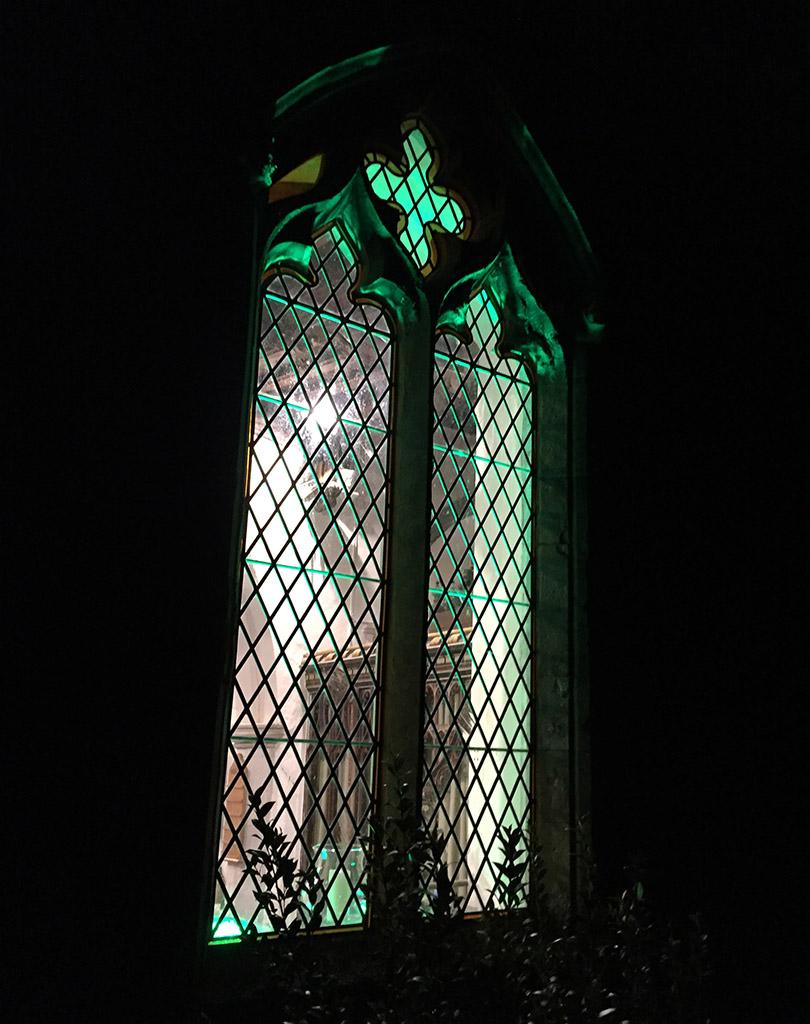
    Church window

    It seems like I have had the sentimental attachment most of us feel towards everything we revere in society systematically thrashed out of me. If you pick one thing that summons feelings of safety, security, comfort, respect for authority and faith in the divine/spiritual, then I will tell you how exactly how I came to question everything: every institution, everything sacred, every tradition, every profession, people who are normally considered beyond reproach and ultimately even existence and its purpose.

    Starting with my birth, I’m literally a bastard. I was born outside of wedlock. My parents never married and always planned to remain unmarried, such that I took my mother’s surname instead of my father’s. Ironically, my mother had once been married, and I have the surname of her ex-husband instead of her maiden name. Confused? Imagine trying to explain that to your fellow pre-schoolers when you’re 3 years old. I didn’t really understand it at the time, but I understood that I was different; unusual.

    My schools would often address letters intended for my parents to Mr & Mrs Grant, and my father would always tell me that I was the only Mr Grant in the house and therefore the letter was addressed to me. My mother would tell me that she was no longer Mrs Grant and she was Ms Grant. “Why not Miss?” I would ask, and she would explain that she had been married, and Miss was only used by women who hadn’t been married. If anybody telephoned the house and asked to speak to Mr Grant, my father would hand the receiver to me and say “it’s for you”, which it never was, of course.

    I understood that there was divorce and some of my school-friends were raised by a single parent, or a step-parent. My peers would often ask if my father was my step-father, to which I would reply “no”. Nobody could understand how I came to have a different surname from my biological father, or entertain the notion that I could have been given my mother’s surname, not my father’s.

    At some point, a fairly clear question formed in my mind: “why aren’t my parents married?”. 

    The reasons why people get married had become quite clear in my mind, for the very simple reason that I had endured years and years of people’s reactions that suggested that not getting married was very atypical behaviour. Nobody wants to feel unusual; freakish. Nobody likes to feel odd.

    When I posed my question – “why aren’t you married?” – to my parents, they replied with their own question: “why should we get married?”. I had a pretty easy answer for them, as I’ve explained: because that’s what everybody else does. “Do you want to be like everybody else?” my parents asked. “Yes” I replied.

    [I just burst into uncontrollable sobbing. If it wasn’t what you experienced, I don’t think you can begin to understand what it’s like to spend your entire childhood as the freakish weirdo; the odd one out… the one who’s different from everybody else]

    Having covered marriage there is a natural segue into the topic of religion, and the origins of my atheism.

    For a number of formative and important childhood years I lived in an attractive terraced house in an area called Jericho, on one of the most desirable roads in central Oxford. These houses are the most expensive in the world, far exceeding real estate prices in London, San Francisco and Hong Kong, in terms of their affordability. However, these £1.5 million houses were bought by the first wave of gentrifiers, when academics and young professionals with families started to move into slummy areas because they couldn’t afford family homes in the more desirable parts of the city.

    When your immediate neighbours include an MP, a barrister, a heart surgeon, a City banker and a number of promenant Oxford dons and professors, their children were raised in an environment which was knowledge-rich and encouraged the exploration afforded by a curious rational mind; critical thinking. Nobody went to church. My friends, whose father was a consultant at Oxford John Radcliffe Hospital, went to Quaker “friends meetings” occasionally, but my peer group – the sons and daughters of the intellectual elite – had little place for God and church in their lives.

    We should rewind a little bit, back to the village our family lived in before we moved to central Oxford. If one were to imagine the most quintessentially English picturesque Cotswolds village, with the manor house, the village green, the workers’ cottages, the post office and village shop, the village pub, the village school, one should not forget the church and its graveyard. The church’s presence and influence is not to be underestimated. My religious indoctrination began as soon as I started school, with the vicar regularly present. Village social events are very often church-linked, like harvest festival, and of course everybody who grew up in such an idyllic village wants to get married in that particular church, have their children baptised there and be buried in that graveyard.

    Essentially, the church’s opportunity to exploit a child’s vulnerable immature mind were scuppered by my father. For everything that the church had a comforting but incorrect explanation for, my dad cited a lack of evidence and instilled in me the skepticism which gradually became integral to my developing personality: “show me the evidence”.

    When we moved to the centre of a city whose university is globally recognised for its academic excellence, I never encountered another simple-minded fool who had been persuaded to believe in Gods and other aspects of religion, which are so obviously irreconcilable with the pursuit of knowledge. Religion encourages ignorance but I had been raised to question everything and remain skeptical until I had seen convincing proof. “What are atoms made of?” I remember asking one of my friends who lived on my street. “Quarks” he replied. We were perhaps only 5 or 6 years old – the product of a childhood immersed in academic culture, as opposed to the sentimental and traditional.

    The disturbing and unpleasant consequences of an irreverent life can impose themselves on a child at a worryingly young age. I’ve already been uncontrollably sobbing about just one thing – the tradition and sanctity of the institution of marriage – and I haven’t even mentioned how a child deals with the concept of mortality and threat of death without the comfort of religion.

    A US Air Force pilot who drank at the village pub which my parents later bought and now live in, drunkenly boasted about the ability of the United States to wipe humanity off the face of the earth. I was definitely no older than 4 years old. With my friend with whom I had discussed subatomic particles, we talked about the temperatures which could be reached near ground zero of a fission or fusion nuclear bomb, and how the radiated ‘heat’ (electromagnetic radiation) had instantly vaporised human beings in Hiroshima and Nagasaki, with only their shadows left behind, permanently etched into the walls of buildings.

    If you believe you live in a Godless world with no afterlife you naturally want to know what everything’s made of if God didn’t make it; you want to know why it’s here. How did it get here? Why is it here? You start to pick everything to pieces by iteratively asking what each thing is made of: humans are made of cells, and cells are made of molecules, and molecules are made of atoms, and atoms are made of quarks and leptons… and you can in fact keep asking the question. There’s good proof that the electron is not a fundamental particle, as had originally been thought.

    When your schoolmates are smart-arse little shits, because their parents are brilliant academics, teachers and school loses its awe and authority. If you’re being taught science that’s almost 100 years old, and sometimes even 200+ years old, the whole exercise is nothing more than a box-ticking exercise to be endured.

    The other thing to consider is that my parents used illegal drugs on a daily basis, and had strong views about the legitimacy and usefulness of the law, certainly in the instances that suited their own addictions. As with many drug users, they were very paranoid. They viewed the police as corrupt and not to be trusted – the enemy. My father’s criminal conviction for drugs not only poisoned his views on the police, but also made him very anti-American, as he believed he would never be allowed to enter the country due to his criminal record.

    [I’m crying again]

    It was only because of first-hand dealings with the police that my viewpoint changed from skepticism due to lack of evidence: the police had never caused me any harm, and in fact I had never had any dealings with the police at all for most of my adult life. You might be surprised to learn I adore and respect the police. My accumulated experience of police encounters has consistently shown that they are some of the most kind, patient, empathetic, forgiving, reasonable people, who have always gone out of their way to bend the rules and simply help as opposed to ever enforcing the letter of the law.

    One shouldn’t mistake my respect for the men and women of the police force for reverence. I would never for a minute expect that a 999 call is somehow going to be the answer to my prayers. I don’t feel safer or more secure, knowing that I can call for police assistance. I wouldn’t feel any more comfortable in a stressful situation if there was a police officer present. Of the very many police men and women who I have had first-hand dealings with, they have always treated me very fairly and kindly, and it’s quite clear that they deal on a daily basis with a huge number of very vulnerable and damaged people, which they do so with incredible compassion – they are the living embodiment of humanity not deities who should be worshipped and revered.

    [More crying]

    So if I don’t revere priests, vicars, teachers, headmistresses, marriage, religion, military superpowers, soldiers, the police, the law and my own parents, what else is there left for me to lack reverence for?

    Cumulatively, I’ve spent almost 6 months having my life saved in hospital – often in high dependency and intensive treatment unit (ITU) wards. Shouldn’t I revere doctors; surgeons?

    I think that if there was one thing that would make almost anybody feel more secure and happy in a stressful situation, it would be knowing that there’s a doctor present. It’s such a clichéd question: “is there a doctor here?”.

    To explain my irreverence for doctors, we merely need to explore the reasons why I have ever had to deal with one, and the outcomes of those interactions.

    Having been lucky enough to escape congenital abnormality, it doesn’t take a rocket surgeon to figure out what I want from a doctor and why. You don’t need to spend 5 or 6 years at medical school to know that the human body has been dealing with pathogens since the species first came into existence. You hardly have to be brain of Britain to figure out whether you’re dealing with a viral, bacterial, fungal or parasitic infection, and furthermore, which is likely to be treatable. In actual fact, I’ve never been to my doctor for antibiotics: every infection has always cleared up on its own. Fungal and parasitic infections can be dealt with without a doctor obviously: head lice shampoo is available in every pharmacy, without a prescription, for example.

    At the age of 28 I went to my doctor wanting treatment for depression, but I knew which specific medications I was prepared to try and which medications I didn’t want because the side effects were not acceptable. Having my choices limited only to SSRIs provided firm evidence that doctors were an obstacle to be overcome, not a panacea.

    When we think about the first time I was hospitalised, do you think I didn’t know that I was going to end up there and what the problems were going to be? Do you think it was an accident that I ended up in hospital?

    Again, you don’t need to spend 5 or 6 years at medical school to know that the human body needs water, salt, glucose, proteins, amino acids, vitamins, minerals and myriad trace elements, or else the bodily functions haven’t got the fuel, carrier fluid and raw materiels they need. You don’t need to be a doctor to know that human body temperature needs to be homeostatic as much as possible – much like every other measurable thing in the human body – and any extreme variation too high or too low is going to have dire consequences.

    When you are making choices in full knowledge of the likely consequences, medicine ceases to be lifesaving magic, and instead it becomes another simple case of what do you want and why?

    One must consider the very last time I was hospitalised to truly understand my irreverence.

    Not only had I quite carefully pre-planned my suicide attempt, when I arrived at hospital against my will, I gave very clear instructions: do not put activated charcoal into my stomach, do not perform gastric lavage, do not intubate, do not provide life support and most importantly of all, do not resuscitate. “Do you know what’s going to happen?” the A&E doctor asked. “Yes. I’m going to die of a combination of organ failure and serotonin syndrome, with a lot of seizures” I replied. “Do you think you’ll be unconscious? Do you think it’ll be painless?” the doctor asked. “No. I expect that it will take a long time to die and I’ll be conscious and in a lot of pain for most of it” I replied. Then I started having seizures.

    Doctors see a lot of people who are scared and they don’t understand what’s happening to them. They’re desperate for somebody who seems to know what they’re doing and what they’re talking about; doctors are an authority figure. I have no doubt that for feckless simpletons and those who lack access to medicine, the arrival of a doctor or a priest/shamen/witch-doctor is incredibly soothing and comforting. If you don’t know what you want and why, your reverence is misplaced, but it may still ease your passage from life to death.

    When shit goes bad, who are you going to turn to? If you have to pick your team of people to survive on a remote island, who are you going to pick and why?

    Why revere anyone? Why kiss anyone’s arse and tell them they’re great because they did the study and training that you could’ve done if you wanted to. You could have passed those exams. You could have gained those qualifications. You could have followed that path if you wanted to. If you wanted it bad enough, you could put on that uniform; you could get that job title; you could prefix or suffix your name with the bit that tells the world just exactly why everyone should drop to their knees and worship you.

    Nothing’s sacred to me. I could do your job if I wanted to.

    I’m not smarter than anybody. I’m not better than anybody. That’s the whole point: I’m lucky enough to not have anything that’s holding me back; limiting my potential.

    I really don’t recommend telling your kids they can follow their dreams and be anything they want to be. I really don’t recommend telling your kids to question everything, and understand everything about how the universe works, to the point where they reach the very bleeding edge of scientific research. I really don’t recommend raising your kids to challenge the status quo and resist the urge to fit in with wider society and their peers.

    Take it from me: there’s a mind-destroying kind of cold uncaring “nothing matters” bad feeling that comes from being too rational; too much of a free-thinker. Take my word for it: understanding the absurdity of existence will destroy your mental health.

    You should probably experiment with hard drugs. That’s probably way less likely to fuck up your life than going down the rabbit-hole of picking everything to pieces and trying to reason from first principles and pure logic.


    Tags:

  • How to be a Philosopher

    This is a story about thinking…

    Thought bubble

    There’s a bit of a monopoly on thinking. I mean, you’re allowed to think and stuff, but you’re not allowed to share those thoughts. Well, you can share your thoughts but nobody’s going to care, because you’re a nobody. People want to know the opinions of a rich spoiled heiress who’s famous for having her sex tape plastered all over the internet, but not your opinions. People want to know the opinions of those whose opinions are already well publicised, and those who already have a platform and a group of devout followers. Nobody wants to hear any new thoughts, ideas or have their cherished philosophies challenged.

    Thus, we arrive in the quagmire of modern day living. We are heavily weighed down by our attachment to notions of what we consider to be virtuous, conferring greater social status and conforming to acceptable social behaviour – norms, if you like.

    If you wish to conduct a real-world philosophical experiment, try asking a person on a crowded bus or a train if you can sit where they’re sitting. There’s nothing written into law to say that you’re not allowed to ask if you can sit down without a socially accepted reason, such as being old or pregnant, and I very much doubt you were taught by your parents or in school that you shouldn’t ask for somebody to give up their seat for you, so where did the protocol come from? How did it become enshrined that we accept “they had it first” as validity for possession of something we desire?

    One might argue that thieves are an example of an antisocial behavioural pattern that, nevertheless, allows a person to get the things that they need in life, just as any one of us might steal the milk from a cow, or the seeds from a plant – we see numerous examples of behaviour that is criminalised and stigmatised in some forms, but accepted and even revered in others. Why is it that we call welfare claimants “scroungers” and “parasites” but we don’t we criticise bosses, managers, slave-owners and similarly idle people who profit from the labour of others?

    I feel compelled to caveat what I’m writing, and say that there’s a kind of absolute morality which decrees that any action which has a victim – rape and murder, for example – is always wrong, while theft and fraud could arguably be said to be victimless, because wealth always needs to be redistributed. In actual fact, in a godless world with no afterlife, there is no place for morality – when you’re dead you’re dead, so you might as well do whatever the hell you want, provided the profit to you is greater than the potential societally-imposed consequences.

    If you were asked to say what the prevailing philosophy of the present day is, what would you reply? Would you say that we are still religious and subscribe to the ancient belief systems of the major religions? Would you say that we have adopted the philosophy of the Ancient Greeks? Would you say that we have adopted modern politico-economic philosophies, which could broadly be described as socialist or conservative? How would you react if I suggested that we are like a rudderless ship at the moment – we have no guiding philosophy and we are led by vapid celebrities who are incapable of imagining a culture beyond wealth worship and superficial bullshit.

    The terrifying truth is that atheism and capitalism have won, ushering in an era of scientific progress, technological advancement and incredibly efficient industry, but without a guiding philosophy. Nobody seems to care that we’ve forgotten to ask a fundamental question: Why?

    Why are we here? Why are we doing what we’re doing? Why are we even alive?

    Ultimately, we may come to realise that we might as well live completely hedonistic reckless irresponsible lives, because it’s immediately rewarding and death is inevitable. In a godless world with no afterlife, what possible reason is there to consider anything other than maximising our pleasure, right now? There is nothing after this – we just die.

    Because it’s deeply disturbing to see your family and friends dying, and to know that we are mortal too, we arrive back at the need for religion: Comforting bullshit to allow us to cope with the fact that we’re soon going to die. Religion offers an answer where there is none to be found. Science needs no opinion on what existed before time itself, because the question is nonsensical. Science needs no opinion on where our consciousness goes when we die, because it seems self-evident that it doesn’t go anywhere at all – you just cease to exist.

    Taking the thought experiment – life without any guiding philosophy – to its ultimate conclusion, we can see that we might as well perpetrate rapes and murders and leave the surface of the planet scorched and barren, as we wring every ounce of pleasure out of the present instant. Who cares about tomorrow when we’re all going to die? This seems to have a ring of truth about it, when we consider the direction the human race is travelling in. Our laws are nothing versus the power of global capitalism, celebrity, wealth worship, drugs, slavery and the general abandonment of philosophies that sought to make the world a fairer place, where human excesses were curtailed and greed was considered sinful.

    There is a vacuum at the moment, left behind when we rejected religion as superstitious bullshit, which of course it is, but religion is also the glue between the pooh – religion at least gave us a kind of consensus of opinion about right and wrong, and why it’s better to live life with some view to improving the world for future generations. Governments, politicians and civil servants are not the right people to become a new church. We cannot rely on power-hungry busybodies to provide us with any kind of societal structure, because rules and regulations are nothing if there’s no guiding philosophy that people subscribe to. It’s a bit like speeding: we all know what the speed limit is, but very rarely do we feel like it applies to us, because rules are there to be broken.

    We have created a generation who believe in nothing and want to commit suicide. We have created a generation who are smarter than ever before, but who have nothing to look forward to, and we don’t have an answer for them when they ask: Why was I even born?

    If you’re looking to me for an answer to the big question – why are we here? – then I can give it to you but you’re not going to like it. In fact, it rather deserves a blog post of its own, although I’ve hinted at my answer when I mentioned the scorched earth, created by raping and pillaging all the planet’s resources, and the death of consciousness. I’ve written before about quantum immortality. You really don’t want to hear all that stuff again – it’s not very nice, even if there’s a pretty decent chance it could be correct and it’d be really easy to prove.

    Are you still looking for an answer to the big question? If you are then I have good news [sic]. The argument for not being hedonistic and short-termist is that one person can make a difference. Of course, one person on their own is just a blithering idiot who can rant and rave in isolation. We might see that those who live their lives as an example to others are often taken advantage of and lose out because they don’t cheat, steal and otherwise conduct themselves without a shred of moral decency. What’s the point in voicing an opinion in a world that doesn’t care who you are or and whether you live or die? Well, there’s a slim chance that your tiny contribution might become part of a bigger movement – a billion whispers become a deafening roar. In a world where no almighty church is going to impose itself on you and declare any wayward views heretical, we have both collective and individual responsibility to formulate our own life philosophies, that are hopefully capable of improving the world, rather than continuing to perpetuate patterns of behaviour that will destroy everything.

    Our current thought leaders have provided nothing except the perpetuation of the status quo, the nihilistic vacuum left behind by the decline of religion, and the boom of free-market capitalism. The free market believes in nothing. Politicians believe in nothing. We can no longer survive in a world where we are led by leaders who simply tell us what we want to hear. We can no longer survive as a species when we worship those who exhibit the least capability for free-thinking, the highest preference for elitism and the concentration of the monopoly on thinking in a few powerful hands.

    To call myself a writer, a thinker, an intellectual – these things are laughable, of course. However, why do you think that?


    Tags: