bipolar – Page 12 – Nick Grant

Tag: bipolar

  • Swapping Sanity for Solvency

    This is a story about looking after yourself…
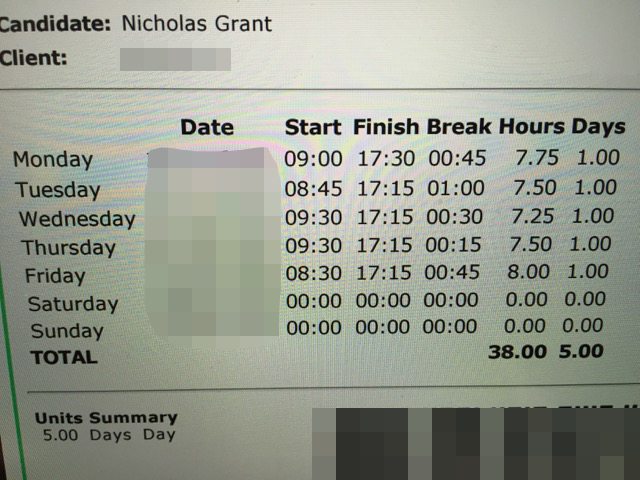
    Timesheet

    I’m an incredibly calculating person. When I take a risk, it’s a calculated risk. If you want to be a sailor, a rock climber, a mountaineer, you’ve got to be able to weigh up multiple factors. You look at the difficulty of the route or passage. You look at the weather conditions. You look at your equipment. You think about your crew, your rope party. You consider your own abilities. Failure means falling to your death, or drowning.

    Let me give you an example.

    I was at a petrol station, and I was paying at the counter when a car that was on fire was driven up to the pumps and then abandoned by the driver and passengers. They fled for their lives. The car was there, going up in flames, right next to the petrol pumps.

    What would you do?

    There didn’t seem much point in standing around waiting for the fire brigade. There certainly didn’t seem like a moment to lose, as there were passengers sat in their cars, waiting for the drivers to pay for their petrol and come back to their vehicles.

    Selfishly, the best thing to do would have been to stay where I was, at the counter where I was paying, or to flee out the fire exit at the back.

    I didn’t think “I want to be a hero”. I thought “can I put that fire out?”. I decided that I could.

    I went out onto the forecourt and shouted for everybody to get out of their cars and get the fuck away from the petrol station.

    Then I picked up a couple of fire extinguishers and went and put out the fire. It wasn’t unbearably hot because the whole car wasn’t yet on fire. The whole engine compartment was on fire, but with the wind behind me, it carried the smoke away from me, along with some of the heat. I managed to direct most of the foam from the extinguisher into the engine compartment, and the flames were quickly put out.

    That was a calculated risk.

    I’m currently working a job that is destroying my mental health. It was a 6 month contract, and I calculated that in that time I could reach financial security. Financial security is an important component in wellbeing, given how shockingly appalling the welfare state is. It’s more important that I’m able to support myself financially, than it is that I suffer 6 months of depression, putting me at risk of suicide.

    My assumption is that when I have reached the point of financial security, I can have a mini nervous breakdown, and then start to recover without sinking back into financial hardship. If I have financial security, I can recover without becoming homeless and destitute again.

    If I have learnt anything about my mental health to date, it’s that I can recover from almost anything, given enough time & money.

    It’s sad to see lives thrown away because we treat them so cheaply.

    If I can do it, I will have proved that it’s possible to plumb unimaginably awful depths and recover, if only we would take the chance and invest in people. If only we trusted people. If only we respected people.

    So many people get written off as if they’re as good as dead, and that’s disgusting.

    It should be a collective stain on our conscience that we prefer to prop up the ideas of the “lost cause” and to discriminate against people because of the mistakes of their past, rather than looking at their potential.

    Instead of chucking me into some “care in the community” bucket as an incurable madman, or kicking me into the gutter as a hopeless addict, I’m looking forward to proving what an injust death sentence that is. My parents are reprehensibly disgusting people for abandoning their own son when I was vulnerable and alone. My parents had insisted that they would help, only to renege on their promises at the vital moment.

    I’ve done nothing but try to improve the lives of others. I’m not a thief, a liar. I’m not a violent man. I’m not even a criminal.

    My dad’s a criminal. My dad has a criminal conviction for his drug offences. The police have seen fit to caution me 4 times for various things, but the police have seen that there is no criminal intent with me that would warrant prosecution. My dad has broken the law and he has a criminal record. Why would he treat me like a criminal? Why would he treat me as if I’ve committed crimes, when it’s him who has the criminal record?

    I suppose we judge people based on who we really are. If you’re a bad person, you see bad in other people. I’ve always given people the benefit of the doubt. I’ve always helped people, and even forgiven them when they’ve screwed me over.

    I don’t think I’m necessarily a good person, but I try to be. I try to help people. I try to see the best in everybody. I try to invest in people’s potential.

    It’s a calculated risk, being nice to people. Sure, I’ve lost loads of money as people have taken advantage of me. I doubt anybody thinks I’m a mug though. I doubt anybody feels proud or pleased that they profited at my expense.

    One of the best ever moments I can remember was when a young addict couldn’t believe that I’d forgiven him for – as he saw it – scamming me out of a load of money. In actual fact, my risk was hedged. It was a calculated gamble. I just hope that he benefitted in some way. My life certainly wasn’t any the worse off.

    Anybody who says “don’t give money to an addict or an alcoholic because it’ll do more harm than good” is simply wrong. If you’re poor and you steal from the rich, you don’t feel guilty about it. But if somebody is kind to you and trusts you, and you betray that trust, it eats you up inside like crazy.

    By helping people to be solvent you can help restore their sanity. For many people who live lives of poverty, this can be surprisingly cheap. I could get my friend Frank a hostel bed so that he wasn’t living on the street for £120/week. I could help get Frank a room in a shared house for £500. Nobody had taken that kind of chance on him before.

    Fixing my situation has been more expensive, because I’m more leveraged. When my parents fucked me over, I borrowed what I could on credit cards, bought Bitcoins, and made 1,200% profit. That was a calculated gamble. When I was homeless living in the park, looking for a well paid IT consultancy contract, I was using my creditworthiness to stay alive and get back into lucrative work: that’s leverage. The peaks and troughs of my debt and my solvency are erratic and stressful, but you’d be a fool to bet against me.

    Obviously, the idea is to link two lucrative contracts back to back, or have one last long enough to give me a financial cushion to at last be safe from homelessness and destitution. I desperately need a break from these boom and bust cycles. I desperately need a run of good luck.

    The luck is not forthcoming, as my 6 month contract has been terminated 2 months early, but I have a little time to rest before the stress and torment of having to find a new job.

    If you put all this into the context of relentless depression, suicidal thoughts, threat of homelessness, bankruptcy, destitution, reputational destruction, and everything else that threatens to consume me, I’m surprised I’m still standing.

    All I know is that I’m able to just about make a swap for my mental health and sense of wellbeing, for a chance at financial security. It’s a calculated gamble.
     

    Tags:

  • Take This Tablet 3 Times a Day

    This is a story about prescriptions…

    Tablets

    Are you underemployed? Are you unchallenged? Are you jaded? Are you disillusioned? Is your existence meaningless? Are you lacking purpose, goal? Are your ambitions, creativity, ingenuity and resourcefulness being thwarted? Are the prime years of your life draining away, washed into the gutter?

    I want to write 3 times a day, at least.

    I need to write 3 times a day.

    I get to work, nearly an hour late. I have a quick 10-minute call with my team. Then, I have nothing to do until lunchtime. If anything is going wrong I try and fix it, but my whole job is to try and steer the ship strategically so we don’t ever get into trouble. I’d love it if a big crisis kicked off, but I’ve managed things effectively, so everything runs itself with little drama. Sensible, but boring.

    So, I need to write something in the morning to get me through to my mid-day break.

    I take a 2-hour lunch. I get away from my desk and go and read a book somewhere. Sometimes I sit in the park. Sometimes I sit by the river. I’m only supposed to take an hour for lunch, but who’s going to question it when my team are so far ahead of the project deadlines and the client is happy?

    Then, I need to write something in the afternoon to get me through to home time.

    I stay on top of any queries. I’m watching like a hawk in case there’s anything I need to deal with. One strategy that I’ve employed in the past is to let things build up and build up until there’s an artificial crisis that I’ve created, and then I deal with the backlog in a flurry of activity. Through this strategy of putting things off I made a depressing discovery: most ‘work’ is unnecessary and can be forgotten about. Nobody’s going to die if the crap that I do doesn’t get done.

    When I get home, I have pent-up frustration that I haven’t been productive. My energy and enthusiasm for completing tangible tasks with meaningful output, has been completely unmet during office hours.

    Sometimes I draw. Sometimes I make music. Sometimes I make a video.

    What I really want to be doing is writing. There’s nothing nicer than relaxing on my sofa with my laptop, brain-dumping. I have so much to say, and there’s so little time. Words come flooding out of me. There’s no shortage of things I want to write about. Researching what I want to write about means that there is even more to write about. Research sets off a chain reaction. The number of topics that I’m passionately interested in grows exponentially.

    When I get home, I take off my suit and hang it up. I put on my civilian clothes. I relax, but I’m still not quite in a relaxed mood. It’s not like I want to go out for a run, or to go out drinking or dancing. I’m not quite able to shake off the shackles of the rat race, despite the fact that the last thing I would ever think about doing is flipping open my work laptop or giving my project a moment’s further thought.

    My thoughts revolve torturously around “how am I going to get up and do it all over again tomorrow?”.

    Drawing, music composition, video editing… these things require a considerable amount of effort. Writing is something I’m compelled to do. Freedom of expression is important, and I’ve allowed myself to be completely free to write, when time allows. I do not self-censor. The only people whose identity I’m careful to protect are my friends. The only people whose feelings I consider are those who care whether I live & breathe. It’s remarkably liberating, not caring if some mean judgemental family member takes offence. It’s terrifying thinking that every word I write could make me unemployable, but so exhilarating to thumb your nose at a job you have total contempt for.

    A simplistic analysis might conclude that I have transferred my ‘addictive personality’ to writing, but doesn’t our society applaud the workaholic? The serial entrepreneur who puts him or herself through enormous stress is lauded as a captain of industry, an engine for growth, a valued member of the economic community. Whatever I do, I’m unlikely to approach it half-heartedly. If I’m going to work a job and make money, I’m going to work as hard as I can, and make as much money as possible. If I write, I’m going to write until my fingers bleed and I have to be prised away from the keyboard.

    Society applauds my bipolarity. Not so much the depression, but the fact that I can achieve ‘overnight success’ during my hypomania means that I have no shortage of achievements in my portfolio. My shrewd opportunism means that cash windfalls have always carried me through the inevitable crash in my mood.

    In fact, the whole working world is structured to celebrate the person who does the heroic big push to meet the deadlines. The steady eddies who just quietly get on with their work, have nothing remarkable to help them to stand out from the crowd. Even the idea of working at the level of intensity that we do in academia and employment, is destabilising. Cramming for exams, dealing with unrealistic workloads, and then collapsing during the holidays, barely recovering before the next painful bout of work or study. Who cares if your nerves are frazzled, as long as you’re getting the “A” grades, right?

    The project I’m working on is being cancelled, because it’s failing. My team is way ahead of the deadline and our part is the big success of the project, but the other 7 teams have failed. It’s a big mess. An expensive white elephant. A big embarrassment for the consultancy and the end client.

    My attitude has been completely different to the projects I have worked on in the past. Normally, I don’t care what my official role & responsibilities are. Normally, I go and find the biggest fire and try to help put that out.

    I decided to adopt the attitude of focussing only on my responsibilities. I decided that I would concentrate on the job that I’d been originally been asked to do. I didn’t go looking for trouble. I didn’t tread on anybody’s toes.

    The net result is that I have happy bosses who are overjoyed with my work and I’m getting a good reference, but the overall project is a failure. Whether or not I would have been able to make a contribution to the success of the wider project is debatable, but I do have a track record of helping to turn around late or failing projects. I’ve made a habit of running into the burning building when all others are fleeing for their lives.

    It’s so bizarre and surreal that I’ve spent 4 months keeping a low profile, writing, doing as little as possible, and I’m far more appreciated than when I was working 14 hours a day, 6 days a week.

    I used to get rung up routinely every weekend, to run conference bridges and orchestrate things on the failing project I worked on before this one. When shit was hitting the fan, I was there rolling up my sleeves and at least trying to be a calm head, even though I obviously claim no credit for the hard work of my colleagues.

    That previous project ended with me finding out my security pass and access to email had suddenly been revoked and I was persona non grata with the senior management team who had previously been begging me for my help.

    This current project is finishing with the work that my team have produced being lauded as some kind of ‘jewel in the crown’. I’m being hailed as some kind of amazing manager, when in truth all I’ve done is sit unobtrusively in the corner of the office and write my blog.

    I’m certainly one of the highest paid writers that you’re ever likely to meet, but yet I was hired to run a software project, not to write.

    For all those people who say “art is just a hobby” you’re wrong. I spend the bulk of my time and effort writing, and being an IT consultant running a software project has been a little side project for me.

    People walk up to my desk to ask me a question, and I quickly minimise what I’m doing. I then give the first answer that pops into my head. My whole body language seems to suggest that I’m very busy and my time is precious, so there isn’t really a culture of lengthy discussions and debate in my team. It might sound horribly autocratic, but it certainly seems to get the software built and my team report a high level of job satisfaction. There is actually a great level of teamwork and mutual support in my team. The language we use with each other is very positive and complementary. We spend time applauding each other’s efforts and celebrating our achievements.

    So, I’m torn. Clearly I’m doing something right. It just feels so wrong.

    Imposter syndrome means doubting your skills and abilities. I feel like a double imposter, because not only do people tell me I’m doing a good job, but I know that I spend most of my time writing my blog.

    Things are coming to a head even more in my final week. My team are pulling together pieces of work that I asked them to do as part of a strategic plan, and it’s working. In the final analysis we will finish up with a piece of software that’s amazing quality and yet neatly packaged up to be thrown in the garbage. My team will all go off to new projects, knowing how to follow industry best practices and having seen them successfully implemented.

    So many things in software get hopelessly botched: Agile project management, test-driven development, code quality, technical debt, continuous integration, release management, production stability, automated regression testing and intuitive user interfaces. Even for me, it’s felt like a dream to see that some of these things can be achieved in a corporate environment.

    My usual attitude of agreeing with bosses – “yeah yeah yeah” – and then just doing things the way I was going to do them anyway is unchanged. The only difference this time is that I’ve used my spare capacity to work on a personal project – this blog – instead of trying to think about the wider project.

    It’s quite exhausting – faking it, looking busy, watching out for anybody who might look over my shoulder – while also attempting to alleviate the boredom and fight the uncomfortable feeling of knowing that you’re being unproductive, wasting time.

    On the face of it, it looks like a good prescription for stability, financial success. I’ve turned up to work every day. I got paid every week. What more could you want?

    However, how sustainable is it really, to live such a lie?


    Tags:

  • Rolling Stone: a Picture Story

    This is a story about quicksand…

    Koa Tree Camp

    After being discharged from psychiatric hospital, what do you think you’d do next? Well, imagine that for months you have been travelling but you haven’t been moving.

    Things are not stable for me, no matter what my senses tell me. I go to the same office, looking at the same computer screen, surrounded by the same people, for months if not years on end. According to my senses I’m not moving anywhere.

    However, my bank balance would tell a very different story. Just sitting mute in a chair, keeping my head down and being a perfect corporate drone who never rocks the boat, means that I am very rapidly travelling… financially. My body and mind don’t really agree though.

    My moods tell a very different story again. I don’t necessarily notice seasonal effects and depression taking hold. I’m not fully able to tell when I’m getting hyped up and excessively involved in work or other projects. I’m not great at judging when it’s time to take a break, either because I’m too down or too up.

    It is unhealthy and unnatural that I work in the same place, doing the same thing, and working a job that moves at snail’s pace. I just don’t have the social life and hobbies at the moment to get any balance, let alone the financial means to travel, socialise and pursue pastimes with the usual gusto that I apply to everything.

    What happens is that I become like a champagne cork. The pressure builds and builds, and then I explode with frustration.

    My journey began with a two week stay in a psychiatric hospital, because I was so beaten down by the task of getting myself off the streets, back from the brink of bankruptcy, beating addiction, working on a massively important high-pressure project, renting an apartment, moving house for the zillionth time, and then realising that I was in an unsustainable situation: I needed to get rid of a ‘friend’ who thought he’d live with me rent free and get pocket money: for what reason he thought he deserved that, I’m not even sure. I also needed to quit a horrible contract that just wasn’t worth the sleepless nights.

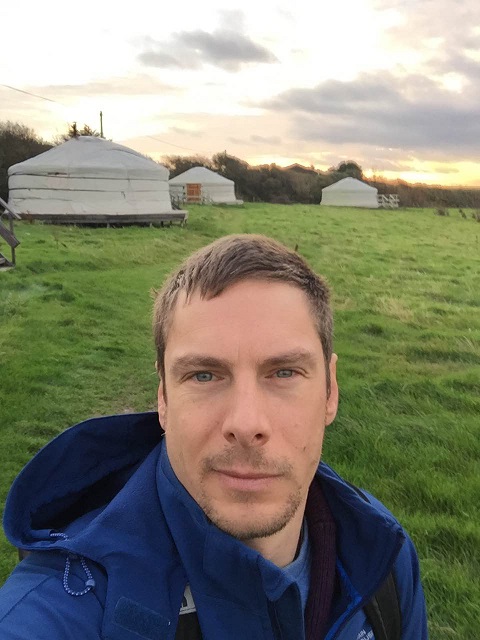
    Next thing I knew, I was sleeping in a Mongolian yurt in Devon.

    Hitchikers

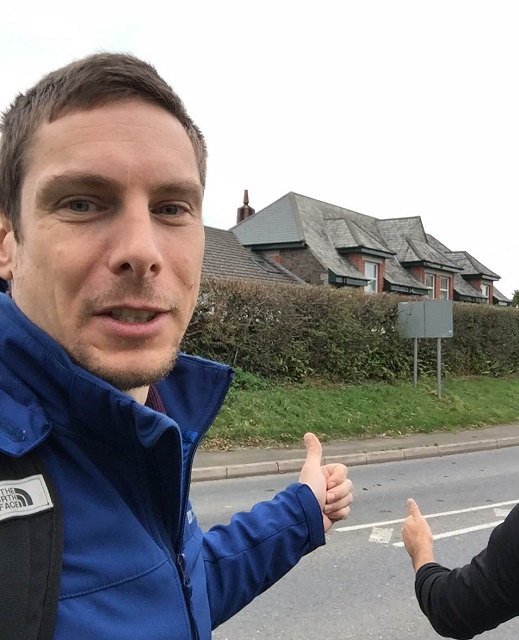
    Then, I was surfing and hitch-hiking in Cornwall. Hitch-hiking is surprisingly hard, it turns out. Hitch-hiking is a bad way to get around if you have to be in a certain place at a certain time. I’d hitch-hiked once before, earlier in the year, in Ireland, but it turns out the Irish are a lot more friendly, helpful and trusting than the British, based on my anecdotal evidence.

    Back in London after my Westcountry adventure, I still felt overwhelmed by depression and the feeling that I was trapped by my job. I had a lovely trip, but it had been very short and coming home was very anti-climactic. I knew I needed to quit my job, but I didn’t quite have the guts to terminate a very lucrative contract.

    I had made a plan a couple of months prior, to shame HSBC by sleeping rough in Canary Wharf, right by their headquarters. I found it deliciously ironic that they had inadvertently helped one of their customers to avoid bankruptcy, escape homelessness and generally improve their financial situation. I had no doubt that if they’d done their due diligence on me, then I would never have been employed to work on their number one project. I was planning on getting my contract terminated for no reason other than I cared about my job and was trying to do the right thing: acting with ethics and integrity.

    But, I still had the contract like a millstone around my neck. I was desperately trapped and depressed about it.

    I decided to fly to San Francisco and go to the Golden Gate Bridge. I wanted to illustrate how the desperation of my situation had driven me to contemplate suicide. I also wanted to go because I had planned to go 3 years earlier, but my parents had reneged on a promise and generally conspired to pull the rug out from under my feet at a time when I was terribly vulnerable. What they did was an awful thing, and I wanted to take that trip that I never got to make, because of their horrible behaviour.

    I booked a flight for approximately 4 hours’ time, packed a bag and left immediately. It’s the most impulsive thing I’ve ever done in my life.

    London Heathrow

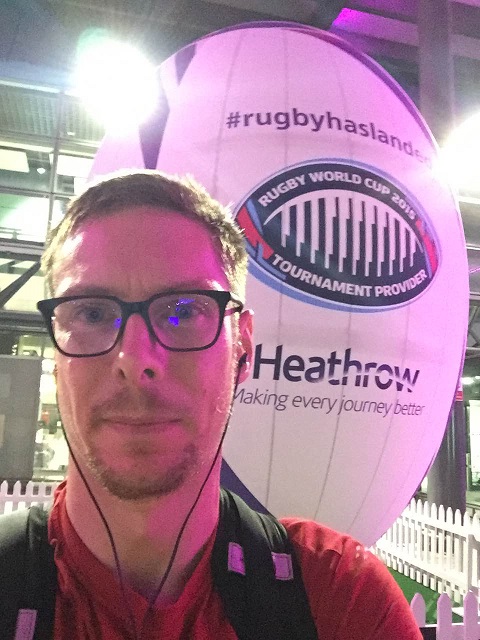
    In San Francisco, a friend kindly picked me up and I dumped my bags at her house. I then borrowed a bike and rode to the Golden Gate Bridge. Less than 24 hours had elapsed since deciding to travel 5,351 miles. I stood in a jetlagged and travel weary state, peering over the edge, looking at the perilous drop to the sea below.

    Travel, novelty, adventure, excitement, old friends, social contact, good weather… all of these things are the perfect antidote to depression. Who knew that the prospect of being chained to the same damn desk, in the same damn office, doing the same damn work you’ve done for 19 years, could lead to a tiny twinge of “Fuck My Life”.

    Obviously, the whole dumping your bags at your friends’ place and then going off and killing yourself thing would be poor social etiquette. Plus I’d arranged to see an old schoolfriend while I was in San Francisco. The potential for positive experiences was massive. In the office, I had found myself hoping for a fire drill just because it would be slightly novel.

    Grant Avenue

    I’m no dumbass. I know it’s important to stop and smell the roses. But, there isn’t the time, energy or motivation to do so when you’re trapped in the rat race.

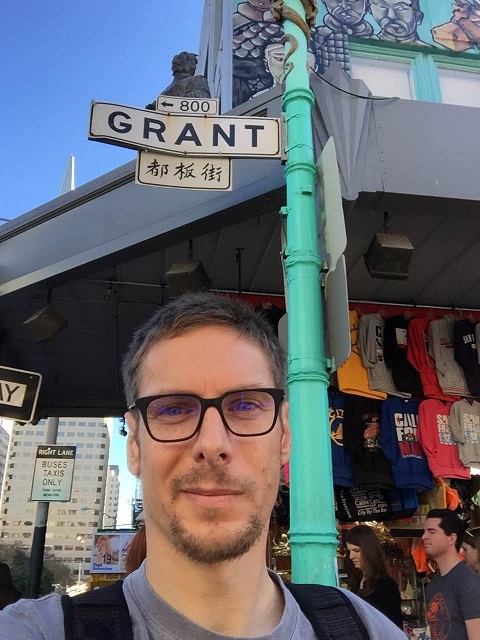
    In San Francisco I took delight in the simplest of things, like taking a selfie of myself by a road sign that matches my surname. I didn’t even do any specific sightseeing or look at a map. I took a trolleycar because I saw one passing. I found myself by landmark buildings, just because I stumbled on them. I walked miles and miles.

    My AirBnB host invited me out to a Halloween party. I dressed up. We drove to some house near Mountain View, where there were fascinating Silicon Valley tech people to meet from Google and Apple. That kind of shit generally doesn’t happen when you’re depressed working your desk job.

    I got a tattoo to piss my parents off. My sister has several tattoos and my parents are always giving her a hard time about them. I thought that getting a tattoo would be some gesture of solidarity with my sister, and my parents would have to give both of us a hard time for having one. It was also a kind of souvenir from the trip, and a bit of reminder that I was going to try and stay in the land of the living for a little longer.

    I caught up with a schoolfriend who I hadn’t seen for years and years. He was supposed to be a mentor on a startup accelerator that I did in 2011, but he’d had to move back to California. It was great to see him, in the Mission district of San Francisco, even if we only had the briefest of time to catch up. Precious moments.

    Meeting my friends’ second child, and hanging out at their house reading stories to their eldest. Going with the kids to the science museum and playing with the interactive exhibits. Still etched in my mind.

    Getting a glimpse into family life, valley startup life, California life… special.

    Hanging out with some of the people who I have so much respect and love for… priceless.

    I tried to provoke HSBC into terminating my contract immediately, by sending truthful emails, saying things that needed to be said, but were blatantly above my pay grade. Sadly, the mark of a corporate drone is somebody who’s completely gutless and two-faced. They emailed me to say they just wanted to have a “routine chat” with me when I got back. No matter how hard I pushed, they wouldn’t admit that my contract was effectively terminated, which is what I wanted so I could stay in the USA longer.

    Bournemouth Pier

    I came home. I went into the office and exploited the fact that nobody would be straight with me. I kinda got my goodbyes from everybody, even though they were “great to see you back in the office” but only those who were nice genuine people seemed to be unaware that the long knives were drawn. I loved the look of shock on the faces of those whose incompetence I had exposed.

    I shaved my stupid beard and kept my moustache, because it was now November. There’s no greater pleasure than having your contract terminated from a ‘straight’ job, when you’re wearing a stupid moustache and you have a tattoo. This was all part of the plan in preparation for the sleeping rough by HSBC headquarters anyway.

    Then, I was deflated again.

    It’d been a helluva journey. Psychiatric hospital, Devon, Cornwall, Mongolian yurts, surfing, hitch-hiking, sleeping on the floor of New York’s JFK airport, cycling over the Golden Gate Bridge, sightseeing in Silicon Valley, old friends, nice work colleagues, miserable office drones, contract termination… relax!

    Bonfire night – November 5th – I was still pretty hyped up. For some reason I decided that I wanted to whizz around London giving out brightly coloured cardboard stars. I think I spent 90 minutes from conceiving the idea, to then whizzing round London sticking stickers on stuff, giving out stars, losing my luggage and generally careering out of control somewhat. That was classic hypomania. What gets held down must go up. It was such a relief to be released from my soul-destroying contract that the nervous energy almost demanded to be released by doing something crazy.

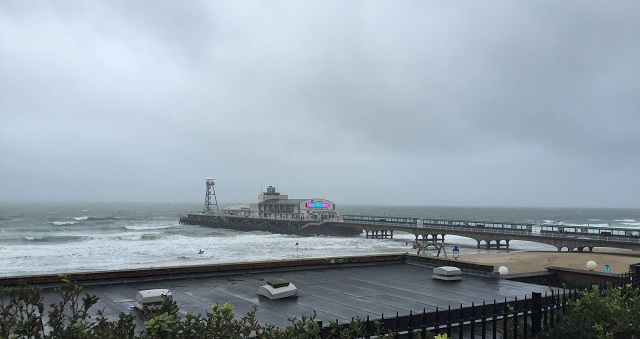
    I decided I needed to see some neglected UK friends. I zoomed down to Bournemouth and stayed in the Royal Bath Hotel by the pier. I met up with one of my most loyal friends, and met his son, caught up with him and his wife, saw their house. I caught up with another friend. Friends who had offered to take me kitesurfing didn’t materialise, but it didn’t matter… I’d already had a very action-packed trip.

    Sleep Out

    Then, finally, the night of the sleep out came. Lots of things got conflated in my mind: “Hacking” humanity, Techfugees, homelessness, bankruptcy, HSBC’s unethical behaviour, soul-destroying bullshit jobs and the unbelievably erratic, exhausting, stressful path I had taken to reach that point.

    I always knew that keeping moving is the answer to staying alive, but there’s so much financial incentive to be trapped into a chair, chained to a desk, not moving anywhere, not doing anything, not talking to anybody.

    As I burnt through my money on rent and bills over the winter months, I knew the day would come when I’d have to go back into the rat race, and it depressed the hell out of me. By Christmas Day I was in a pretty shitty state. By New Year’s Eve I was cutting my arms with a razor blade.

    For the last 4 months, I’ve sat at my desk, not saying anything. For the last 4 months, I haven’t rocked the boat, I haven’t tried to improve anything, I haven’t tried to do a good job. For the last 4 months, I’ve kept a low profile. My bosses couldn’t be more pleased. My bank balance is much improved. In theory, my mental health should have done something but it doesn’t feel like my mood’s done anything but sink.

    How am I supposed to reconcile the drudgery of the rat race with the excitement of the crazy tale that led me here? When I look back 6 months, 12 months, 18 months, things were very different. Are things better? It doesn’t feel like it.

    I’m still not moving, I’m not travelling. I still don’t have my needs met.

    If I want to survive, I need to be moving. It’s not sustainable for me to stagnate. I wasn’t built to just sit and rot at a desk.

    If I stop moving, I sink into the quicksand.


    Tags:

  • Seasonal Variation

    This is a story about cyclical natures…

    Columbia Road

    Summer = happy. Winter = sad. It’s usually that simple. Why would anybody be happy in winter? Winter is a time of hibernation, cold, hunger and death.

    However, human society has evolved to take advantage of seasonal variations. We all tend to have a wild time in August, as our children are off school and we also enjoy the good weather and general festivities. Summer brings optimism and joy, in line with our increased energy levels due to longer days and the balmy air temperature.

    Frankly, this summer has been the most depressing that I can remember.

    I thrive on human connection, and most people are distracted with all the fun of the fair at the moment. The bright lights and fanfare of the Olympics and other theatrical bullshit are titillating the fickle attentions of the proletariat. It’s mighty dull for anybody who doesn’t subscribe to the mass hysteria that can afflict our society of simpletons.

    So, I’m riding out the summer, waiting for reality to bite and the true situation to reveal itself. Things always look better when bathed in golden sunlight. In the shortening days of the autumn, things are going to look pretty bleak. I don’t relish the collapse in the current mood of delusional optimism, but at least destruction heralds reconstruction. So many things are broken. Limping along thinking everything is OK is not helping anybody.

    I have now come to understand my own cyclical nature. Normally my moods are dictated by the prevailing weather, but now my mental health is so deeply damaged that even summertime cannot lift my depression. However, I’m able to appreciate that all of humanity is similarly affected by the weakness that means they feel unreasonably happy when the sun is shining.

    Last year, I predicted a winter of discontent. This was plainly wrong.

    But! I tend to be a bit premature with all my proclamations of doom. The number of years that I’ve been talking about a collapse in the London housing market have proven ridiculously wrong… although the bubble continues to inflate to epic proportions.

    I was once young and naïve. Now I’m old and cynical.

    I’ve made a few smart predictions: the credit crunch, the commodity boom (gold, oil) and Bitcoin. I’ve profited from astute investment and hedging during every crisis of the last 20 years. I’m most definitely proactive, not reactive.

    The simplest thing to predict is that summer must come to an end. People will come back from holiday. The kids will go back to school. Workers will go back to their jobs.

    In the cold light of day, everything’s going to look pretty shit.


    Tags:

  • E = mc²

    This is a story about simplicity…

    Spiral

    A compressed spring is heavier than an uncompressed spring. When you lay down on your mattress, the springs of the mattress are actually getting heavier. When you get in your car, the springs of the suspension are getting heavier. When you wind up a clockwork watch, it weighs more. Wait, what?

    Yes, it’s as simple as I just said. When you squash a spring, the spring gets heavier. Any questions?

    Probably just one: whaaaaat?

    Well, it’s because of E = mc² you see.

    Oh, boring. It’s one of Nick’s crazy rants about physics. Perhaps he’s gone nuts again. Perhaps he’s having another hypomanic episode. Well, in some ways you’re right. But before anybody shouts “BANANA” at me [it’s my ‘safe’ word] you should really read on a little further.

    The reason why I race off on those hypomanic episodes is that most of the time, some evil passenger in my car keeps putting the handbrake on. People keep climbing on my back and making me carry them. People keep putting rocks in my pockets and getting me to drag their shit along for them. I’m basically frustrated as hell the whole time at the endless monotonous boredom and not being able to get on with my projects because of absolute bullshit. I just like to work on things and finish them, you see. If you tell me that you need something building, I’ll get on and build it, and give you a completed project, instead of sitting around with my head up my butt. I don’t really like sitting around with my head up my butt. I like getting on and building shit.

    And so, I become a compressed spring. The more that I’m held back, the more that I become coiled and squashed and full of energy, ready to spring forwards when I’m released. The time windows are very short, but I build a lot of cool stuff very quickly. I built iPhone apps that reached #1 in the charts in a matter of weeks. I built a gigantic summerhouse in my garden in the space of a few days. I don’t generally fuck about.

    “But why do springs get heavier when they’re compressed, Nick?” I hear you ask. It’s really easy to explain.

    Energy and mass are equivalent. Therefore, if you apply a weight to the top of a spring, and it squashes down, the energy that is stored up in that spring is stored as mass. More mass means the spring is more heavy. When you take the weight off the spring, allowing it to uncompress, the mass is converted back into energy, and the spring gets lighter again.

    That’s all that the equation E = mc² really says. It says energy equals mass [times the speed of light squared]. Energy-mass equivalence.

    OK… the speed of light squared is a pretty big number, so the amount of mass is pretty tiny compared to the amount of energy. So tiny that there isn’t a set of scales accurate enough in the whole world to measure just how much heavier our spring got, when we compressed it. The amount of mass that we created from energy, by compressing the spring, was teeny tiny.

    Equally though, you don’t need to turn much mass into energy to create lots of energy.

    When people talk about splitting the atom and nuclear weapons, I’m not sure what your average person on the street imagines. Perhaps they think that atoms are actually being destroyed to create the explosion. When a chemical explosive is detonated, the chemicals are rapidly being turned into gas, which is many many times more voluminous than the size of the solid or liquid explosives. This is not what’s happening during a nuclear reaction.

    The nuclei of atoms are held together by the strong nuclear force. Think of it like a door latch. The door latch holds together particles with similar electrical charge. I’m sure you remember playing with magnets, and you know that like poles repel each other. So, when you put the red end of magnet towards the red end of another magnet, they don’t want to touch each other. The strong nuclear force holds those two red ends together, stopping them from flying apart. This is much akin to our coiled spring.

    When the nucleus of an atom is split by being bashed into by another particle, a bit like a wrecking ball smashing into a house, then the ‘latch’ of the strong nuclear force is broken, and the particles with the same charge repel each other. The different parts of the atom fly apart because of this repulsion. It’s like those coiled springs are uncoiling.

    This means that energy is being released. Lots more energy than it took to unlatch the strong nuclear force that held the nucleus together. It’s a bit like a room full of mouse traps, all sprung-loaded and waiting to go off. It only takes one light little touch to cause one mouse trap to go off, and before you know it, they’re all setting each other off in a great big chain reaction.

    And that’s how a self-sustaining nuclear reaction works. A small amount of input energy is required to start the chain reaction, but once it’s started, there’s plenty of energetic particles flying around to smash into other nuclei and cause them to break apart. Less energy input was required than the amount of total energy output, and only a very small amount of the mass is actually being released, by the strong nuclear force being overcome, allowing the subatomic parts of the nucleus to fly apart.

    The same cascade reaction is used in a nuclear power plant as was used in the atomic bombs that blew up Hiroshima and Nagasaki. It’s called nuclear fission.

    So, how does this relate to anything? Well, whether it’s reading a stack of books about nuclear physics (this, by the way, was only the most basic introduction I’m afraid) or writing hundreds of thousands of words, I’m kinda a bit like that coiled spring, ready to unleash my energy on whatever I can when I’m given my chance, and I’m unlatched.

    I just need a small opening, a small opportunity, and I’ll run headlong at it. I’m so desperately bored by having to go at snails pace because of the limitations of the world around me. I live with constant frustration that I can’t go at a natural pace, and so I go twice as quick as I should do when I’m finally given the opportunity to get on with something.

    Had I ever gotten the chance to study theoretical physics at university, I would have read half as much in twice the time. Had I ever gotten to write at my own pace, with enough money behind me to keep a roof over my head, I would have taken twice as long and written half as much.

    I’m now wrestling with the problem that I’m pretty much working two jobs, and in one of them I’m trying too hard at to compensate for the lack of fulfilment in the other. My day job doesn’t challenge me. My day job gives me zero job satisfaction. And so when I get home in the evenings, I write and I write and I write. I’ve even taken to rattling off a couple of short stories every day while I’m at work. The one I wrote this morning was 6,000 words. That’s right. I just rattled off 6,000 words because I’m so damn frustrated and bored, but I’m still working a full time job as well as producing some 14,000 words a day. It’s too damn much and I’m going to burn out, but my day job is utter bullshit. My life is utter bullshit.

    It’s such a fucking rush, a hurry. It’s such a fucking struggle. Trying to put up with enough boring bullshit that I’ve got a lump of money behind me to allow me to take a break and work on something I love and I’m passionate about. Either that, or I just take the tiny windows of opportunity where I find them, and work as hard as I can and as fast as I can, before the bullshit catches up with me again.

    I honestly thought to myself that prison wouldn’t be so bad. So much time to read and write, and ponder stuff. Really, I’m a fucking prisoner at the moment. I can’t exactly get an interesting book out at my desk. Even when I’m writing, I’m doing it while looking over my shoulder. I’ve got to keep one eye on the boss, and be on my game in case I get asked to do something or somebody has a question for me. It’s so fucking tense you know? It’s compressing me. It’s squashing me. It’s making me dense and dark and heavy.

    I fantasise about living in a tent, unencumbered by having to make rent payments and keep the electric and gas switched on. What would I really need, in this day and age? You can do so much on a smartphone.

    I’m coming full circle. In a little over a month I will have been writing every day for a year. This whole thing started with me writing about some research I did on a public bench at a railway station. I think how different my life was then, and somehow I had much better quality of life, even though I was destitute.

    Do I want this? This life? This life of commuting on the morning train, and office chit-chat and the daily grind, and of looking busy at my desk and saying clever shit to impress the boss, and hiding in the toilets browsing the Internet, and writing short stories in a really small font to disguise what I’m doing, just to pass the endless boring hours, and watching the clock, counting down, counting down, down, down. Down to what? My premature death from the stress and anxiety of it all?

    Plenty of research has now proven that working a boring shitty office job is more unhealthy and lifespan shortening than smoking. Famously, people are suing their employers for the mind-numbingly dumb work they’re asked to do. It’s almost physically agonising. I’m being squashed. My very life force, my energy, my dignity, my passion, my personality… it’s all being squeezed out of me like I’m a tube of cheap toothpaste.

    I feel so sick and anxious. I don’t know how to continue. I know that fiscally it makes perfect sense to continue. It’s easy money, but it doesn’t look that easy when it seems to be the root cause of my mood instability. People either ask me to work too hard for too long, so I burn out, or they bore the shit out of me, so I eventually explode with frustration. The pyramid scheme of corporate life is destroying lives. My life is being destroyed.

    Oh God I want to throw up. This isn’t just a job you fuckers. This is literally fucking me up. I can’t do it much longer. I’m going to have a motherfucking breakdown. I can’t cope and I’m waving the white flag in surrender but yet the gunfire does not seem to pause.

    “Everybody needs to work”

    “You have a great job”

    “You’re so well paid”

    “People would love to have your opportunities”

    “Count your blessings”

    “Just another few decades and you’ll be rich beyond your wildest dreams”

    “Not long now”

    “C’mon it can’t be that hard”

    “You should try my job”

    “You’ve got things easy”

    “I’d love it if I was bored all the time”

    “You spoiled bratty bastard”

    “You earn 6 or 7 times as much as I do”

    “Why don’t you follow your dreams”

    “You’ve got nothing to complain about”

    FUCK OFF, FUCK OFF, FUCK OFF

    Argh! I can’t deny my feelings any longer. I fucking well did what I have to, to get out from a fucked up situation, and I got somewhat out of the way of the oncoming collision, but it’s been at great personal expense. I can’t express how much it’s killed me to put myself in a position where I might as well put my brain in a pickle jar and wheel my cryogenically frozen body into position at my desk.

    Imagine if I picked fruit and vegetables for a living, and I slept in a barn on the farm where I worked. I could keep some of the fruit and vegetables that I picked, and eat them. My labour would provide my contribution for my space in the barn, as well as enough beans, rice, pulses and meat to keep my protein and carbohydrate intake at a healthy level. I would be able to see, quite literally, the fruits of my labour each day.

    I live a life that could not be more opposite. I will never meet the people who use my software, and I don’t even create the software anymore. I manage a bunch of people to create software for me. And I don’t even see the people I manage face to face. They live thousands of miles away in some developing world country. I don’t even know what management is. I pretty much just say “you’re doing a great job. Keep going!” over and over again, to these poorly paid people who toil away, on the other side of the planet. Then some money is digitally credited to my bank balance, and I digitally credit it somewhere else to pay my rent. I never see actual physical money. I don’t ever carry cash. Coins are just an antique novelty to me.

    Modern life is making me unwell, I can sense it.

    I have embraced technology and science, and I understand it better than 99% of people. In abstract terms, I’m doing really well, and it looks insane to be dissatisfied with my lot in life, but how do I really define my existence? Can I define myself as a father and enjoy family life, when I have no children? Can I define myself as a builder or a soldier, when what I do is so ethereal and intangible? Can I define myself as a farmer or a gardener, when what I do is so unnatural?

    I’m a spring. That’s what I am: a rusty spring.

    I’m coiled up and compressed, ready to unspring, ready to bounce and boing.

    It’s fucking awful, let me tell you, being so unable to apply yourself to some useful mission, project or productive endeavour. It’s fucking awful, feeling so trapped and imprisoned. That’s why my thoughts turn dark and brooding so often. That’s why suicide is so often on my mind.


    Tags:

  • 3 Graphs: My Mental Health

    This is a story about ups & downs…

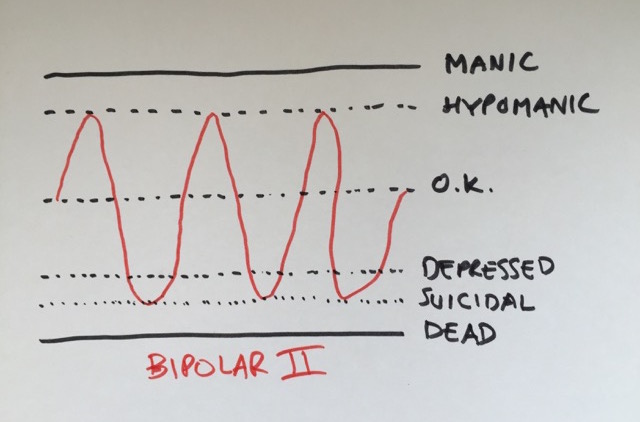
    Bipolar II

    I used to quite enjoy my hypomanic episodes. I haven’t had one for over 8 months though, and I’m beginning to miss the energy, focus, enthusiasm, fast-paced thinking, creativity and passion for something, anything.

    When I average out the amount of time that I would spend hypomanic versus the amount of time I would spend depressed, you’d think that it’s something you wouldn’t want, because my episodes of depression were always far longer than my episodes of hypomania. However, I never wanted to give up those hypomanic highs, even though my episodes of depression have been brutal and I’ve nearly taken my own life.

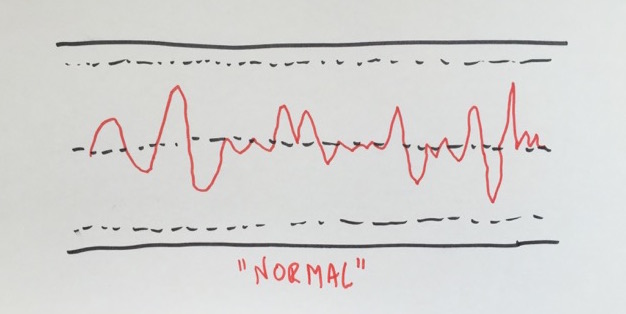
    Some people ask me “aren’t you just experiencing what every human experiences? Joy and sadness?“. Here is a graph that kinda explains the difference between Bipolar and ‘normal’:

    Normal mental health

    Do you see much difference?

    The first thing I should draw your attention to is the range. The red line never reaches the dotted line that signifies hypomania and depression. In any given moment, you might be happy that your sports team just won a game, or you might be sad because somebody ate all the cakes, but this is a normal range of moods. In normal life, you’re not spending every cent in your bank balance, taking crazy risks and undertaking insane projects at breakneck speed. In normal life, you’re not unable to work or socialise, and on the brink of suicide.

    The second thing that I should draw your attention to is the irregularity of it. It’s unpredictable, because it’s dictated by external events. Who knows when a friend is unexpectedly going to drop by and say “Hi!” which will lift your mood. Who knows when your boss is going to say something’s wrong with your work, which will make you upset. These events are unpredictable, because they come from the world at large, which is also unpredictable. This is normal life. Normal life is unpredictable and exciting.

    With my Bipolar II, I know that every episode of hypomania is going to be followed by a crash. I know that my hypomania is going to last a few weeks, maybe a month and a bit. I know that my depression is going to last anywhere between 6 weeks and 6 months. These episodes are monotonous. Sure, good stuff and bad stuff happens during those episodes, but it does little to affect my prevailing mood.

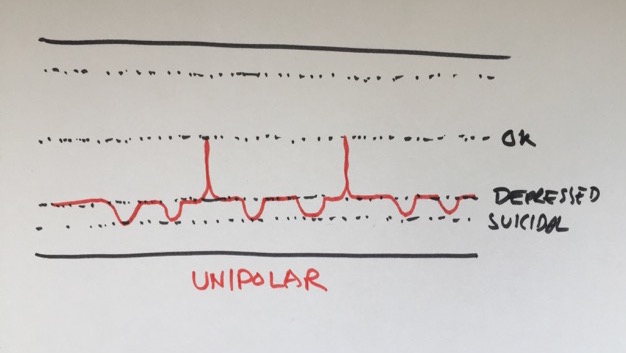
    This year I seem to have had the longest depression of my life. It’s given me somewhat of an appreciation for what it must be like for people with Unipolar Depression. Here is a graph of what my life looks like at the moment:

    Unipolar Depression

    Looks pretty bleak, doesn’t it? Unrelenting depression, and only very brief moments where I feel OK. Look how sharp those spikes are. Surely my life can’t be that bad?

    Well, look at it in these terms: we are now in July. That means that in 2016, I have had 7 months of this shitty feeling. January to April, it was understandable that I was depressed, right, because it was shitty winter, I was unemployed and I was stressed about running out of money and being evicted out of my apartment onto the streets. You can surely empathise with that situation, and agree that it would be pretty depressing?

    So what about May, June and July? Well, I’ve been working a job that I took out of desperation. My mental health really does not permit me to be working a shit job full time, because I’m exhausted and demotivated, due to the aforementioned depression. But what about all that cash I’m earning? Shouldn’t I be happy – glad – to have a job again?

    Well, I’m working to replenish my savings. I’m working to pay off debts that I ran up when I was unable to work. I’m working to literally stand still.

    But what about fun time?

    Well, look at it this way. There are 120 hours in the working week. Let’s look at my lunch hour: that’s about 4% of the time. So, 96% of the working week is not lunch hour. Another way of looking at it is Saturdays. Saturday is the only day of the week where I’m not working or anxious about going back to work. That means that only 1/7th of the week is somewhat free of anxiety. What about holidays? Well, 7 months have elapsed this year without a holiday. Let’s say that I take a 1-week holiday. Leaving aside the fact that for the whole week I’ll be dreading going back to work, we are only talking about 1 week in 30. That’s right… I’m only on holiday 1/30th of the time.

    Things will improve when I have money in the bank and I can afford to take more time off (I don’t get paid holiday and I also have loss of earnings while I’m away) but predominantly, my life this year has been monotonous depression.

    I’m dying for my mood to swing to the other ‘pole’ and to enter a hypomanic episode. Depression is literally killing me.


    Tags:

  • Neuroplasticity

    This is a story about self healing…

    Messed up

    Does brain damage mean game over? Is it right to write off somebody who has suffered brain lesions, neurotoxicity, a stroke etc. etc.?

    At one time, my left eyelid had started to droop and I had a pretty bad facial tic. My body jerked and shook with pseudo-Parkinsonian symptoms. My speech was slow and slurred. No wonder I was treated as if I was as good as dead, right?

    But you know what? With good diet & sleep, you can quickly recover your heath, depending on the severity of your situation.

    Bizarrely, I was able to get a job and get through an eventful and highly stressful re-entry into the working world, while my poor brain was busily trying to repair itself. How is that even possible?

    I’ve done the same job for the best part of 20 years. In fact, my friend Ben taught me how to program a computer when we were 12 years old, and I’d been messing around with computers since my first forays onto my friend Joe’s Dad’s Apple Mac, in 1985.

    With repetition, your brain lays down pathways that become more permanent with age. Neural pruning – the loss of less used connections between brain cells – makes your brain into something that has become well adapted for the common tasks you perform. Some people call this “muscle memory” but of course it’s your brain, not your muscles, that has the memories. Practice makes permanent, as they say. Just like riding a bike.

    So, I relied on instincts and techniques, knowledge and experience that has been unchanging for my whole working life. I still use the same job search technique, the same interview technique, and the job of developing software is unchanged, despite the constant creation of new acronyms and jargon for things that do exactly the same job in exactly the same way.

    Just like riding a bike, I was able to navigate the corporate landscape and just about get away with a day job that involved my damaged brain pulling the levers to operate the battered mince-puppet that was my body, in a vaguely convincing way, to cover up the fact that I was basically at death’s door.

    With physiotherapy for the body, your recovery can be improved, and I’m sure that brain training exercises would be useful for those with brain injuries, but the stimulation of trying to get myself off the streets and escape bankruptcy and destitution was challenging and stimulating enough.

    Fundamentally, time is the great healer. The brain is a homeostatic organ that will try to restore itself to a stable base state, once external forces are no longer pulling it hither and thither. I was able to have nearly 6 months abstinent from stimulants and over 3 months abstinent from alcohol, in order to give my brain a fighting chance of finding equilibrium again.

    But, just as important as cessation of putting powerful narcotics into my body, was stopping drinking tea & coffee, as well as other caffeinated beverages. Even though my brain screamed out for stimulants, because it was going through withdrawal, they are terrible things when your brain needs to adapt and heal.

    Caffeine is very bad for your neuroplasticity. That is to say, the ability of the remaining undamaged neurons in your brain to try to compensate for whatever trauma it has suffered, and repair itself. Caffeine impairs your ability to recover.

    If you have some boring repetitive task to perform again & again, then caffeine is your drug. Once you’ve mastered the simple steps that most jobs require, the boredom becomes unbearable. Caffeine solves this problem, and allows us to maintain concentration on the most mind-numbing dumbarsery that ever disgraced the working world.

    Most of the world is just doing stupid shit, time & again, because they’re in a trance-like state performing repetitive actions and making the same old mistakes over & over, because they’ve medicated themselves up to the eyeballs with the powerful stimulant called caffeine.

    By stopping my caffeine intake, I was able to recover from the symptoms of fairly harrowing neurological damage, spot patterns in my behaviour and even re-learn new healthy behaviour. I genuinely believe that this would not have been possible, with caffeine in my life.

    I did supplement my diet heavily with amino acid building blocks:

    • 5-HTP to help my serotonergic system
    • L-Tyrosine to help my dopaminergic system
    • Phenylalanine to help my adrenal / epinephrine system

    I ate vast quantities of biltong (dried beef) and other protein supplements, to give my body everything it could possibly need to repair itself, and replenish its stores.

    In theory, I should have been left in a permanently psychotic state, with delusions, paranoia, inability to emotionally regulate, facial tics, poor concentration, poor memory, nerve damage on one side of my face etc. etc.

    However, I put out the fire before it consumed me. When somebody is sick, you don’t write them off and watch them wither and die. That’s immoral!

    I was watching a Louis Theroux documentary, and one hospital patient they followed was declared brain dead after he asphyxiated from a heroin overdose. The doctors were absolutely certain there was no hope, and that the life support systems should be switched off. I agreed, and I thought it was madness that the family were holding out any hope at all. After 37 days, the young man in a coma woke up. His family saved him from a premature and unnecessary death, by refusing to cut off his life support.

    My life support has come in the form of kind strangers, policemen, nurses, doctors and indeed unwitting work colleagues, who have been willing to overlook the immediate situation and imagine that things can and will get better, given time and opportunity.

    I’m physically, neurologically, a completely different beast to who and what I was a little over a year ago, when I was totally fucked.


    Tags:

  • Alcohol as a Mood Regulator

    This is a story about counterintuitive results…

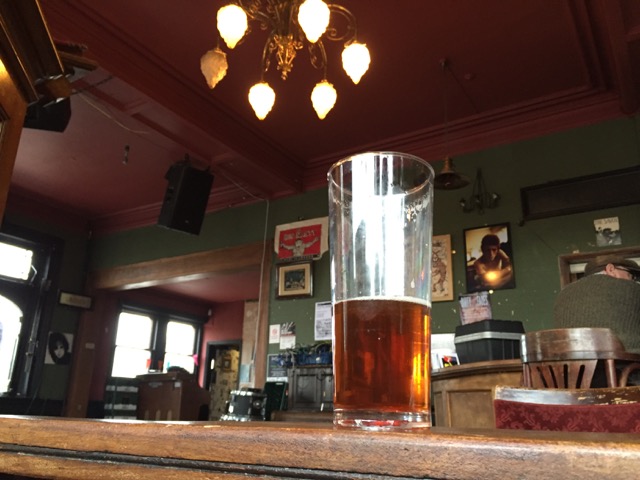
    Pint in the pub

    Conventional wisdom tells us that sobriety is the route to salvation. If you’re being treated for substance dependency, most approaches are abstinence-based. But what if these approaches are totally wrong?

    I had ‘too much‘ to drink last night, but yet this morning I was on time to work for the first time in ages. I was also on top form during a 2 hour meeting that was highly pressured and intense. Clearly my work performance, my productivity, was improved by alcohol, rather than hindered.

    Alcohol works for me as a substance that I can titrate the dose of to control my mood fluctuations. When I quit drinking last year, my anxiety levels became unbearable after 30 days sober, and I had to go into hospital and be on suicide watch. I then went hypomanic and quit a well paid job, and did a bunch of other mad shit, before finally relapsing onto hard drugs and slashing my forearms with a razor blade, after 101 days sober. Hardly an encouraging result.

    The fact of the matter is: my job is boring and shit. My life is empty, unfulfilling and stressful. Of course I need something to help me cope with an intolerable daily existence. How the hell am I supposed to get through the crap I’m going through without a chemical crutch.

    Just about everybody you know has some kind of substance that they depend upon to cope with modern life. Maybe it’s antidepressants, sleeping pills, tranquillisers, opiates. Maybe it’s cigarettes, tea, coffee, coca-cola, Red Bull, beer, wine, spirits. Maybe it’s cannabis, cocaine, amphetamines, heroin, MDMA, GHB, M-CAT or any one of the myriad other legal and illegal drugs. Humans love drugs.

    Clearly, I know what my ‘drug of choice‘ is, and I know that there’s no way that I can use it in moderation. Thankfully, alcohol is not something that I’ve struggled to live without, except where life choices that are forced upon me – such as having to work a shitty job – demand that I find some kind of coping mechanism.

    I don’t have any kids or pets, so I get no natural endorphins. I don’t have any time or money to pursue sports or go to the gym, so I get no natural endorphins and adrenalin boosts. My job is dull as ditch water, so I don’t even get any kind of thrill from my work.

    But, good news! I’ve found a formula that worked for me for years & years & years & years: self-medication with alcohol.

    Yes! Hurrah for alcohol. It kept the lid on my hypomanic episodes for years.

    Basically, the reality that we must all face up to, is that modern life is so fucking shit that we’ve all got to be drugged up and drunk to get through it.

    I could get my cat back from my parents, and get some plants to water and care for. I can soon get a car and some new kites, and go and get my adrenalin and endorphin fix at the beach. However, without those things, I’m forced into puting chemicals into my body, to allow me to keep my shitty job and keep functioning in this crazy society that values corporate profits more than mental health.

    My life really sucks, but I’d rather drink a few bottles of wine and keep my highly lucrative contract, so I can escape the rat race at some point, rather than have another repeat of last year’s failed experiment.


    Tags:

  • Psychiatrists Hate This One Weird Trick

    This is a story about what happened next…

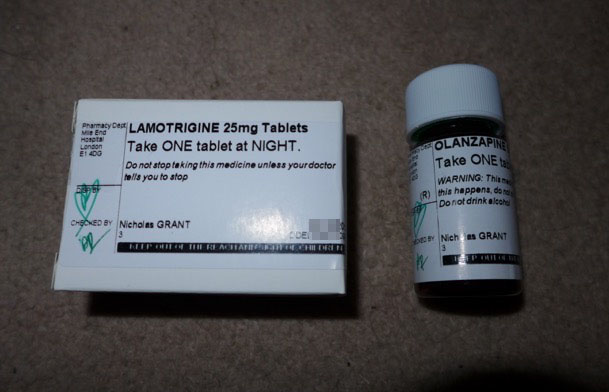
    Shake your meds

    Ordinary person discovers this one weird trick. When they saw what happened next, they were AMAZED!!!

    So, I’ve been accused of being anti-psychiatry, but in fact I’m not. The discovery of chemicals that can cross the blood-brain barrier and affect your perception of the world, has been incredibly important for the understanding of neurological functions, as well as the pathology of mental illness. It’s also true that pharmacological interventions are priceless during episodes that would otherwise be unmanageable.

    For the record, my own diagnoses have included:

    • Clinical depression
    • Type II Bipolar Disorder
    • Anxiety
    • Stress
    • Borderline Personality Disorder (BPD)

    I’ve been treated with:

    • Antidepressants
    • Antipsychotics
    • Mood stabilisers
    • Anxiolytics / hypnotic sedatives
    • Sleep aids

    Then having read a meta-analysis of psychiatric treatment outcomes by Robert Whittaker in his books Mad in America and Anatomy of an Epidemic, I decided to embark upon an unethical study, with me as the test subject. I decided to go completely unmedicated.

    The general public often associate unmedicated mental health patients with some wild-eyed looney, who has slipped their straightjacket, ducked the tackles of the hospital orderlies and legged it out of some mental health institution. There is an assumption that people with mental health problems are homicidal maniacs, and a danger to the public. I’m here to dispel that myth.

    Going unmedicated is not something I would ever advocate. The withdrawal effects from psychiatric medication are likely to be severe and unpredictable. It’s not something that should ever be done without consulting your doctor. However, I did it, and this is my account of what happened.

    Firstly, coming off medication is hard. Really hard. I’ve had comedowns from drug abuse that haven’t been as bad as coming off anxiety medications, for example. What goes up must come down, and there’s no avoiding the fact that coming off a ‘feel good‘ medication means that you are going to feel bad. Really bad.

    Fundamentally, that’s why many of us take medication, isn’t it? To feel normal. To feel better than we would do without it. That’s certainly how I got mixed up in the whole world of mental health in the first place… because I felt terrible. I was exhausted and suicidal and depressed and demotivated and I didn’t enjoy anything. I needed happy pills, because all my happy had leaked away somewhere, and I was just spending 14 to 16 hours a day asleep, and the rest of it in bed hoping that the world would go away.

    The thing is, the unnatural ‘happy‘ pills destabilised me, and my mood then swung too happy, and entered a mood cycle of alternating periods of depression and hypomania. Enter the mood stabilisers. It’s starting to sound like a story about the old woman who swallowed a fly, isn’t it? For those who are unfamiliar with the story, she then swallowed a spider to catch the fly, and then something else to catch the spider and so on, until she swallowed something so large it killed her.

    The problem with trying to treat human moods with medications is that the brain has evolved to be homeostatic. That is to say, the brain has evolved its own mechanisms to maintain stability, and anything you introduce artificially will quite naturally destabilise those systems.

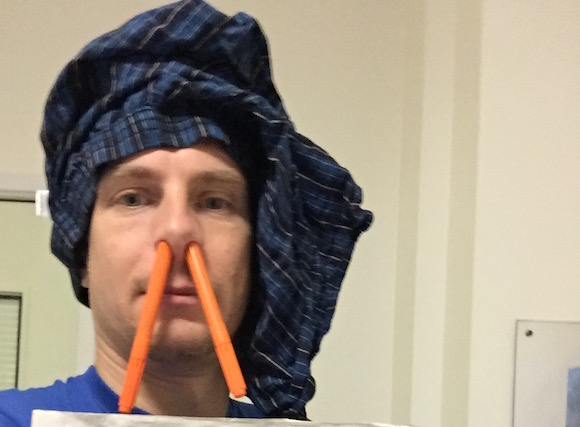
    Underpants on the head

    The stability of your moods can also be destabilised by supposedly normal things. We are all supposed to be able to cope with the pressure of exams, work, domestic duties and so on, but for some of us, it will all become too much. Is this mental illness, or are these ‘nervous breakdowns‘ actually something that threaten to blight the lives of every single person? Is it a lottery as to whether the stress will become overwhelming?

    I self-medicated for stress for years, using copious amounts of alcohol. Of course, at work you then have to compensate for the foggy mind caused by a hangover, so you start to drink strong coffee. I was probably having the equivalent of about 12 shots of espresso every single day. The amount of caffeine contained in those shots was practically the same as being an amphetamine addict, and indeed my boss at the time – who got me into this destructive lifestyle – had the racing speech and fast jerky movements that you would associate with a speed freak.

    When I moved onto harder stimulants, including a drug that would keep me awake for over a week at a time, I found that my mind was not as robust as I had assumed it would be. I managed to induce within myself, symptoms that were unmistakably schizophrenic.

    Consumed with paranoid delusions, hearing and seeing things and with completely warped perceptions, I was very mentally unwell indeed. This divided medical opinion. Some professionals wanted to treat me as if I had permanently damaged my brain, and had now become a schizophreniac. Others could see that the symptoms were likely to abate, if I just got some sleep, had some food & drink and started to detox and let my frazzled brain recover. Thankfully, the latter was the correct opinion.

    Does that mean that all schizophreniacs can recover and live normal unmedicated lives? No, sadly not. I’ve seen quite a lot of people who have been suffering acute episodes of mental illness as a result of circumstances or substance abuse, and these people have recovered as soon as they were removed from the situation that landed them in hospital. However, there are clearly some patients who are either too badly damaged, or have some other pathology that is driving their illness, and medication is necessary to control the psychosis & mania.

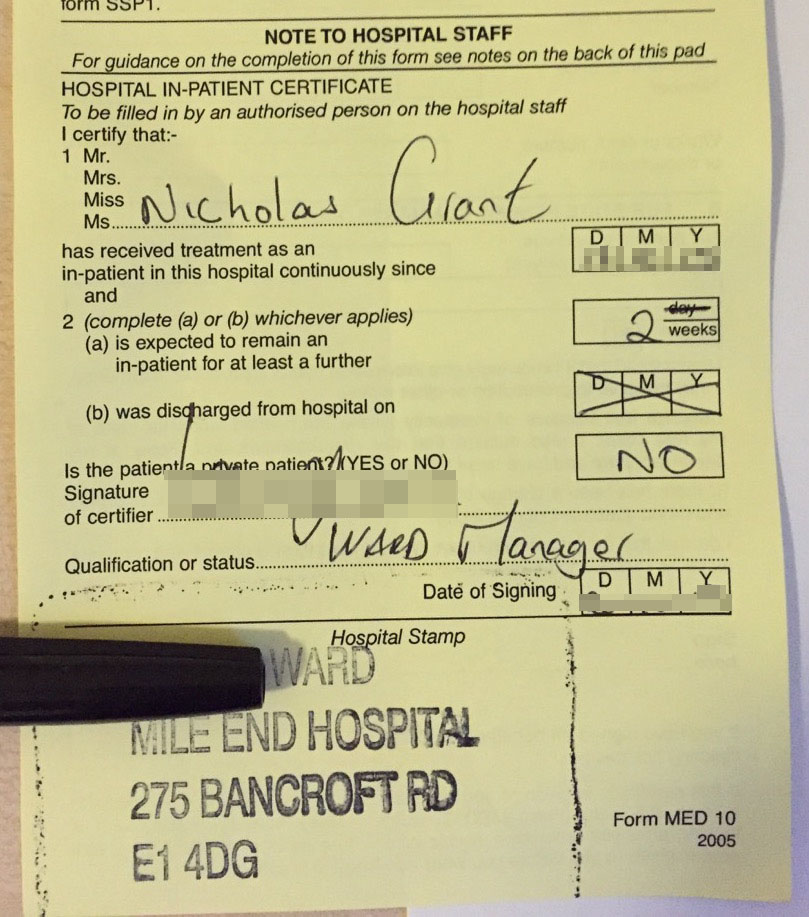
    Hospital Note

    For my own part, I have lived without caffeine for many years now, and I try to keep alcohol consumption to a minimum. I’ve been medication free for a few years, but I have dipped back into both sedatives, sleep aids as well as powerful stimulants, during times of crisis. It’s been a few months since the last time I dabbled with anything psychoactive, and I’m still suffering rebound anxiety and depression.

    Life is incredibly hard right now. I’m stalked by suicidal thoughts all the time, and stress is almost unbearable. I would dearly love the comforting embrace of a chemical security blanket. I long for intoxication. However, despite the hard, sharp edges of daily existence, at least my emotions aren’t blunted and I feel like I have wonderful mental clarity.

    Every day is a struggle, and my perception of time is completely warped. I feel like this depression is going to last forever, and I assume that everybody hates me and that I have nothing to offer the world, and I’m never going to be happy ever again. However, I’m able to be very rational, and I can see that my perceptions have merely been warped by my mood, which is partly because I’m still recovering from the abuse of sleeping pills, anxiety drugs and stimulants.

    It would be easy to write off my tale as that of a drug addict, but that’s not really the story. In actual fact, self medication with ‘bad‘ chemicals was only very recently, and well after I was diagnosed with various mental health problems and had already been taking ‘good‘ chemicals (i.e. medications). All psychoactive chemicals are inherently destabilising.

    Self medication is a disastrous path to go down, but all attempts to force your moods to go one way or the other without changing the environment that you’re in, will be doomed to failure. I wanted happy pills so that I could remain in the rat race, and maintain a standard of living that I had gotten used to. However, what I really needed was to escape that bullshit world.

    Propping up my ailing mental health so that I could continue to work a job that I hated and that bored the shit out of me was a dumb choice. Mental health is too precious to fuck about with using pills and potions. If you’re not feeling great, that’s probably because you need to get out in green spaces more, eat healthier, get some new friends, ditch that mean abusive partner, disown those horrible parents who never congratulate you on your achievements and always give you a hard time, and quit trying so hard to impress people and be somebody you’re not.

    This is my prescription for life: be myself and tell everybody to shove their ill-informed opinions about my life up their arse. Nobody’s an expert in my life and how to live it, and so many of the so-called experts are actually unhappy themselves, nor are they bringing happiness to the lives of the people they advise. Judge people on their results.

    Fundamentally, there is an epidemic of mental health issues, and nobody is curing anyone, so trust nobody except for yourself, and do what feels right for you.

    Discharged from hospital

    I discharged myself, because I was in hospital voluntarily. I’ve had several ‘section’ assessments but never been sectioned under the Mental Health Act. However, I’m an unmedicated mental health patient on the loose, so look out!

    Tags:

  • Thorn Tinted Glasses

    This is a story about viewing the world through the lens of a mood disorder…

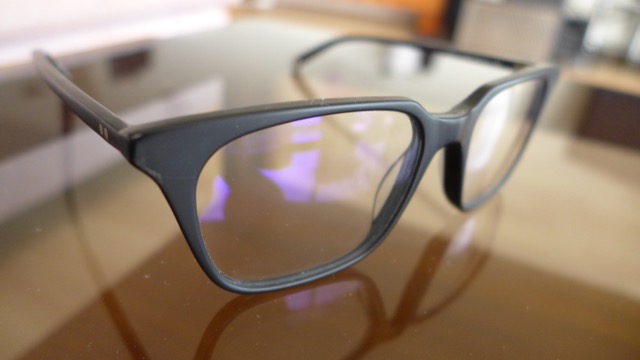
    Blue light filtering glasses

    When I’m hypomanic, nothing seems impossible. Hypomania brings big ideas and grand ambitions, and the only thing standing in my way is the stupidity and myopia of other people. Nobody seems to have the guts to go for the glory, and nobody seems to be able to keep up with me. I get frustrated at a sense of dragging other people along in my wake, having to dumb things down and spoon-feed people at a painfully slow pace.

    Obviously, when I’m hypomanic, I over-estimate my abilities and I’m rather rude and obnoxious about other people. Not exactly a team player. I tend to be pretty disrespectful of other people’s opinions, believing that they’ve had their chance, and have failed to make any significant impact. Why should I listen to such gutless wimps? Why should I listen to anybody not firing on all cylinders, like I am, when I’m riding that hypomanic high?

    Another thing that I overestimate when hypomanic is my stamina. I assume that I can continue at breakneck pace indefinitely. I feel like the enthusiasm and passion that I’m feeling will carry me along, despite the huge amount of energy that is being expended. I don’t walk, I run. I don’t speak, I shout. I don’t discuss, I decide and act. It’s a blur of activity, in single-minded pursuit of a goal, to the exclusion of everything else. There’s no balance. There’s no downtime. There isn’t a second to spare: rush! rush! rush!

    But, I’m not stupid. I’ve been through enough episodes of hypomania now to know what’s happening. So why don’t I modify my behaviour? Well, part of the big rush is the fact that I know that I’ll hit a wall, and almost overnight, I’ll hate everything and everybody, and I’ll just want to curl up and die. I will have run out of energy, and suddenly be overwhelmed by the enormity of the task ahead, and with no gas left in the tank, I’ll realise there’s no way I can continue without sleeping off the work binge and catching up on those lost hours of rest.

    Instead of trying to work at a steady pace that could last for years, instead I try to pack work into frantic periods of rushed and hectic activity, before I run out of steam and depression hits me like a sledgehammer. Instead of being discouraged from milking hypomania for all its creativity and productivity, I feel encouraged to try to achieve Herculean tasks.

    When I’m in one of these moods, lots of stuff gets done, but there’s lots of wastage. Instead of planning ahead or hesitating for a single moment, I’ll just do whatever I can to minimise downtime and delays. If I unexpectedly need to work through the night, I’ll do that and go out and buy a fresh shirt for the following day. If I need to get some rest, I’ll book whichever hotel is quickest and easiest to book. If the project I’m working on needs something, I’ll buy whatever I need, whatever the price, on the assumption that it would be a waste of time trying to penny pinch.

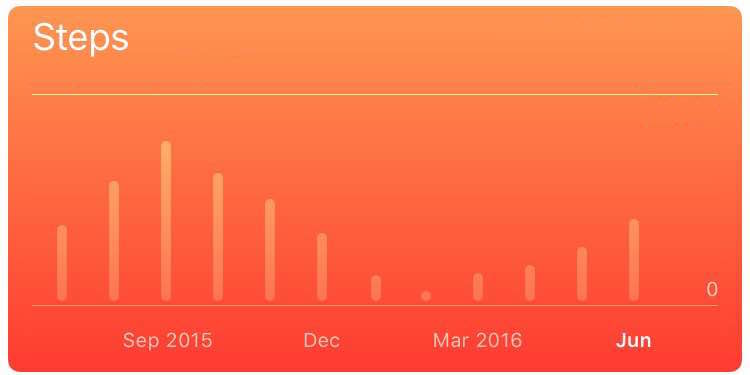
    Step Count

    Can you spot the pattern in my activity? Can you see any trend that would suggest ups & downs? This is actual movement data that has been gathered over a whole year. I would never have thought my mood fluctuations would look this obvious, with hard data.

    I used to keep a mood diary, but of course, when you’re hypomanic you can’t be bothered with the faff of it, and besides, you’re not sick when you’re hypomanic… at least you’re convinced that you’re not anyway.

    I’m not sure whether I’m mostly suffering from Seasonal Affective Disorder (SAD) or whether my Type II Bipolar Disorder has simply become aligned to the seasons. It’s virtually impossible to unpick cause and effect anyway. There are so many seasonal factors, such as the stress of Christmas and the fact that nothing much gets done at work during the holiday season between late December and mid-January.

    Anyway, I’m locked into this cycle, where I start to emerge from hibernation around March/April time. In May I start to begin to do normal things again, rather than just being completely decimated by a sense of malaise, exhaustion, demotivation and feelings of being totally overwhelmed by mundane trivial shit. By June time, I’m about ready to work again, but in danger of tipping into hypomania at any moment.

    At the moment, I struggle to get out of bed in the morning. I have a feeling of dread throughout the working day. The continuous anxiety is matched only by crushing boredom and an inability to concentrate. I flit between looking at my phone and making trips to the toilet to look at Facebook and message my friends. I read documents, but the words don’t sink into my head. The phrase “what the fuck am I doing here?” is on repeat in my head. I’m struck with regular impulses to commit suicide and end the relentless monotony and unending pursuit of a seemingly impossibly distant goal of my next potential holiday.

    By contrast to my hypomanic state, I assume that something is going to go wrong, and I’m going to be plunged back into the stress and pressure of looking for some more work, while the bills pile up and imminent deadlines to pay my taxes and deal with debts that have built up during my winter depression. Everything looks impossible, and boring, and pointless.

    When I’m depressed, I’m absolutely convinced that my skills and abilities and experience count for nothing, and that I’m only good for the scrap heap. Even when I get a job, I feel like a fraud and that I’m going to be found out. When I make a mistake, I beat myself up about it for days, weeks even. I grimace and groan at my desk as I replay something stupid I said, over and over and over again.

    I sit at my desk, watching the clock, wishing I was busy, wishing I felt useful, wishing that the feeling that life was completely pointless would go away, and feeling like death wouldn’t be so bad, because there’s no way I’ll be able to put up with months and years of just turning the pedals, over and over and over again. The same commute, the same routine, the same colleagues, the same game, the same formula.

    Bipolar memory

    How on earth am I going to cope with feeling so bored and unchallenged, and so uninspired and so lacking in passion and like such a fraud and like I’m wasting away, and like there’s no way I can stand even the next few minutes, let alone the next few hours, let alone the whole day, let alone the whole week, let alone the whole project and the whole contract, and the whole career? How the hell am I supposed to keep doing what I do?

    I could drink coffee, which aids my concentration and motivation, but as soon as I do that I’ll start getting big ideas and getting really bossy and overconfident, and before you know it, I’ll be hypomanic again. Coffee always stokes my hypomania up. Also coffee stops me from sleeping, so I start drinking alcohol to get to sleep… and before you know it I’m knocking back copious amounts of both caffeine and alcohol to get through the shitty work.

    Once I start drinking alcohol, I start having days where I wake up massively hungover, but weirdly I can get up and go to work. I find it easier to get up with a massive hangover, and easier to sit quietly at my desk getting on with my work, when I’m just about holding down my breakfast and I’ve got a pounding headache.

    I think that drinking lots of alcohol regularly means that I’ve always got booze in my system, and it works like a kind of anti-anxiety drug. I feel super sick and stuff, but it gets rid of that sense of dread. By the afternoons, I start to sober up and my hangover goes, and I’m really happy and productive. When I get home, then I start to get the sense of dread about going to work again the next day, so I start boozing all over again, and end up going to bed pissed again. The whole cycle repeats itself.

    Alcohol and work seem to go hand in hand for me, and it seems to stop me from being such an obnoxious prick and pissing everybody off before finally chucking in the towel on a perfectly good job. I’ve gotten used to using alcohol to bring my hypomania and anxiety under control. It’s a massive crutch for me, and the temptation to use it is massive, when there’s such pressure on me to perform and earn money and not fuck up yet another job.

    I know that I could quite easily return to a tried-and-trusted form of mood stabilisation, using caffeine to get me moving when I’m deep in an exhausted depression, and alcohol to bring my hypomania under control when my brain is starting to get a bit over-excited, or anxiety and boredom are threatening to make life unliveable. However, these things led me to a massive breakdown eventually, which I’m sure was caused in part by massive amounts of these two innocuous chemicals.

    When you’re drinking 12 espresso shots during the day and two bottles of wine at night, everybody’s chuffed to bits with your work, but surely you’re just screwing your body up for the sake of making some money while you’re young enough to cope with that kind of beating.

    I value my liver and my mental health now, not that I have much of the latter. I’m struggling virtually all year round with a mind that tends towards either suicidal depression or self-sabotaging and career-wrecking hypomania. I’ve trashed my financial security, meaning I now have extra added stress and hassle that I could really do without, but I don’t think resorting to self-medication will be good in the long run.

    So, I remain caffeine free and I’m trying to wean myself off alcohol. Today is my 3rd consecutive day without booze. It might not sound like much, but you probably can’t imagine the kind of pressure I’m under, with life very much hanging by a slender thread.

    My days pretty much start with deciding whether to kill myself or not, and they don’t improve much from there. The evenings and weekends are good, when I can see friends, but possibly it’s also been the excuse to drink that’s also played a part.

    I need to get a handle on booze, but I also want my moods to be manageable. However, I also need to earn money and be able to cope with work. It’s a Catch 22.

    My gut feel is that I’m just going to stick with my harsh regimen of zero caffeine and very moderate booze consumption – ideally no booze at all except on a Friday & Saturday night.

    Coffee

    Clearly, I’m just emerging from under the cloud of a very severe depression, especially as I slashed my own arm with a kitchen knife because the sense of hopelessness and relentless anxiety in the face of overwhelming odds stacked against me, was just so unbearable. Things look a little brighter, but now I’m starting to worry that hypomania will suddenly rear its ugly head, and I’ll sabotage everything, like usual.

    However, I do still refuse to medicate myself, merely to cope with the bullshit life that we’re expected to live. I’ll play the game as best as I can, but my brain is not for sale. Hopefully one day, I’ll be able to better align my needs and my values with my work, but for now, I have to do some stuff that’s pretty incompatible with good mental health.

    One big thing I’ve learned from this rollercoaster ride, is to not expect change to happen quickly. Thinking things will change overnight has led to frustration and disappointment, which has either triggered further depression or has spurred me into regrettable actions. Thinking that I can use the blunt instruments of medication, drugs, legal highs, caffeine and alcohol to force my moods to bend to my will, has been very hard on my body and mind, and has only achieved very temporary effects, for horrific long-term costs.

    Unfortunately, returning to stable mental health, a sense of wellbeing, comfort, happiness, security and an acceptable standard of living, has always required more luck, more time, more favourable conditions than I’ve ever been granted. I’m not complaining – we all face the same harsh and uncaring world, after all – but I recognise that modern society does little to allow people who get sick to ever re-enter the game.

    Stop the world, I want to get off.


    Tags: