bipolar – Page 11 – Nick Grant

Tag: bipolar

  • Care in the Community

    This is a story about home treatment…

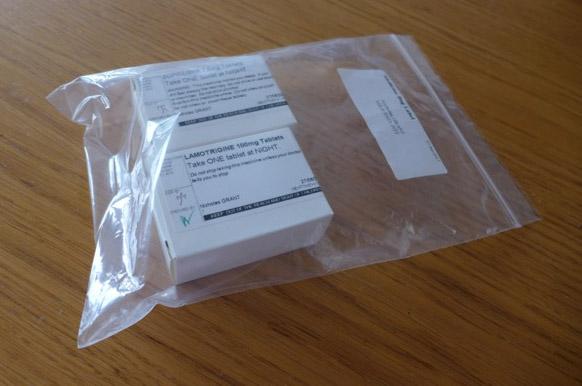
    Meds bag

    This is what the Conservative government’s 1990’s Care in the Community policy looks like, in practice. An extremely low-paid NHS worker, who isn’t trained as a mental health nurse, is dispatched on public transport to travel across the London borough of Tower Hamlets, to bring me a bag of medication. They’re supposed to check that the old packets are empty, which ‘proves’ I’ve been taking my medication. They’re supposed to escalate any problems to nurses and doctors, back at base. If they can’t find me or get in contact, they’re supposed to ring the police.

    It’s that final point that’s the important one: the police got co-opted into this half-baked scheme. Of the people the police deal with – the front-line officers – most of them will have mental health issues. The police are picking up the pieces of the mental health epidemic. When somebody is truly having a mental health crisis, the police will be the ones who get that sick person to the place where they should have been in the first place: a psychiatric institution.

    There are nurses, psychiatrists, social workers and the like, who are involved in assessing whether you need to be detained under the Mental Health Act – what’s known colloquially as a ‘section’. If you’re seriously mentally ill and out in the community, it’s down to the police to find you, catch you, detain you and get you to that assessment where you get ‘sectioned’.

    Also, the police are out there, picking up body parts off the train tracks and underground railway. The police are there when somebody has jumped off a bridge and landed in a river or on some mud flats, or maybe gone splat into something harder below – perhaps a road. The police are there when somebody looks like they’re about to jump under a train or off a bridge – CCTV operators are trained to look out for agitated members of the public, who look like they’re about to top themselves.

    Around the time of Care in the Community, there was an explosion in prescribing of psychiatric medication by our ordinary general practitioners (GPs) – our regular family doctors – there were 9 million prescriptions for Prozac in the UK in 1991. This is the principle behind Care in the Community: put people in a chemical straightjacket, and they can be safely released back into the general population. Ten years later, there were 24 million prescriptions for Prozac and another ten or so years later again, and London alone gets through over 60 million prescriptions for Prozac. These are almost all issued by a GP, not a psychiatrist.

    When it comes to “serious” mental illness – anxiety disorders, bipolar disorder (a.k.a. manic depression), schizophrenia, personality disorders – the NHS kicks you out of the bit where you get various therapy options (e.g. CBT) and instead you’re referred to a psychiatrist, who will prescribe some fairly brutal medication. In the case of schizophrenia, you could have a risperidone implant, injected underneath your skin, which will keep you in a chemical straightjacket for up to 6 months.

    The other people who got co-opted into this Care in the Community policy were the general public. An average member of the public is fairly fearful of a schizophrenic, believing them to have multiple personalities and a propensity for violence. Several murders that received significant media attention, focussed on the fact that they were committed by formerly institutionalised schizophrenics. Depression is now such a common feature of people’s lives, that any stigma has gone, but most people would be fearful of living near, working with, or having their children around a schizophrenic, surveys have found. Lock your doors – there might be a madman lurking nearby.

    If I was in hospital, I’d have somebody checking on me every 30 minutes to an hour – making sure I hadn’t found some way to harm myself. With the Crisis Team (a.k.a. Home Treatment Team) who are tasked with keeping me safe at home, I see them every other day. I could take a fatal overdose 2 hours before they were due to arrive, and by the time an ambulance got to me, I would be well and truly dead as a dodo.

    I had stockpiled 336 tramadol tablets (16.8 grams) which is enough for two people to commit suicide, easily. As part of their responsibility to help keep me safe, they asked me for the tramadol back. I gave them 112 tablets (one box) which was a tick in their box. In hospital, I would never be able to hide the remaining 224 tablets from the nurses. If I took an overdose, I’d be fed activated charcoal, have my stomach pumped, be put on a respirator and given various medications to counteract the deadly effects of a tramadol overdose, in plenty of time to save my life.

    I can’t tell you what the cause and effect is. I can’t tell you whether Care in the Community is the reason for the mental health epidemic, or whether it’s something else, such as the collapse in living standards and precarious lives we live now, with our income and housing under constant threat.

    Most people don’t like to lose their liberty. In fact, it’s distressing to be locked up somewhere, and not allowed to leave. There are crisis houses, where you can come and go as you please during the day, but you have to be back by nightfall and sleep there or else the police will be sent out to find you. This seems like a compromise that would suit most people who are having a mental health crisis, who pose no danger to the general public.

    With the false security of Care in the Community, the number of beds available for those having a mental health crisis, has been slashed dramatically. You can attempt suicide and be hospitalised – in intensive care – and then discharged out onto the streets, simply because there isn’t a free bed on a psych ward or in a crisis house, where you could more safely transition back to normal life. You can be suicidal, and the best the NHS can offer you is to come check that you’re still alive once a day.

    As a man, I’m many times more likely to commit suicide than a woman, but far less likely to seek help. This means that I have had the good fortune of being looked after once in a crisis house and once under a voluntary ‘section’ on a psych ward. Not many people receive lifesaving treatment like that – the resources just aren’t there anymore.

    So, what’s the solution? Pharmaceutical companies tell us their medications are better than ever. More and more of us are taking powerful psychiatric medication. But, yet, the percentage of the population suffering from mental health issues is ever-growing; suicide rates keep climbing – there is, undoubtably, a mental health epidemic. My personal opinion is that it’s not a medical problem: it’s a problem created by insecurity: jobs and housing; it’s a problem created by declining living standards and soaring levels of stress.

    No amount of pills are going to fix the mental health epidemic, even if you bring them to my door.


    Tags:

  • Two Contrasting Weeks

    This is a story about comfort zones…

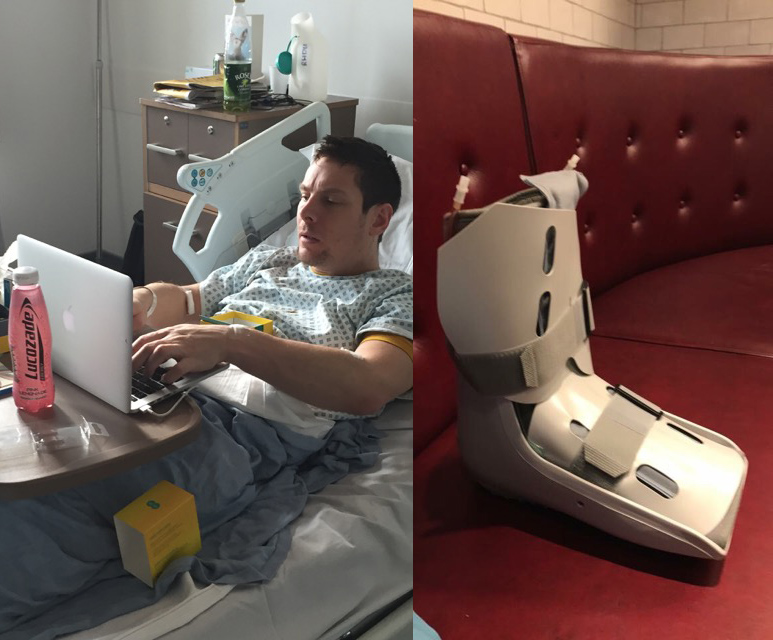
    Montage

    Relax and put your feet up, I’m about to tell you the tale of two sedentary situations.

    I’m institutionalised. Put me inside a hospital or a head office, and I’ll feel right at home.

    Most people don’t like hospitals: they associate them with pain, death and stress. Most people don’t find hospital relaxing; quite the opposite in fact. Hospitals are places of mysterious rhythms and routines that seem chaotic to most people. There are different sounds that all the machines make when they’re working, and when they’re making noises that indicate that something is going wrong. There are different NHS staff, in different roles, in different clothes, who appear at different times.

    My week in hospital that I’m going to tell you about – although I spent the best part of two weeks in hospital  – sounds kinda nice, because I was never really afraid or outside my comfort zone. I find the functioning of complex organisations to be fascinating. I love observing the systems and the people, trying to second-guess what’s going to happen next, and what’s going on behind the scenes. I like asking loads of questions and adding whatever I can learn to my growing body of knowledge that allows me to feel more in control of my destiny and more able to know what to expect next, than the tense, anxious and extremely tedious waiting game that most patients face on the National Health Service.

    Once one has resigned oneself to the maximum speed that a massive organisation can function at, the whole hospital experience becomes quite meditative. Sitting in Accident & Emergency, you can fill your time sneakily looking at the other patients in the waiting room, and trying to guess what symptoms they reported to the reception staff when they arrived. Shortness of breath, chest pains, numbness in one side, drooped face, earlier seizures, unconscious or otherwise delirious patients will normally arrive by ambulance, but any walk-in presentations will obviously jump to the front of the queue. Then, there are the people with minor injuries who have put up with their trivial ailments for days or even weeks. The reception staff aren’t allowed to tell them to fuck off, so these idiots must sit for hours on end, only to be told off for wasting valuable NHS resources, quite rightly. In the middle, there are nasty workplace injuries, DIY accidents and total wildcards. You usually get seen by a triage nurse within an hour.

    Having been admitted into Accident and Emergency, there is a brief flurry of activity while routine blood samples are taken, and perhaps you’re hooked up to a drip. A barrage of questions is fired at you. Examinations seem to be probing and thorough. Surely these professionals are going to have this problem fixed in no time?

    It’s always a mistake to believe that important things are happening and it won’t be long before the right diagnosis is reached and the right treatment is administered. One should be aware that the function of A&E is to rapidly assess whether you’re about to die, whether you might need to be properly admitted to the hospital, or whether you can be discharged swiftly, suddenly and brutally.

    Once on a ward, a certain amount of orientation and induction is necessary, but all wards function with great similarity. All nurses are grateful if you don’t press the call button all the time, for trivial things, as well as being cantankerous and discourteous. Remembering one’s Ps and Qs at all times is a pleasant distraction from boredom, pain and discomfort. There will be shifts, and it’s important to be mindful of when these shift changes occur. The NHS staff see so many patients come and go, and many are lucky enough to only have a very short stay in hospital, so there will be a certain initial reluctance to absorb you into the system: the ward wants to spit you out undigested.

    Having overcome some initial resistance, you can relax into hospital life. Your day begins with your vital signs being measured. Then blood samples are taken. Then there is the hullabaloo of breakfast, ridiculously early in the morning at 7am. Then, there is nothing. All of that disturbance keeps the night shift staff briefly busy before they hand over to the day shift. The day shift hope to be able to ease their way into the working day gradually. Consultants start to appear at around 10:30am, followed by a gaggle of registrars and junior doctors. The most important time of the day arrives: choosing your lunch and dinner for the next day. By the time that lunch is served, you can’t remember what you’re going to get because it wasn’t long ago you had to choose what to eat tomorrow. The meals are pleasantly bland and easy enough to eat. Mealtimes are something to look forward to, even if the food is far from gourmet. Expecting much to happen during the day, in terms of treatment, is a mistake. Anticipation of treatment that has been promised can only lead to frustration and disappointment. The NHS does what the NHS does, and it does it at its own speed. Things cannot be rushed or expedited. Complaining or asking staff when things are going to happen or what’s going on, will only piss them off and ruin their day. Dinner arrives surprisingly early. Treatment can be sprung upon you at the end of the day, just when you thought you were going to have a relaxing evening, or you can have a lengthy wait until you get your pain medication and anything to help you sleep. Dropping off to sleep is not easy, especially as the day shift will hand over to the night shift loudly at the end of your bed, and there will be more vital signs being measured before you’ll be left in peace to try to get some rest.

    And so, my week in hospital consisted of lying on a bed that had buttons that could make me sit up or lie down, with no effort required at all. I was able to elevate my bad leg, to reduce the swelling. I was brought paracetamol every 4 hours, tramadol every 6 hours, and 2 hot meals a day. There were few unexpected interruptions, and if I was well enough, I would have been able to read, listen to music, browse the internet and watch films & TV, pretty much all day, all evening and as late at night as I wanted. I could stake a piss without even having to get out of bed. Friends travelled to see me. Doctors came to my bedside, and I was wheeled to wherever I needed treatment, by hospital porters. I was under no obligation to do anything, except to get better, and all my basic needs were met. My lovely girlfriend augmented the hospital care, so I wanted for absolutely nothing. Blissful, right? I could have stayed for a month, and I would have even earned £676 (I pay myself minimum wage).

    —

    Why then was I in such a hurry to discharge myself? Why would I leave the lap of luxury, and risk my health and even my life, by leaving the safe confines of hospital?

    Well, that’s a topic of discussion I’ve covered at length in prior blog posts, so I invite you to peruse the archives.

    —

    People rarely change their bank. We open current accounts in our teens, and we keep them into adulthood. Some of us even opened special accounts when we were children, and we have a certain nostalgic brand loyalty for the bank that we’ve been a customer of since we were youths.

    The ‘big four’ or ‘big five’ high-street banks have not changed for my entire lifetime. We have (in alphabetical order) Barclays, HSBC [Midland], Lloyds [TSB], Royal Bank of Scotland and Santander [Abbey National]. These banks hoover up 85% of all the current account banking customers in the UK.

    Just like current account holders, people join these banks when they’re young – often their first job – and tend to stay loyal. Many people who I deal with on a day-to-day basis have worked for 15, 20 or 25+ years for the same bank that’s been so good to them that they’ve never felt compelled to leave. Everybody bitches about their job, but a bank employee knows that they’re very well looked after and they’d be mad to go off in search of a better job.

    I’ve worked for 3 of the big 5, and they’re institutions that I feel very at home in. Some people might think that I work in a rather high-stress environment, where it’s imperative that I’m up to date with the latest cutting-edge developments in my field, and I need to perform in an exceptionally demanding role. The truth is, once you’re in the door, you’re in for good. You get your feet under the desk, and adopt the right kind of jaded resignation, that everything is going to be slow, sloppy, shit and a massive festering pile of neglected crap that nobody gives two fucks about, and you’ll fit in just fine. Moan as much as you want – everybody does – but for God’s sake don’t go on any crusades to change or improve anything. Just settle in, get comfortable and enjoy the masochistic experience of being in a world where not a lot gets done and the right answer is always “no”.

    A lot of people get into technology and engineering, because they like to fix things and make stuff that works. They like to build stuff. They like the feeling of completing a technical project, throwing the switch and seeing their hard work put into action. A bank is a terrible, terrible place to build anything that will ever see daylight.

    Having come to terms with the fact that any ambitions you had of building useful things that people might actually use, will be forever thwarted by a bank, you can begin to enjoy the ridiculous game. You command millions of pounds of budget, and you will achieve nothing. When you estimate how long you think it will take you to do something, you double your original estimate, double it again, and then double it one final time for good luck, and it’s still not long enough. When you are asked about the feasibility of doing something, or whether you have any spare bandwidth to perhaps do something extra, you instinctively say no; it can’t be done; no chance. Nobody ever got fired for saying no. In fact, people start to love you and think you’re great at your job, if you get really good at saying no.

    Delivering pieces of important technology, 100% working and of high quality, in short timescales and with hardly any resources, is liable to cost you your sanity. “It can’t be true” colleagues will proclaim, even as the results are staring them in the face. From denial, your colleagues will move to the belief that it’s a one-off fluke, or they will hate you. Colleagues will mainly hate you for making them look like totally incompetent blundering slowcoach fools. Nobody ever made friends and got ahead in a bank, by doing a good job. Finding yourself burnt out from the exertions of persuading people of the merits of doing things properly, without pointless delays, you find yourself suddenly alone; isolated. You may create some kind of mythical; legendary; cult status around yourself and your achievements, but you have no future with the bank: the bank doesn’t want your type, and it will unceremoniously eject you.

    You can work for a bank for as long as you like, provided you just go along with things. Never challenge anything. Never push for change. Never go the extra mile. For sure, banking demands that you be seen to be going the extra mile, but it’s all just for show; part of the act.

    So, if you want to be really successful in your banking career, you learn the rhythm and routine of your department. You learn when your boss arrives at work, and you get to your desk before him or her, and leave with them in the evening, making pathetic small-talk. You learn who’s got kids, what ages they are, and what stressful childcare arrangements are a pain in the arse for your colleagues. You learn how everybody gets to work. You learn whether they’re morning people or night owls. You learn their interests: topics to get them talking; things that enthuse them. You learn who takes their job seriously; who’s ambitious; who’s jaded and demotivated. You learn who drinks heavily, smokes, gets stoned. You learn who’s lived, and who’s been insulated. You learn who’s worked hard, and who’s had advantages. You learn when to make yourself scarce and blend into the background, and when to promote yourself. You learn the things that need to regularly get done, and you discover many things that don’t need doing. You learn how to do just enough to please the handful of important and influential people, and how to avoid having to do any pointless busywork.

    You can’t prepare yourself for boredom. There is nothing in the world worse than boredom.

    My first week back in the office was 4 days of boredom. I’ve seen it all before, done it all before, and I’m the master of minimal effort. The only problem is that I need to look busy to make a good first impression. I forbade myself from reading the news on my laptop. I tried really hard to not look at my phone too much, and to pretend to be busy.

    My boss and his boss, both sit right next to me. My boss is a nice guy who seems to have a paternal nature. The big boss talks too much and doesn’t realise that I find him amusingly stupid. I listen, make the right noises and say some encouraging sounding things, but I’m completely failing to disguise my contempt for this fellow, but luckily he’s the only one who fails to see my total lack of respect for him, except for my bosss. I endeavour to make my boss feel that my number one priority is in supporting him in making our team look good in the eyes of the big boss. I try to make the big boss feel in control, while diverting any respect he commanded away from him. There’s a mutiny in progress, but nobody will realise until it’s past the point of no return.

    Virtually nothing can be achieved in 4 days in a bank, and I’ve achieved far more than anybody expects of me, even though I’ve spent a considerable amount of time in the toilets, browsing Facebook and writing amusing things for my friends to read. I invested as much time as I possibly could in developing a good relationship with my boss and my team, but I have nothing of value to contribute yet. Aside from dazzling my colleagues with my all-round technical knowledge, my main task is to stay the fuck out of their way and not disrupt things too much.

    Regrettably, I’ve had to take Friday off work. Making a good first impression can only be done once, and the lasting image that my colleagues will have of me – the guy wearing the robocop ankle splint – will now be tainted with the fact that I had to take time off work, giving the impression that I’m unreliable and prone to sickness. Damage to your image like that can be irreparable.

    Sometimes, it’s desirable to be known for being unhelpful, regularly late to work and somebody who leaves on time in the evenings. Being somebody who walks out the office door, even when there’s a major crisis, is the sign that you have become perfectly adjusted to bank culture. However, the clever ploy is to try hard at first, to develop an image of being a hard worker, but in actuality, you are avoiding work and responsibilities at all costs. In time, you will have the best of both worlds: being thought of as dedicated and useful, but actually adding no value at all.

    My foot has been steadily getting more and more painful through the week, and I’ve been popping painkillers throughout the day. I’ve passed the week in a dreamlike state; heavily medicated. Having strong coffee in the morning to make me sharp and alert enough to make a good first impression, has meant that I’ve been able to stay awake in some horribly boring meetings, but it has made me a little hypomanic, causing me to be far too outspoken at times, but I think I’ve got away with it.

    I’ve earned more in a single day in the office, than I would for almost a whole month of being in hospital. That kind of cash does motivate you to get out of bed in the morning, and to stay at your desk with your mouth shut, when really you can’t stand being in the office.

    You’d think it wouldn’t be that hard, being a bit bored, going to a few meetings, talking to people, saying fairly standard things that are obvious. Having the exhaustion of being unwell, plus being in pain and discomfort, make things hard for sure, but in a way, it’s been an excuse to be fucked up on drugs for 4 days and get paid an obscene amount of money for the privilege.

    It seems fairly clear that if I can dial the intensity down to 4 or 5 from 11 – and the dial only goes to 10 – and ease my way into a gentle routine that I can just about cope with, then I’ll be able to blend in for years. There’s no reason why I wouldn’t be liked and respected. There’s no reason why I can’t be perceived as doing a great job, even though I’m not doing anything useful. That’s the main thing I need to remember: I’m specifically there to not do anything.

    Saying the right thing at the right moment – being the smartest guy in the room (as someone I know once jibed) – comes easily to me, and it does unfortunately command a disproportionate amount of respect versus doing some real work instead.

    —

    I’m not sure which week was more comfortable. Certainly hospital was more physically comfortable, but I was highly stressed about losing my lucrative hard-won contract and being too tired to be able to function when I started work. My job is extremely easy and I anticipate no problems, except coping with boredom and my propensity to blow a fuse with frustration at the snail-like pace that everything moves at.

    Sleeping in my own bed has been far superior to the hospital bed, but getting up in the morning is never pleasant. However, my lie-ins were so ruined in hospital – by irritatingly early breakfast and the like – that I have actually been getting ready for work, relatively painlessly.

    Commuting is hell, but because I know it’s hell, I’m able to impassively observe the shit that I’m going through; detach. Commuting is the price that one must pay, if you wish for your gross income to exceed a year’s average salary in the space of just 8 weeks.

    How can anybody handle such contrast? It’s insane. It’s surreal.

    How can I walk out of a hospital, against medical advice, and go straight into a brand new job where they’re oblivious of just how sick I am and how messed up my brain is by strong medication? Can’t they see that they have an imposter in their mix? Obviously not.

    That, effectively, sums up the bipolarity of my life. The ups and the downs. The highs and the lows. What more extreme example could I come up with?


    Tags:

  • Depressive Realism

    This is a story about bias…

    Nick in blue

    When you go hypomanic, you overestimate your capacity to work without sleep and food; you overestimate your ability to take on difficult tasks without negative consequences; you believe you can achieve superhuman feats. Often, hypomania can mean hypersexuality and the belief that you’re irresistible to the opposite sex. Hypomania brings extreme risk taking, for me, and I’m a big risk taker anyway!

    There must be an element of underestimation too. When hypomanic, you underestimate the difficulty of what you’re trying to achieve. You underestimate the risks and the consequences of failure. “How hard can it be?” you find yourself thinking, as you get stuck into the quantum mechanics books. I rejected a highly paid career, in favour of building my own business, mostly because it seemed like it would be quick and easy at the time.

    Depression has flipped all that on its head. I had an interview with a well known high-street bank earlier in the week. I thought it went dreadfully and I sank into an even deeper depression, because I gave such an appalling performance. I was beating myself about things I said and cringing about holes in my knowledge and experience that the interviewer had exposed. Then my agent phoned me:

    “They loved you. They want to meet you again”

    I spent the rest of the week dreading this second interview. I imagined all the things that they were going to ask, that would be difficult for me to answer. They were going to haul me over the coals and my incompetence would be laid bare for all to see. It would be embarrassing; shameful. I was losing sleep over it and waking up each day with a feeling of dread.

    At the second interview, they cooed enthusiastically at everything I said, and laughed encouragingly at my anecdotes. It was almost as if we were friends and work colleagues, gossiping conspiratorially about the good and bad things that happen in the world of grey suits and office blocks. I thoroughly enjoyed myself.

    Afterwards, I thought “oh no!” What if my intuition is wrong again? What if there’s an inverse correlation between how I feel like things went, and how impressed my interviewers were?

    Depression is almost like a defence mechanism: a reaction to a hostile world where bad shit happens. When the UK voted to leave the EU, and when the USA voted for Donald Trump, I had placed bets correctly on both outcomes, at substantially long odds. I knew I was sad that those things had happened and I didn’t make enough money to be happy, but I still didn’t really feel anything even though they were awful events. I was prepared for the worst. In fact, I expected the worst.

    There are psychological experiments that prove that depressed people are able to perceive the world more accurately, in certain circumstances. This depressive realism is the antidote to illusory superiority. This depressive realism is the antidote to the madness of crowds and a misplaced sense of optimism.

    Humans are notoriously bad at perceiving the risk of very real and likely events: stock market crashes, earthquakes and hurricanes. If we were risk-averse according to probable catastrophes, we would steer clear of the Pacific Rim of Fire and the San Andreas Fault, but yet we see insane real estate prices and a concentration of our best technologists, in Silicon Valley and Japan.

    London is currently rated by MI5 as at severe threat of international terrorism: an attack is highly likely. When I see huge crowds of people at Canary Wharf underground station, I see a swarm of sitting ducks. There are two vans full of armed police parked nearby, but it doesn’t make me feel any safer… it just makes me glad that I don’t have brown skin.

    On a day-to-day basis, I generally assume I’m going to be blown up by a terrorist, fail to get a job, run out of money, be evicted, be declared bankrupt, never be able to work again, society is going to collapse, there will be riots and looting and the human race is going to retreat into the dark ages of barbarism, religious dogma, superstition and ignorance. It just seems likely, given the evidence.

    I might be wrong, but I tend to put my money where my mouth is, and I’ve sadly been right more than I’ve been wrong.

    I just placed a bet on Marine Le Pen. I hope I lose.


    Tags:

  • Selected Short Stories of 2016

    This is a story about a year in review…

    Woz Ere

    Are you sitting comfortably? Good. Then I’ll begin.

    For anybody following along at home, there are a few highlights buried in the 600,000+ words I’ve written to date. There’s some required reading for anybody making a study of my psyche.

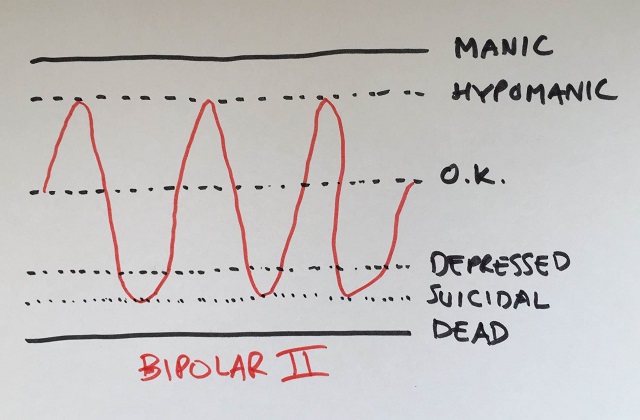
    I decided I wanted to write something more popular and so I drew some graphs explaining mood disorders, like bipolar. It was my most read blog post of 2016.

    Along the same lines, I wrote about the onset of depression and attempts to treat it.

    I wrote a letter to myself.

    I was an inpatient on a secure psychiatric ward, so naturally I came up with a bizarre thought experiment. I even did a drawing of my quantum suicide experiment.

    When I was bored out of my mind at work one day, I wrote a short story called The Factory.

    If you ever wondered why I have a semicolon tattooed behind my ear, this is half the story.

    Everything you never wanted to know about addiction.

    But, is it art? This is a good example of me rambling while strung-out. I’m surprised I could even see the keyboard. I just like the title and it’s a bit of a private joke, sorry.

    There’s a 3-part account of the time I lost my mind and started hearing voices.

    That’ll probably do. There’s a lot to get through there.

    Of course, there’s also the first draft of my novel if you have time to read 53,000 words. I’m going to start editing it tomorrow, so any feedback would be gratefully received.

    I’ve slightly bent the rules, because I have a bit of a warped sense of time, but these are all significant pieces of writing for me, that I associate with the events of 2016.

    Happy New Year’s Eve.


    Tags:

  • GSOH

    This is a story about compatibility…

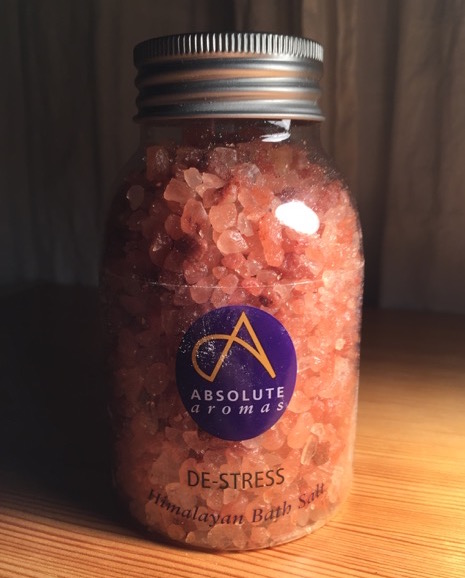
    Bath salts

    Very often, when you’re acutely aware that there’s something that you need to avoid crashing into, you’ll end up staring at it, unable to tear your eyes away. When riding a board or a bike, flying, driving or otherwise in motion, you tend to go in the direction you’re looking. If you want to avoid a crash, you should look at a spot away from danger.

    Is this the reason why we don’t talk about taboo subjects, because we’re worried about tempting fate? We turn our back on the ugly truth and try to pretend like everything’s OK.

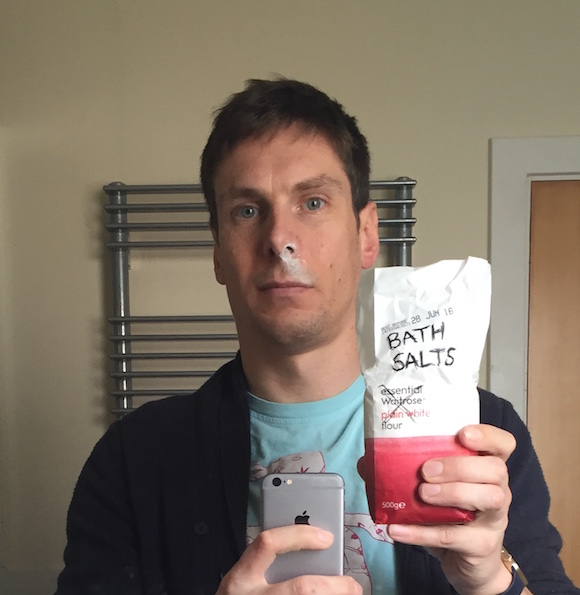
    My Christmas stocking included some bath salts.

    White lines

    Clearly, Santa has the same dark sense of humour as me. That’s great. I think humour is a fantastic way to exorcise the demons of the past. First comes talking, then understanding and finally you can laugh and joke about a topic that was originally quite painful and difficult to remember. Repressing memories and walking on eggshells is no way to move forward.

    If we don’t have honest conversations where we can talk about how we really think and feel, then we build up a load of sensitive topics. Secrets and lies lead to paranoia and weak relationships. Keeping schtum about my parents’ drug use – when I was a child – was too much of a burden. Writing openly has been liberating and has allowed me to move on from shame and regret, to regain my self-esteem and confidence.

    I remember a desperate scramble to cover up my admission to The Priory. My psychiatrist had made a referral to a “private hospital” for treatment of an acute episode of bipolar disorder. All perfectly true, but there was a certain economic use of the truth. What would most people think, if they found out that I was spending weeks in the UK’s most notorious treatment specialist for drug & alcohol abuse? They would leap to the wrong conclusions, surely?

    It’s so bloody exhausting keeping up appearances. One must be aware of how things can be [mis]interpreted and people aren’t likely to share their true thoughts and feelings: “better keep him away from the kids if he’s mentally ill” or “I bet he’s a raging alcoholic behind closed doors if he’s been in The Priory”.

    We’re brought up to believe that our reputation is like a balloon: one little prick and it goes pop. We’re scared to take time off work, because we’ll have gaps on our CV that need to be explained. We’re scared to share details of our private lives, lest our employers decide we’re unreliable and judge us on preconceived notions. Who wants to work with a madman?

    When it comes to dating, the same applies. Who wants to date somebody with flaws; defects? Who wants to take a risk on a ticking time bomb; an unsteady ship? And so, I should have found myself unemployable and undateable. “Take your pills, sit in the corner and shut up” says society.

    However, if you ever meet me in a work or social context, you may gain the [false?] impression that I’m pleasant company: a healthy, happy and capable member of society, engaged in productive endeavours. Strangely, you might have the wool pulled over your eyes so much that you actually mistake me for a normal human being.

    Surely this is thanks to the excellent medication that I take?

    Well, no. I don’t take any medication. I don’t do therapy. I haven’t had a course of electro-convulsive shock treatment. I don’t even have a psychiatrist at the moment.

    “But you’re going to murder everybody if you don’t take your pills.”

    Yes, that’s right. I’m your worst nightmare. I’m out there, on the dating scene, luring unsuspecting vulnerable young women into my web. I’m a dangerous fantasist; a con-man. I’m so good at living a lie that I’ve constructed an elaborate fable that looks, smells, tastes and sounds very much like an authentic real life, but it’s all fake. It can’t be real. What about the secrets we now know?

    If you take your secrets and turn them into jokes, you defuse that ticking time bomb… or at least that’s my working hypothesis.

    I certainly feel a lot happier knowing that I’ve met somebody with enough of a good sense of humour to make a joke on Christmas Day about my chequered past. I feel less sensitive, paranoid and insecure than ever before. I feel like I’m myself, and that’s OK.

    Maybe it’s just a getting old thing: the realisation that we’re all flawed in some way. We’re all human. We all have weaknesses and strengths, and we all have history; baggage even. It seems better to wear my heart on my sleeve than present myself as some whiter than white, holier than thou saint who never put a foot wrong in their life.

    I doubt I’ll ever unify my professional and private identities, but I certainly don’t regret jettisoning the traditional approach to dating. Honesty seems to have been the best policy in this case.


    Tags:

  • Ups and Downs

    This is a story about data collection…

    Step Count

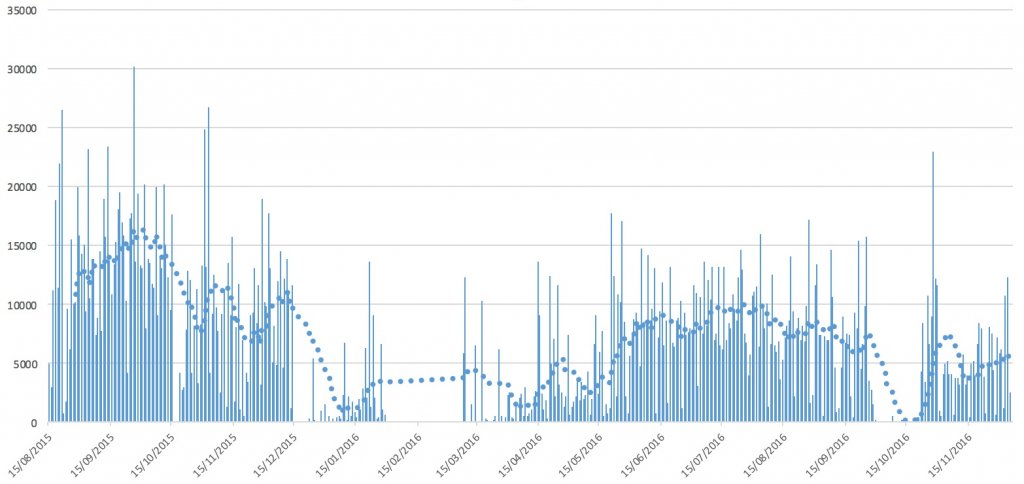
    Here’s a graph of my daily step count for the last 18 months, as recorded by my iPhone. I practically always have my iPhone in my pocket, so it should be fairly accurate.

    As you can see, there are big gaps.

    I’ve added a 14-day moving average to the graph too, which is the dotted line.

    How do I interpret this?

    The optimistic interpretation is that I was overdoing it last year and had a big crash. There’s a little gap in the graph that you can hardly see at the end of October. I was in hospital then. This year got off to a shit start and then improved and stabilised, but I still had a hiccup at the start of October. The graph is much flatter on the right hand side – on average – than it is on the left hand side. Perhaps the volatility in my life has been reduced.

    The pessimistic interpretation is that there’s a strongly downward trend. There are also signs of repeated periods of inactivity: shit times. Perhaps there’s a cycle that would be clearer to see with more years of data.

    I could bring in my Android phone data which covers the period before this, and maybe some other data sources too, but it was a pain just to produce this. 

    Interestingly, if you own a smartphone, you should be aware just how much it’s tracking you all the time you carry it around!


    Tags:

  • Only Smarties Have the Answer

    This is a story about a pill for every ill…

    My pills

    There was a young man who swallowed a lie, about how hard work and loyalty to his company would make him successful. It left him exhausted and with depression, that wiggled and jiggled inside his brain. I don’t know why he swallowed the lie. Perhaps he’ll die.

    There was a young man who swallowed 150mg of Bupropion – a fast acting antidepressant – to cancel out the depression and exhaustion, that wiggled and jiggled inside his brain. Perhaps he’ll die.

    There was a young man who swallowed 5mg of Olanzapine – a mood stabiliser – to cancel out the hypomanic highs that were created by the Bupropion, that was supposed to fix the depression and exhaustion, that wiggled and jiggled inside his brain. Perhaps he’ll die.

    There was a young man who swallowed 15mg of Mirtazapine – another antidepressant – because the Bupropion wasn’t working so well any more on its own, to fix the depression and exhaustion, that wiggled and jiggled inside his brain. Perhaps he’ll die.

    There was a young man who swallowed 25mg of Lamotrigine, to raise his seizure threshold so he could take more Bupropion, stabilise his mood more and as a third antidepressant, to fix the depression and exhaustion, that wiggled and jiggled inside his brain. Perhaps he’ll die.

    There was a young man who swallowed 10mg of Diazepam – an anti-anxiety drug – because by now he was pretty jittery from all the damn drugs, that were supposed to fix his depression and exhaustion, that wiggled and jiggled inside his brain. Perhaps he’ll die.

    There was a young man who was going to swallow 2,000mg of potassium cyanide, to end the depression and exhaustion, that wiggled and jiggled inside his brain. Of course he would die.


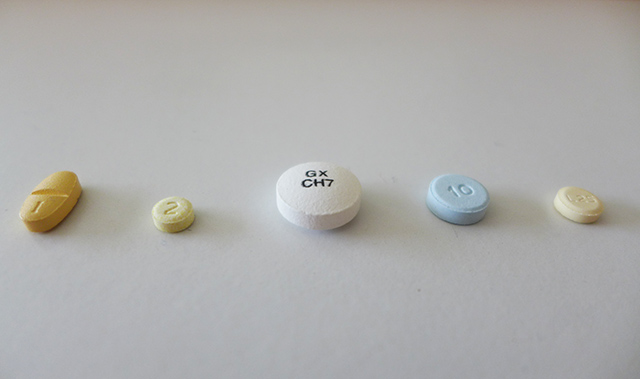
    Top picture, from left to right: Mirtazepine, Olanzapine, Bupropion, Diazepam, Lamotrigine.


    Tags:

  • The Doors of Self-Perception

    This is a story about being objective…
    Yardsticks

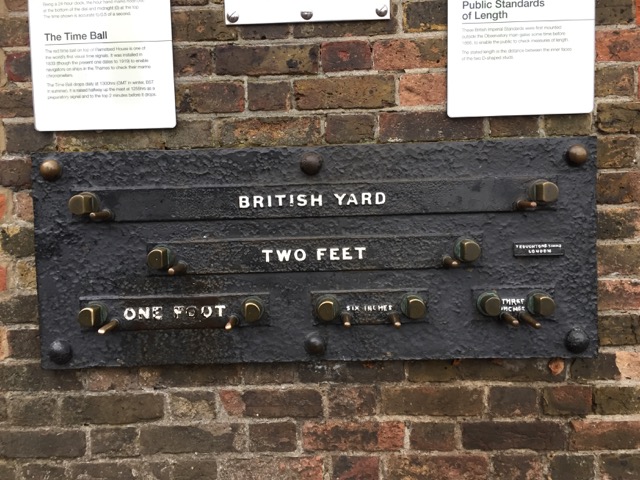
    If you want to compare two measurements you have to use the same yardstick. If you are comparing two subjective things then how can you possibly draw any concrete conclusions?

    At times, I have kept a mood diary. I rate my mood from 1 for worst to 10 for best. Who’s to say that if I rate myself as “1” during prolonged depression that’s comparable to “1” on a bad day when otherwise I’ve been feeling mostly normal?

    During a lengthy period of depression, where nothing seems to hold any pleasure or enjoyment: subjectively, life is terrible. I also have periods when I’m generally in a much better mood, but something really shitty will happen. The shitty thing might feel like the end of the world at the time, but I’m not going to kill myself over it: I’ll quickly get over it and move on with my life… so can it really be a “1” even if it feels like it at the time?

    If your mood slowly improves or declines, over the course of several weeks or months, can you spot the trend? If you’re suffering a lengthy depression, does your yardstick change? You might have a day where you just feel normal, but now you rate that 10, because it’s the best you’ve felt in as long as you can remember.

    Do you even remember how you used to feel, before you got depressed?

    This might be why I have a tendency to invite hypomania, because at least it’s clearly some kind of polar opposite from depression, even if I don’t exactly feel “happy”.

    Defining “happy” has started to get really hard.

    Going in search of happiness has been a disappointing experience. Anhedonia means the loss of pleasure and enjoyment of things that you used to get a kick out of. Finding that you no longer love the things you’ve always loved to do, is terrifying, because it’s further confirmation of the way that you feel: “everything is shit”.

    I ended up completely rebasing my whole idea about what made a happy day:

    • “Got to work only an hour late”
    • “Didn’t quit my job”
    • “Only drank one bottle of wine instead of two”
    • “Survived another week without being sacked”
    • “Got out of bed at the weekend before it went dark”
    • “Went to the shops”

    I know that I must be unwell, because I used to have happy days that were more like this:

    • “Cooked a healthy dinner”
    • “Went for a walk or a bike ride”
    • “Took some cool photographs”
    • “Went to an event”
    • “Made a new friend”
    • “Did some work I’m proud of”

    Now, I could do those things, but I don’t feel like it. Often when I try to force myself to do things, I get very stressed about it and I find it really exhausting. When I get home I feel wiped out and that I shouldn’t have bothered. I find myself out taking a walk and nothing takes my interest enough to photograph it. That’s weird. I used to live behind the lens.

    So, I started to bring in more objective measurements: movement data, alcohol consumption, number of social engagements, number of words written.

    When I analyse the data, I think the most reliable predictors of my subjective feelings of depression, are movement and alcohol. Looking at last year, I was averaging 12,000 steps a day, and although I had alcohol binges, my average consumption was reasonably low. This year, I’m averaging 7,000 steps a day and drinking excessively nearly every day.

    Now, you might think “walk more, drink less” would be the solution, but this assumes a causal relationship. Perhaps I was more in the mood to walk more and drink less, last year. Perhaps the relationship is the other way around and my poor lifestyle ‘choices’ are actually due to depression.

    We often tell people to eat healthier and exercise more, to improve their mood, but perhaps it’s the people who have a happier mood who are the ones more likely to eat right and be active. In actual fact, healthy eating and being more energetic could be a good predictor of happier people.

    The cause-effect relationship is not always clear. Psychologists had published a paper that appeared to show that smiling made you feel happier. However, when the experiments were repeated, the results could not be reproduced. If you can’t reproduce the results of your experiment, it’s not good science.

    A friend made the following amusing observation:

    “People who are dying of dehydration can’t just mime drinking water to quench their thirst”

    I think this hits the nail on the head perfectly. While depressed people can eat healthier and go to the gym, they’re just going through the motions. They’re not getting the benefits that their happy counterparts are getting, and in fact it could be pure torture for them.

    There’s an experiment where a pigeon is fed at a computer-controlled random interval. What the researchers found was that whatever the pigeons were doing the first time they got fed, they then decided they needed to do again, in order to get fed. Let’s say the pigeon was cocking its head to the side when the food was released, the pigeon will then start repeatedly cocking its head, and believe that it is causing the food to be released, when in fact it’s completely random. Essentially, the pigeons had become superstitious.

    It seems relatively random – unpredictable – when a depression is going to lift. Let’s say you were trying acupuncture or homeopathy at the time when your mood started to improve: you might assume a causal relationship between the alternative treatment and the lifting of your depression.

    Even a double-blind placebo trial is not exactly fair. Psychiatric medications do make you feel noticeably different. I would be able to tell whether I was taking an inert placebo pill, or something psychoactive. I would know whether I was in the control group or not. Placebos don’t work if you know you’re taking a placebo, so this could explain some of the mood improvements seen with antidepressants. The antidepressant might look effective, when compared with the control group, but it’s the placebo effect.

    Antidepressant clinical trials generally only take place over 6 to 12 weeks. Many common antidepressants take 6 weeks before their effects can even be felt. There is no focus on long-term outcomes in these trials, only that the medication should perform better than placebo.

    Many trials of longer duration have shown that being unmedicated might be more effective in the long-term, than taking antidepressants. Pharmaceutical companies are not concerned with long-term outcomes. In order for a medication to be sold to the public, it merely has to be safe and proven to be marginally better than placebo.

    You would have thought that taking antidepressants would be a lot better than not taking them, right? In actual fact, there might only be a 15% chance of you feeling better, but there’s a 15% chance of unpleasant side effects. The very process of going to your doctor, being listened to by somebody nonjudgemental, and then feeling something even if it’s not actually better, might convince you that you’re improving, when actually your depression could be lifting quite naturally anyway.

    Culturally, we have developed a strong superstitious belief in the power of medicine. We believe there’s a pill for every ill. We believe that a man in a white coat can wave a magic wand and we’ll be cured of any ailment; discomfort.

    You only have to go into any pharmacy during the winter, to see signs that say “we have no medication to treat your common cold”. The fact that doctors and pharmacists have to tell people not to waste their time with an incurable virus that has unpleasant but non-life-threatening symptoms, shows how strongly we believe in the power of medical science to save us from even a runny nose.

    There is a clear difference between “feeling a bit sad” and depression. Depression is life-threatening. Depression has a massive impact on people’s quality of life. However, we are often medicalising a non-medical problem.

    If somebody who’s feeling down visits their doctor and receives some medication that’s basically a placebo that makes them feel a bit different – drugged – then their pseudo-depression will lift, because it was going to anyway. The non-judgemental medical consultation will also have marginally assisted.

    However, those who have prolonged severe depression – to the point of suicidal thoughts – may find that their quality of life is actually reduced by medication, because it gives no real mood improvement, but it does have unpleasant side effects. The longer-term studies seem to back this up.

    Through extensive research, I found a number of medications that are very rarely prescribed, but have been used for treatment-resistent depression. These medications are dopaminergic not serotonergic.

    There are a whole raft of medications used to treat Parkinson’s disease, that have been shown to exhibit antidepressant effects and can successfully treat patients who had previously been treatment-resistent.

    In the most severe cases of depression, deep-brain stimulation has been employed with remarkable efficacy. Deep-brain stimulation had previously only been used on patients suffering from Parkinson’s disease, to stop their tremors.

    The idea of having electrodes implanted into my brain does not sound immensely appealing. Rats who have had electrodes implanted in their lateral hypothalamus will starve themselves to death, in order to press a lever thousands of times an hour, to stimulate their brains. Do humans who have had the same procedure, just stay at home hitting the button as often as they can? We have wandered into the territory of the neurological basis for addiction.

    This is how I arrived at my decision to use a medication that helps people to quit smoking.

    My very first addiction was to nicotine. I had no choice in the matter. My parents forced me to breathe their second-hand smoke. Because I was a tiny child, the concentration of nicotine in my bloodstream would have been very high. Second-hand smoke was responsible for inflicting an addiction onto me in my infancy.

    In the UK, nightclubs, bars and pubs used to be filled with smoke, until July 2007. My addiction was therefore maintained through passive smoking. The timing of the ban seems to correspond with my first episodes of depression.

    The stop-smoking drug called Zyban is actually France’s most popular antidepressant. The French have found that Bupropion – the active ingredient in Zyban – is also effective for treating alcoholism. The link between addiction and depression seems clear.

    I have a theory that my brain is in mourning. I was subjected to second-hand smoke throughout my childhood, and I spent a lot of time in smoky clubs and pubs. Nicotine withdrawal was something I was used to experiencing again and again, but what I’d never been through was a prolonged period of withdrawal, because I would regularly get a hit of second-hand smoke. It wasn’t until the age of 27 that I was finally able to escape nicotine, because of the smoking ban, even though I have never smoked in my life. You would expect that such a prolonged addiction would produce a profound psychological effect, when my brain realised it was never getting any nicotine ever again.

    I then experienced a later period of addiction. Although there were periods of abstinence, these never exceeded 3 or 4 months, and the total amount of time that I struggled with addiction is close to 5 years. The addiction was extreme. The drugs I was using have a much more profound effect than cigarettes. Still today, after 6 months of total abstinence, I get shaky sweaty hands and feel sick with anticipation at even the merest thought that I might be able to obtain some drugs.

    Although Bupropion is a poor substitute for the addiction I once had, it does at least slightly soothe the aching sense of loss… the mourning.

    Thinking about this more now, it seems obvious that I should mourn the loss of the love of my life. My addiction was so obsessive, overwhelming, all-consuming. How on earth can you let something like that go, with just a 28-day detox, or a 13-week rehab, if it’s been a huge part of your life for years?

    It should be noted that my mental health problems, which predated my addiction, compound the problems. To give an official name to my ailment: it’s called dual-diagnosis. That is to say, Bipolar II & substance abuse. Yes, substance abuse is a kind of mental illness. Take a look at the kind of self-harm that addicts are inflicting and tell me that’s normal behaviour. That is why substance abuse is classified as a disease.

    Bipolar II is a motherfucker, because it comprises both clinical depression and hypomania, which are both destructive. Therefore, I’m actually suffering with triple-diagnosis and trying to fix 3 illnesses… although the hypomania is something that most people with Bipolar II wouldn’t give up, and substance abuse is hard to stop because of addiction.

    I haven’t had a hypomanic episode in almost a year, and I’ve been abstinent from drugs of abuse for 6 months, therefore the final nut to crack is this damn depression, which might turn out to simply be the fact that – subconsciously – I’m depressed that I can’t take drugs anymore. It feels like the love of my life has died, hence why I’m describing it as mourning.

    How long it will last, I have no idea, and I’ve lost patience… hence resorting to a mild form of substitute prescribing. I successfully beat addiction once before using Bupropion. I beat it using progressively weaker drugs, until I was weaned from my addiction.

    You wouldn’t ask a smoker to quit without nicotine patches. Why would you expect somebody with an addiction to harder drugs could quit with willpower alone? The only slightly unusual thing is that the stop-smoking drug seems to be just as effective for addictions to things other than nicotine.

    Perhaps we will one day treat all addictions as compassionately as we treat nicotine addictions. Certainly, there doesn’t seem to be a lot of appliance of science, when it comes to treating addiction to anything other than smoking.

    Subjectively, cold-turkey & willpower is a fucking awful approach to beating addiction. We have the scientific data to show that smokers are 4 times as likely to successfully quit, with nicotine replacement therapy and smoking cessation medications like Zyban.

    Of course, a relapse would be disastrous, but haven’t I already relapsed back into depression?

    I’ve been on medication for 5 days now, and Bupropion should start to be effective within a week, so perhaps I will feel an improvement in my mood any day now. Certainly, my suicidal thoughts seem to have stopped, but that could be psychosomatic and also because my horrible contract ended.

    You see what I mean about how hard it is to control the variables? Human lives are messy and complex. It takes vast quantities of data to be gathered over many years, not a 6 to 12 week trial with 30 people.

    Also, there’s an argument to say that your subjective yardstick is altered by your experiences. Your perfect 10 can become unattainable, except through the use of powerful narcotics. Does that also mean that the best you can ever hope to feel is mildly depressed, now that the bar has been set so high? My only hope is that my brain “resets” itself over time. The brain can downregulate parts that are overactive, in order to maintain equilibrium, so it can also upregulate… eventually. The big concern is neurotoxicity: have I irreversibly “burnt out” the reward centres of my brain?

    6 months isn’t long though. I’m going to see what happens if I can make it to a year. Presumably, there might be marginal improvements that have happened already, but are too subtle for me to perceive. The data actually bodes well: instead of spiking back up into hypomania, things have plateaued during the last couple of months.

    This unethical self-experimentation doesn’t yield any results worth publishing but it does give clues as to what could be worth researching. A sample size of one is not statistically significant, but it’s important to me, because my life depends on it.


    Tags:

  • Structure and Routine

    This is a story about unhealthy coping mechanisms…

    Work shoes

    I’ve been surviving on a combination of barely concealed loathing and contempt for my job, copious amounts of alcohol, occasional use of tranquillisers and a lot of passive-aggressive blogging. It seems to have worked, according to my bank balance and my CV.

    In four months, I had one day off sick and a one-week holiday. That’s not bad. Just 6 working days that I was unproductive. 1 out 82 working days unwell is only 1.2%.

    It’s been killing me in unusual ways though.

    I’ve been comfort eating a lot. When I first started my contract, I was munching my way through loads of sweets and nuts at my desk. I was having a great big lunch. I was having cakes and pasties. I was having super-size meals at McDonalds. I was coming home and stuffing my face with crisps, ice cream and unhealthy meals.

    I’ve been drinking far too much. To begin with, I was picking up a bottle of wine on my way home, every single day. I switched to beer because I could drink more of it, but there would be less alcohol in it. There’s 94ml of alcohol in your average bottle of white wine. There’s 75ml of alcohol in 3 cans of lager, even though the beer is double the volume. Then, things got out of control briefly. I was having two bottles of wine, or 6 cans of beer. The alcohol was a real problem, but then so was the job. Sobering up at my desk was a way of getting through the day.

    Early on in my contract, I decided that I wasn’t going to blog at work. I wanted to do my best to look busy. I didn’t even want to surf the web and read the news websites that I like. I certainly didn’t want to be looking at Facebook on my phone all day long. However, that just made things worse. Getting through the empty boring days was excruciating agony. By the time I got home, I was so relieved, but so stressed out, that I felt I needed alcohol to relax and face the next day.

    Then, I started to read the news. I found myself constantly clicking refresh, willing something to happen. The summer months are fairly dreadful anyway. The politicians have gone off on holiday, the markets are quiet. Not a lot was going on. Brexit provided a very unhealthy obsession for a while, and I took great delight in trolling the closet racists and xenophobes. Post-Brexit was quite anti-climactic, and just tragic.

    I decided that the only way that I was going to stay sane was to write 3 times a day. I was briefly mailing short stories that I was writing to a couple of friends. They helped to keep me sane by being the willing recipients of my bleak allegorical tales of wage slavery: read Alan the Alcoholic if you want to know what I mean.

    Finally, I decided I would allow myself to blog at work. I had the additional problem of being told I could no longer use my personal MacBook and I would have to have some piece of shit PC “because data security” or whatever. Anyway, I then didn’t have access to my photo library – I try to use images that I own the copyright for – and I didn’t have Photoshop to be able to make high quality edits. There’s also a slight worry about what kind of corporate spyware is watching what I’m doing.

    Somehow, I’ve nearly limped through to the end of my contract, and I even managed to work my notice period, which is something I haven’t done for 6 or 7 years. I’m even getting a couple of leaving dos, as opposed to being escorted off the premises by security (that’s never actually happened, but things haven’t been wrapped up ‘neatly’ in recent years).

    Obviously, I’m on really dodgy ground, because I’m going to be looking for a new contract in a fortnight or so, and I suppose prospective new employers could stumble on my Twitter profile, Facebook page or this blog. So, to be sensible, I probably have to blog “nicey nicey” for a couple of weeks, so that all the juicy gossip is buried deeper than most miserable corporate drones would ever dig.

    I’m not sure what the magic formula is for recovery from clinical depression / major depressive disorder, bipolar disorder, substance abuse (dual diagnosis), borderline personality disorder, functional alcoholism and all the other labels that get bandied around. However, I’m pretty sure that it looks like this:

    • An absolute imperial fucktonne of cash. I mean LOADS.
    • Rest & recuperation. I don’t just mean a couple of weeks. We’re talking months or years
    • Surround yourself with addicts and people with mental health problems. Nobody else ‘gets’ it
    • Cut horrible toxic people out of your life
    • No compromise
    • Force yourself to do things you don’t like very much
    • Do something that requires discipline and routine, and stick with it for months, if not years
    • Set yourself some achievable goals, where you’re in control

    That last one is probably the most important. I absolutely love the fact that I’ve been blogging for over a year, and I’m on track to write 365 blog posts and 450,000 words in less than 13 months. I’ve blogged from psychiatric hospital. I’ve blogged from San Francisco. I’ve blogged from a desert island off the coast of North Africa. I’ve blogged through a couple of projects from hell. I’ve blogged through depression. I’ve blogged through addiction. I’ve blogged through isolation. I’ve blogged through loneliness. I’ve blogged through suicidal thoughts and self harm.

    The only thing I haven’t quite done yet is to blog through happiness and contentment, but either that’s coming or blogging is keeping me trapped in a certain mindset and stopping me moving on with my life.

    I don’t think writing like this is keeping me stuck in a rut. I can’t imagine my life without writing now. Writing has become such a part of me. I’m more a writer than anything else. There’s nothing else I live for, as much as writing. There’s nothing else that I put as much passion and energy into. There’s nothing else I’m as enthusiastic about.

    I guess for many people, work is what defines them. “What do you do?” is the classic middle-class party icebreaker question, when meeting new people. What do you even say if you hate what you do, or you’re flailing around to find something new? What should I say, on Thursday, when I’m out of a job again?

    If I tell people I’m an IT consultant, that’s slightly misleading, because that’s a thing that I do just to get money when I’m desperate, and I won’t even be consulting for any clients on Thursday, or for at least a fortnight or so after that.

    However, I’m not going to stop writing when I finish my contract. I can’t see me ever stopping writing, now I’ve started. What would I do with myself? How would I structure my day, without writing?

    Obviously, writing is not a panacea, and it’s a dangerous strategy to turn yourself into an open book. So many people will gleefully abuse your honesty, in order to gain a competitive advantage over you, put you down. So many people are looking for an excuse not to hire you, or to sack you. I’m giving my enemies all the ammunition they could possibly want.

    However, isn’t there something poetically wonderful about loading the gun, handing it to your enemy and turning your back on them? If they choose to shoot you in the back, with the bullet that you loaded in the weapon that you gave to them, isn’t that going to eat away at them for the rest of their life?

    Isn’t there something exciting about deciding to say things that you’re not allowed to say because of the conspiracy of silence? People are so afraid about becoming unemployable, and tainting their professional reputations. I almost want to start linking to this blog from my LinkedIn. Of course, every time I write the word “LinkedIn” the higher up the Google search index I will climb when somebody types “nick grant linkedin” into the little search box.

    I’m not sure how much the 9 to 5, Monday to Friday routine has given my life some useful structure. I think, on balance, it’s been more damaging to my mental and physical health to have a shitty project and an offshore team, than any benefit that I have gained by forcing myself to get out of bed every morning. I have no difficulty getting up and getting on with being productive, when I’m working on something that isn’t mind-numbingly boring and depressing anyway.

    The suffering has been worth it, financially, and with money comes opportunity: the opportunity to find something better to do with my limited time on the planet. Life is short: too short to be working a job that’s like death itself.

    Who knows how I’m going to feel when I wake up on Thursday. Will I feel elated, depressed, motivated, anxious?

    I’m not exactly in a rush to get my CV out into the marketplace and find myself in another shitty contract. I want some time out, and I want to be more picky about the project I choose next time, even if I am still in a precarious financial situation. It’s unwise to become complacent about your employability. Catastrophic market events can happen at any moment, and work can dry up overnight.

    Will I be able to cut down my drinking, eat less, exercise more, or will the task of job hunting loom large and make me unbearably anxious? I certainly lost a lot of sleep during the week that my contract was terminated early and my flatmate revealed that he didn’t have any money to pay his rent & bills for the 4th month running. Life’s never straightforward, is it?

    Health vs. wealth. That seems to be the battle that is being fought. Is it possible to have it all? Watch this space.


    Tags:

  • Sprint and Coast

    This is a story about IT projects…

    Bipolar Mood Chart

    I’m sorry steady eddies, but if you want to get anywhere with a big complicated project, you’re going to need somebody who’s a little bit of a madman. There’s this idea that building a piece of software is a bit like building an aeroplane. Plan the work, work the plan. The idea is that the software architects will come up with a brilliant design specification, and then programmers can just come along and build it. Wrong.

    Firstly, you have to plug together all the bits of tech, and make them work with each other. From the front end to the back end, you have the “full stack” and it takes a special kind of masochist to declare themselves to be a “full stack” developer, because you’re liable to be asked to change the buttons to a slightly different shade of green far more often than you’re likely to be asked to make a working piece of software.

    For me, I’ll start with a database design – a schema. I will model the data. Most applications have a CRUD element: create, read, update and delete data. If you think about the classic example of a database that holds all the data on your customers, most of it will be performing CRUD operations to keep the data up to date.

    Then the next thing is the data abstraction layer. How is your software going to store and retrieve the data from the database? Software talks one language, databases talk another. Interfacing between them is easiest when you use a bit of software that does the ‘translation’ for you.

    Then you’re going to need a bunch of business logic. Sure, you have all this data stored, but you’re going to want to do something interesting with it. Maybe you want a piece of code that tells you who all the customers who you need to contact today are. That’s a bit of business logic, and you wrap it up in a service.

    Then you’re going to need APIs. APIs are Application Programming Interfaces. APIs let one bit of software talk to another bit of software, which can be done over the Internet. You need an API so that your website running in your Internet browser, can talk to the server to call the services that get the data to display, and call the services that have the business logic in them. When you click a button on a website, a request goes off to another computer somewhere in the world, which is processed, and then the response comes back. The API describes how this can happen: it’s a contract.

    Once you’ve built your APIs, you can build the user interface. The user interface is the pretty bit you see when you download an app from the App Store, or when you visit a website. When you visit a website, the user interface is actually downloaded and it runs on your computer, in your Internet browser.

    With a website, the user interface will be built in code that’s very different to the code that runs elsewhere. Because web servers execute millions of requests, their code is highly optimised. Because your Internet browser needs to support millions of different websites, developed by millions of different developers, the code is designed to run on almost any computer.

    Then, when you’ve written all this code, you need to set up your infrastructure. You need a server, you need to connect it to the Internet, you’ll need to connect your domain name to your server, you’ll need to configure the server with website hosting software and the database, you’ll need to protect your server against hackers, you’ll need to deploy your code onto your server. Then, people can visit your domain by typing www.yourdomain.com and the user interface code will be downloaded to their computer’s Internet browser, and then the API on your server will be called to get the data it needs. Bingo! Your software is live.

    Just getting a basic website running requires you to be:

    • A system administrator (a.k.a. “sysadmin”) so you can configure the server
    • A security specialist (a.k.a. “pentester”) so you can protect yourself from hackers
    • A networking specialist, so you can configure your domain name, load balancing, traffic routing
    • A database administrator (a.k.a. “DBA”) so you can configure the database
    • A serverside developer (a.k.a. “backend dev”) so you can write the service code
    • An API designer, so you can define the interface contract between backend and user interface
    • A web designer, so you can make the website look all pretty
    • A front-end developer (a.k.a. “UI dev”) so you can write the scripts that control the user interface
    • A mobile developer so you can make an iPhone or Android app that does what the website does
    • A QA engineer (a.k.a. “tester”) so you can make sure the damn software works
    • A release manager, so you can package up your software and deploy it
    • An operational support engineer, so you can diagnose and fix problems when they occur

    That’s 12 different roles, or “hats” that you have to wear. Also, bear in mind that all your users care about is what colour the buttons are.

    If you’re a “full stack” developer, you’re highly in demand, because you can take a piece of software from an idea, to something that actually works and can be used by people anywhere in the world, via the gift of the Internet.

    Do you notice that none of those roles are “programmer”. There is no such job as programmer anymore.

    Back in the 1970s, you used to ring IBM up and they would wheel a dirty great big cabinet into your basement, and then a zillion wires would connect every “dumb” terminal in the building to it. The dumb terminals would just display on their screens what the mainframe would tell them. Essentially, it was just one computer that had hundreds of monitors, and hundreds of keyboards.

    Programmers in the 1980s had everything they needed all in one box. User interfaces were just green text on a black screen. There weren’t buttons to click on, that could be different colours, so nobody had to waste their time changing the colour of the buttons. There weren’t pretty graphics for people to argue over. There was just green text on a black screen.

    Because everything was on one box, everything was the same computer code. The data and the code and the different parts of the system were seamlessly interconnected. There wasn’t computer code flying around over the Internet, being executed in billions of different Internet browsers all around the world. There was just one blob of code, running on one computer, with hundreds of users. That was programming: writing programs to run on one computer, not billions.

    Programming’s not even that hard: if this, then that. That’s about the gist of it. If you know what the words AND, OR and NOT mean, you’re well on your way to being a programmer. If you can write a list of instructions for another person to follow… that’s how you become a good programmer. You just get really good at righting really good instructions for a really stupid person to follow.

    IF you see some gold THEN go and pick up the gold

    Looks pretty easy, right? Well, then you find that your program doesn’t work very well when the gold is on the other side of a Plexiglas window. The automatons following your instructions are going to get stuck on the “go” part, and will find themselves just walking on the spot, with their nose pressed against the glass, trying to get to the gold that they can see.

    Fast forward to the present day, and you might have the situation where your website looks absolutely awful because granny is still using Internet Explorer, but you only tested your code in Google Chrome. We have the situation where your website works perfectly fine when one person is using it at a time, but when millions of visitors are trying to access it at the same time, they’re all treading on each other’s feet and the whole thing falls in a heap.

    A lot of techies want to be programmers, but programming is such a tiny part of anybody’s job. If you hire a bunch of programmers, and they all insist that they only want to do programming, you’re never going to have a website.

    If you hire a bunch of web designers to build you a website, you’ll have a very pretty looking thing, but it won’t work very well. It’ll be fake. It’ll be window dressing. It’ll be a film set, where the buildings don’t actually have anything behind them: they’re flat fronts, propped up from behind.

    Film Set

    If you hire a bunch of back-end developers to build you an application, you’ll have a beautiful set of services and APIs, but you won’t have anybody to tell to change the colour of the buttons. If you tell the serverside developers how important it is that the button colour gets changed for the millionth time, they’ll just say “yeah, yeah, yeah… I’m writing down on my invisible TODO list”.

    So, you hire a full-stack developer, because they can do everything. Trouble is, they’re all a bit mental.

    If you can do everything all on your own – you can wear 12 different hats and context-switch between them – then you’re going to be driven mad if you have to work for somebody else.

    Even though I can do everything, it’s not like I should do everything. It’s not healthy, to have constant interruptions, and to be pulled from one thing to another all the time. In fact, it’s distinctly unhealthy.

    The only way that a full-stack developer can make any progress is to work really, really quickly.

    If you throw together a fully working application in the blink of an eye, you can get it done before anybody asks you to change the colour of the damn buttons. These herculean efforts are incredibly draining. Holding so many different competing tasks, and also the big picture, in your head, while working as fast as you can… that’s exhausting.

    Most software ends up in the bin anyway, so you might as well throw together these hastily built applications, that at least prove that things can be done, technically. There’s already too much useless vapourware crap out there that doesn’t actually do what it purports to be able to.

    And so, I end up working on project after project that’s clearly going wrong. I hastily cobble something together. I get something working end-to-end. Then, I’m burnt out and I have to take the money I’ve earned and go have a lie down in a darkened room.

    I actually don’t think software can be built without some nutter who’s actually going to fill in all the blanks and prove out the concepts. Every important computer system that I’ve ever worked on has had one madman who’s single-mindedly taken the project to the point of MVP – Minimum Viable Product.

    It’s unhealthy for your moods, to be expected to sprint as fast as you can, and then reap the rewards but be burnt out, but it’s certainly lucrative and a good career strategy. The financial incentives can’t be ignored. Also, if you’re a complete-finisher personality type, it’s the only way you’re ever going to see a successful IT project, because so many people are happy to bumble along until the project eventually goes so far over budget and has spectacularly missed its deadlines, that it gets cancelled.

    My current project – which is getting cancelled because it’s over budget and late – has been slightly better for me than other projects have been in the past, because I just concentrated on making sure my team was on time and on budget, instead of thinking about the overall project. Net result, I’m out of a job again, but at least I’ve got a happy customer and a good reference, plus I’m not totally burnt out. It’s a damnsight easier to only think about my 1/8th of the project, rather than feel responsible for the whole thing.

    God knows how I’m going to reconcile my personality – a completer-finisher – with IT’s staggeringly bad track record of ever successfully delivering projects on time and on budget. My health is suffering as I’ve tried to single-handedly get projects back on track, and I never get any thanks when I do that. I’m not saying I’m a hero. I’m just saying that I don’t like to bumble along and fail.

    Although I can do full-stack development, I don’t think I should because it’s just too much stress, being spread across 12 different roles. I reckon I’m going to look for some kind of development manager job, where I can have more management input into the way things are run.

    It’d be interesting to know what my mental health would be like without the kind of external pressure to rush, rush, rush. It’d be nice to work on a project where I could take my time, take pride in my work, do the things I’m good at. Do those projects even exist?

    I think it’s the engineer’s curse. “Can you do this?” is always answered honestly. Yes, I can probably fix your damn car, but should I really be doing that if my skill is as a software developer? “Yes I could, but I’m not sure I should” is the correct answer, but engineers aim to please. So few managers understand that it’s a dumb idea to ask their capable engineers to do everything and anything, and expect them to spread themselves so thinly.

    Even though management doesn’t agree with me – too frustrating and boring – at least it gives me the opportunity to throw a bubble around my development team and protect them from bad managers. At least I can create the kind of culture that I’d like to have, as a developer, for my team.

    It’s hard to know how to balance your skills, your needs, your values, and the fact that life’s a lot easier if you’re paid a lot of cold hard cash.

    Anyway, it’s all rather academic until I’ve dug myself out of the debt hole.


    Tags: