banking – Page 4 – Nick Grant

Tag: banking

  • Destroying Your Reputation

    This is a story about self sabotage…

    Man on a mission

    What the hell am I doing, blogging about stuff that could get me fired, sued and make me unemployable? Why the hell am I burning so many bridges, and destroying my own reputation? Is this simply self-sabotaging behaviour?

    If we look at the wider context of my story, the rat race has made me unwell. The boring office jobs propping up the instruments of capitalism so that an idle wealthy elite can ride roughshod over the proletariat, has made me unhappy. Compromising on my moral, ethical position, five days a week is not healthy. Working in an unstimulating environment that is unchallenging and uninteresting is a fate worse than death.

    It’s very easy to keep doing what you do because you fear change and it’s the path of least resistance. I’ve been moulded into a certain career and industry sector. I’m the perfect guy to have join your massive corporation and quickly get up to speed with the bureaucracy, systems and processes. The bulk of the hard work in a big organisation is not the actual skilled thing that people are qualified to do, but just dealing with the crap that gets built up by a zillion little Hitlers all micromanaging their tiny empires they’re building and trying to justify their pathetic jobs.

    It’s interesting who I’m friends with on Facebook, and who follows me on Twitter. In fact, with very little digging you can even find this vast cache of dirt, on Google. This is not about how important and influential I am, because I’m not. This is about public exposure. I took a decision to lay my soul bare, and I stand by that decision. But, for a moment, let’s consider the kinds of people who I know or suspect have at one time dipped into my social media and online accessible over-sharing:

    • Ex colleagues from JPMorgan
    • Ex colleagues from HSBC
    • Cohorts from a technology startup accelerator
    • Two influential and well respected directors of startup accelerators
    • Mentors from startup accelerator
    • My accountant
    • People who are influential and well respected in the technology sector
    • Friends who work in tech and/or industry sectors that I work in

    I’ve stopped short of actually tying my LinkedIn profile back in this direction, towards my blog. I’ve stopped short of in any way linking my limited company back towards this new alter ego of mine, although I did briefly get myself in a muddle over some suicide watch startup idea that I had. That was on September 21st… right when I started this journey of deciding to go public with every struggle I faced when I finally lost my grip on my career, my company, my reputation, everything.

    For sure, I’m a nobody. However, people still talk. There is a rumour mill, no matter how small and insignificant you are. And people who work in offices are particularly interested in lurid tales of people who’re doing anything that is out of the ordinary, even if that’s losing your mind and ending up in the gutter.

    By now, my tale of the toxic combination of stress, abusive relationship, mental health problems, heavy drinking, drug abuse (in that order) leading to suicide attempts, hospitalisation, homelessness, destitution and even police involvement, is well documented.

    Well, I guess it’s not that well documented, but it’s out there in the public domain.

    I have no idea how much was known before I decided to embark upon a mission of full disclosure, but I know that my abusive ex-wife was particularly indiscreet and insensitive. I’m sure that my friends did their best to save my blushes and protect my reputation as much as they could, but people still knew that I was getting more and more unwell.

    Obviously, at times during my descent into melancholy and the infinite madness, I sabotaged my own reputation amongst my Facebook friends. I once shared a picture of some potassium cyanide that I had bought with the express intention of ending my life quickly and cleanly. The lethal dose is about 250 milligrams. I bought 2 grams of the toxic chemical: 8 times more than was strictly necessary.

    Depression now has less stigma associated with it. We pretty much all know somebody who suffers with depression, and takes anti-depressant medication to help them with their low mood. These things are no longer taboo to talk about, and many people are able to still continue to hold down good jobs and be in positions of responsibility. Suffering from clinical depression is not a death sentence, certainly as far as a person’s professional reputation is concerned.

    Bipolar disorder has almost become cool to have. There are a list of celebrities and politicians as long as your arm, who have come forward and declared that they are living with the condition. Obviously, the ability to turn your hypomanic episodes into hyper-energetic flurries of productive activity, means that you can get shit done. In a way, we celebrate the person who has these mood episodes, because they can produce the ‘overnight’ successes we so revere in society.

    Alcohol is everywhere, so unless you’re swigging from a bottle of vodka hidden in your desk and reeking of liquor fumes as you breathe on people, just about any amount of drinking is socially acceptable. It’s only if you declare yourself an alcoholic and have a stay in rehab that people start to stigmatise you. You can cover up your 28 days in The Priory, by saying that it was private hospital treatment for stress and anxiety.

    Drug abuse is the last taboo. You pretty much don’t want to put that one down on your CV. Cocaine use is widespread throughout London, and coffee gets stronger and stronger to the point where you’re practically swallowing amphetamines. A few cans of Red Bull is the socially acceptable equivalent to snorting a couple of lines of some stimulant. Students are increasingly using Modafinil, Ritalin and Adderall to improve their concentration span and fact retention, as well as to stay awake during long revision binges.

    If you think that these things feature in my daily life, you’re wrong. These issues are simply incompatible with day-to-day existence. Depression robs you of the energy to get out of bed and face the day. Bipolar hypomania robs you of the contents of your bank balance, as it all gets ploughed into crazy schemes. Alcoholism is hard to hide, not that I’ve ever been physically dependent on booze, thank God. Drug addiction is all-consuming: there’s no hiding it when you’ve lost the battle with addiction and it’s taking you on a white-knuckle ride to an early grave.

    So, if I’ve won the battles, why would I make it public knowledge that I fought them? Why would I take the time to declare, beyond all reasonable doubt, that I’m a flawed individual? Why would I spell it out, that I could relapse into any number of life-destroying illnesses at any moment?

    Well, we could all succumb to these things at any moment.

    I was 28 years young when I was knocked flat by clinical depression. I was 32 when addiction got its hooks in me. Just because I’d been a good student, a well behaved polite boy, a model employee, a career go-getter, and on the face of it I had a perfect little life, it doesn’t mean that I was immune from anything.

    But “it could never happen to me” right?

    We believe that smart life choices will keep us safe. We believe that we have free will, and that therefore we would never choose to do something stupid. We believe that past performance is indicative of future results, even if the disclaimers always tell us the opposite.

    There’s something ugly about academic and corporate life, where we put a black mark against people’s name if they fuck up even once. Screw up your school exams and you’ll never get a chance to go to university. Screw up in your career and you’ll be frozen out of the good jobs forevermore. Screw up in life and you’ll be a dirty leper who nobody will want to know or to help.

    This is the bleak outlook for so many people, who were simply unlucky or made a decision that was obviously regrettable, but life is continuously setting us traps and pitfalls. Why do consequences have to be so long lasting? Oh, you got in financial trouble? Here, let us help you by now charging you fines and punitive rates of interest, plus denying you opportunities and making the cost of living sky high because you have a poor credit rating.

    The punishment for not having any money is that you have to pay more money. The punishment for your crimes is the deprivation of your liberty and the destruction of your future opportunities.

    Apparently people are mocking those who have chosen to get a semicolon tattoo, but let’s think about this for a minute.

    I work in a big office and I see hundreds of people every day. In all likelihood they have seen that I have a semicolon tattooed behind my ear. If you were to Google “what does a semicolon tattoo mean?” then you will see that it’s mostly to do with struggles with depression, addiction, self-harm and suicide attempts. I wonder how many people are thinking “why the hell did we employ this guy?”.
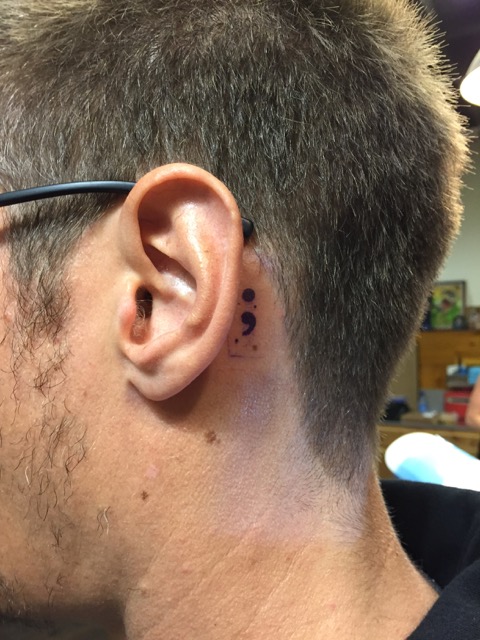
    Semicolon tattoo

    When I did my interview, I sat so that my interviewers were on my right-hand side. The people who interviewed me never saw that tattoo, until soon after I started in my new job. I wonder if they’d have hired me if they had seen the tattoo.

    Tattoos are actually uncommon amongst investment banking IT consultants. Certainly visible tattoos are even declared as not permitted, in many banks dress codes. I even thought about putting a sticking plaster over the mark on my skin, for my interview.

    However, that’s all I ever did for years and years. That’s our whole approach to mental health and the problems that people face in their private lives: put a sticking plaster over it.

    I’ve written at length about how angry I am that our first line of defence for people who are stressed out and depressed by their shitty unfulfilling office jobs, is to give them powerful psychoactive medications that artificially alter their mood so they can continue to work their dreadful jobs.

    I’m angry that I’m so pressurised by wider society to cover up my problems, in order to retain a blemish-free reputation. I feel like the need to appear pristine and infallible to potential employers, fellow work colleagues and bosses, is largely to blame for why I had a massive breakdown and implosion, instead of things getting fixed before they got out of hand.

    We are brainwashed to believe that we can’t have any gaps on our CV that we can’t explain. We are brainwashed to believe that we can’t take our foot off the gas pedal for a single second. We are brainwashed to believe that a stain on our reputation will hang around for the rest of our careers.

    You know what the problem is? It’s our fucking careers. The treadmill. The rat race. It’s making so many people mentally unwell, as well as causing physical health damage due to the sedentary nature of the work. No amount of standing desks or free gym membership is going to compensate for the problem.

    I backslid into office employment because it was easy and I was desperate. My back was against the wall, and it made perfect financial sense to go and suffer another stretch of agonising misery back doing the shit that I’m most qualified and experienced to do, but it’s fucking killing me.

    It’s important to be values-aligned, but it’s also so easy to be tempted by ‘easy’ money. The cash rewards for doing the kind of mind-bogglingly boring work that I do are substantial. In theory, I only have to do this work for short bursts, and then I have spare time and cash to do whatever I need to do to balance the books, psychologically. However, in practice, all I’m doing is servicing debts that were built up just staying alive.

    The welfare state took a dim view on my situation. Why do I need help, when I can go and get a job that pays fabulously well? Well, guess what? I tried it. I tried getting one of these shitty desk jobs that kill me, while I was homeless living in a hostel. And guess what? Working one of those jobs that made you unwell in the first place while you are still unwell really fucks you up.

    This whole exercise of blowing my existence and private life wide open serves to document the ridiculousness of the mental health destroying lives that we are forced to live. If this whole experience ends up killing me, at least I’ve left the evidence: the smoking gun.

    Nobody really cares when white middle class, well educated men in good jobs kill themselves. Why would they? Well, look around you. Do you see people getting happier? Do you see mental illness declining? Do you see suicide rates declining? Do you feel secure, fulfilled? Do you feel like the human condition is improving?

    I look around and I see war and I see poverty. I see ordinary British people being forced into zero hours contract minimum wage McJobs, and still unable to afford basic amenities. I see loneliness and depression. I see a lack of real local community. I see families pulled apart by the need to go to large urban centres to seek your fortune. I see people locked into their own little world: headphones plugged in, eyes cast downwards at their smartphone, not talking to anybody face to face except to ask for their morning coffee.

    Is this just a London thing? Is my view tainted because I’m struggling with depression myself? Actually, London is the canary in the coal mine. The sensitive people who have their head up looking around, sensing for danger, are usually on to something. Everything is pretty shit and fucked up right now.

    And so, I am rejecting the conventional. I’m rejecting the sensible, rational and tried-and-tested. I’m burning the bridges that lead back to places I should never return to.

    Yes, I might be making a fool of myself. Yes, people might be sniggering at me, safe behind their computer screens. Yes, important people are judging me and they have the ability to thwart me because of their prejudice, and make my life hard and even impossible. I could find myself unemployable, but not know why, because nobody has to tell me. I’m giving away all the ammunition you need to destroy me, and people are eagerly taking it.

    But you know, who’s the real winner? If you take what I gave you and use it against me, how are you going to feel? We’re all doing that. We’re all exploiting weaknesses that we discover in each other, in order to get ahead in the rat race.

    How do you win a rigged contest? If everybody is cheating, do you cheat too?

    The other option is to martyr yourself. For sure, you’ll be hated and excluded. Nobody will thank you. But at least you can sleep at night, in the gutter.
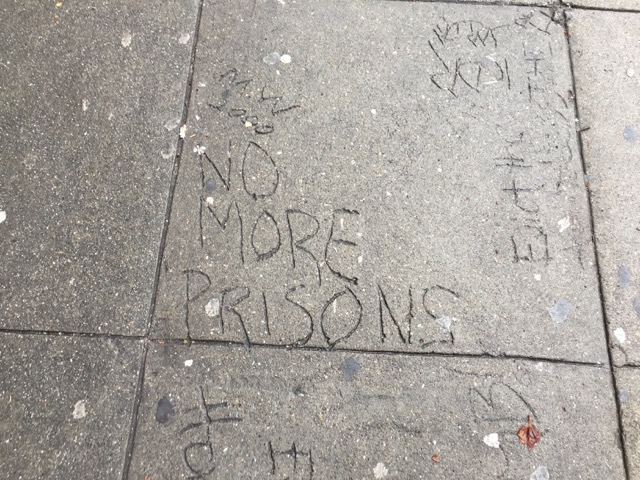
    No more prisons

    Prisons can mean anywhere you feel trapped and your liberty is restricted

    Tags:

  • Living Within Our Means

    This is a story about the rich:poor divide…

    Travel money

    Theresa May, the British prime minister, had the gall to lecture the poor on living within their means. In actual fact, the poor are working hard and just trying to keep up with the wealthy, who are racing ahead.

    If you look at the Instagram account called Rich Kids of Instagram you will see that it is extremely popular. ‘Reality’ TV shows that have followed mega-rich people like Ozzy Osborne and family, the Kardashians and the cast of Made in Chelsea, are some of the most viewed and talked about things on television. Wealth worship is everywhere, and is it wrong for people to feel that they deserve a little of the life that is rammed down their throats by the media?

    When we are talking about living within our means, this is coming from politicians who spend 6-figure sums of money each year on expenses alone, while also pocketing salaries that are many many times more than the average wage. The problem comes right from the top. The more that rich public figures splash their cash, the more the hypocrisy is insulting when they tell the poor to tighten their belts.

    How many people on council estates are driving Ferraris that they can’t afford the repayments on? How many hardworking families have ordered yachts that they now can’t afford to pay the remaining balance on?

    When we talk about living within our means, we are talking about people who are quite familiar with budgeting, make do and mending, and the general attitudes of postwar austerity. Really, when talking about living within our means, we should be talking to the banks, who recklessly endangered their financial stability by not living within their means in terms of their ability to maintain solvency. It’s the banks that are insufficiently capitalised and are excessively over-leveraged. It’s the banks that have lent many, many, many times more money than their reserves allow, in the pursuit of endless effortless profits.

    When a person borrows money, they intend to repay that money using hard work. The borrower will go to their job every day, and be productive. In return for a person’s hard work – productivity – they will receive their salary, with which they will buy the things that they need and repay their debts.

    When a banker lends money, they intend to profit for no labour at all. Through interest slavery, the banker will make money, simply because they already have money. Using the money multiplier – fractional reserve banking – the banker will in fact be able to lend the same money, over and over and over again, multiplying the amount of effortless interest that is earned each time.

    It is the banks who are not living within their means, nor being hardworking or productive in any way. It is the banks who have decimated global finances, and are now demanding that the hardworking people accept austerity, pay freezes, job insecurity, unemployment and low growth, simply because they overstretched themselves in pursuit of yet more effortless and labour free income for doing absolutely nothing.

    Let’s imagine that a banker, with zero money of his own, is paying a generous interest rate of 0.25% on deposits – exactly the same as the Bank of England. Using a fractional reserve of 5%, which is the minimum requirement for today’s stress-tests of banks, to make sure they’re adequately capitalised in the event of another credit crunch, that means the banker can multiply a £1,000 deposit into nearly £19,000 worth of loans. Obviously, the loans carry a hefty interest rate. Let’s imagine that the banker lends out the £19k as overdrafts, which often carry a 20% APR on the high street. In a year, the banker will now net nearly £4,000 of profit, for doing absolutely nothing, out of just a £1,000 deposit. That’s a 4 to 1 ratio! For every £1 deposited with Utter Bastard Bank Plc, they’re going to make nearly £4!!

    So, while the poor toil and tighten their belts, buying the cheapest groceries they can and cutting back on every expense, the banks are getting fat for doing absolutely nothing at all. Interest slavery is a con and a crime, and the perpetuation of this situation is the only reason why ordinary hardworking people are having to suffer NHS cuts, crowded public transport, packed classrooms, pay cuts, redundancies and every other economic penalty for the bankers’ failure to live within their means.

    Yes, we’d all like to make money while we sleep. Yes, we’d all like money for nothing. However, a bank is just utter bullshit. A bank is supposed to be an instrument to grease the wheels of commerce, not a massive leech, sucking so many pounds out of people’s pockets, for every penny they leave in their bank accounts.

    And, when you’re richer, the things that go wrong in your life are mere pocket change. Let’s look at a person who earns £20k, versus a banker who earns £200k, i.e. a 10 to 1 ratio:

    • Parking fine £50… costs the banker £5
    • Car breakdown £500… costs the banker £50
    • Need a new central heating boiler £3,000… costs the banker £300
    • Private school fees £12,000… costs the banker £1,200
    • Food £300… costs the banker £30
    • Holiday £700… costs the banker £70

    Imagine if your budget used the values that the banker pays. They’re a much smaller percentage of your income, aren’t they? Life would be a lot easier if everything cost 1/10th of what it does. Well, guess what, the banker pays exactly what you pay, except they earn 10 times as much, so the two things are equivalent.

    Everybody’s car breaks down from time to time. It’s a fact of life. In fact the shitty old unreliable banger that the poor family bought, is much more likely to break down than the brand new BMW that has a warranty, that the banker bought.

    Once you’ve got money, you can keep it and you can make some more. If you haven’t got any, no amount of living within your means is going to improve your situtation. It’s a con. It’s utter bullshit. It’s a swindle.

    When the banks in Italy start to fail, and cause a domino-like collapse of all the banks across the world in a re-run of the 2007/08 financial crisis, except much, much worse, it will become apparent that all of the suffering that ordinary people have gone through in order to rescue a deeply flawed banking system, was for nothing.

    I think people are going to be pretty angry when they realise that patronising idiots like Theresa May arrived in their positions of power by luck not good judgement. I think people are going to be pretty angry when they find out that the good times never stopped in the City of London, and pay rises and bonuses are just as big as they ever were, while all the hardworking ordinary people suffer the consequences of propping up a broken and corrupt system.

    It’s time to smash the system, and rip it out of the hands of a psychopathic elite who would have us starving and dirty, living on the streets, if it meant they could maintain their ill-gotten position of wealth, power and domination.

    What’s the difference between a successful banker and a struggling worker? Absolutely fuck all, apart from pure dumb luck, but those arrogant fucks don’t even realise how fucking hypocritical and patronising they are when they accuse other people of being underachievers, having been profligate and poorly mismanaged their finances, and having not worked hard enough.

    It incenses me, that a tiny handful have such unimaginable wealth, when so many billions live in abject poverty. Just 62 people have as much money as 3.6 billion others. There is so much that is wrong with that. Off with their fucking heads!


    Tags:

  • Never Be Grateful For A Job

    This is a story about profit…

    Sundial

    If you work in a free market capitalist economy, the company you work for is run for maximum profitability. In order to maximise profits, a company will have the fewest possible admin staff it can, to keep overheads low, whilst also having as many revenue generating staff members as the demand for the company’s products and services can support. There are no jobs that are created, solely for the benefit of the employee.

    Think about it: if you were to quit, the things that you do wouldn’t be getting done. If you’re in an administrative function, perhaps that means bills not getting paid, invoices not being issued or regulatory requirements not being met. Sooner or later your business is going to get shut down if it neglects its backoffice functions. If you’re in a sales function, that means less revenue for the business. Less revenue means less turnover, which lowers the company’s valuation, making it harder for them to raise money for expansion. Less revenue means lower profits, meaning less champagne at the shareholders’ annual meeting and tough questions asked of the board of directors.

    Your salary is a payment for your time. Your time is then used to enable the company to continue to trade, or to make it directly more profitable. Your salary is offset by profits. Your salary is not a gift, out of the kindness of the heart of your boss. Your salary is way less than the profit that somebody else will pocket, for your efforts. Your salary is a price worth paying because the things that you do while at work will generate more money than it costs to employ you.

    The business of employing people, is the process of getting somebody to do something instead of you doing it, but you get to keep a proportion of the fruits of their labour. The profit generated is many, many times more than the cost of the wages.

    And so, we have described the ragged trousered philanthropists. It is the workers who are generously donating the vast proportion of the fruits of their labour, to an idle wealthy elite who employ them. The wages of those who toil at the bottom of the pyramid scheme, are inadequate to pay for high quality housing, the education of their children and nutritious food. Instead, the people who pick your vegetables and build your houses, and generally give themselves arthritic joints, bad backs and knackered knees, are left with ill health and a pittance of a pension when they are so overworked that they can no longer remain in the workforce.

    But, we are told, you should count yourself lucky to have a job!

    Lucky? Lucky? Oh, how terribly fortunate that I have enabled members of the board of directors to buy another yacht, or to purchase another rare artwork to hang on the walls of their mansion. La-de-da, how lucky I am to have been able to plump up the trust funds and offshore bank balances of rich shareholders.

    But, there’s nothing to stop the likes of you or I from quitting our jobs, and starting our own companies, is there?

    Well, there are economies of scale and there are monopolies. Certain businesses will not be very profitable for the likes of you or I, because they have a low gross margin. When a company grows very large through acquisitions, swallowing up all of its competitors, it is better placed to capitalise on a market, because it’s a dominant player. Also, the cost of administrative, legal and tax obligations as percentage of the overall running costs, is much lower for the very large company, which makes it more profitable.

    When a company becomes very large indeed, it is even able to headquarter itself in a country with a favourable tax deal, so all the wealth that is generated by those ragged-trousered philanthropists, flows out of the country where they live and work, so even their public services become deprived of their vital cash.

    Yes, you must consider yourself lucky to be able to have grown your company so large that it is able to cheat even the government out of the taxes that would pay for higher quality housing, healthcare and eduction, that would at least be some recompense for the fact that you see such a tiny share of the profit that you generate.

    But don’t companies offer their staff share options, and bonuses? No. These schemes are just scams to buy your loyalty cheaply. Share options cost far less than offering an attractive salary that would keep you with the company. When you really look into how much money you’re going to make when you can finally exercise the options, you will see that your employer has bought your loyalty extremely cheaply.

    The pips have been squeezed too much, and the wealth has not been shared. Large companies have not made the societal contributions that we must all make – taxes – to prevent the ordinary workers from suffering a drop in living standards. Education, healthcare, public transport, housing: these things are all chronically underfunded, while the mega-rich are opulently wealthy, living in a totally different world from those who toil tirelessly to add yet more zeros onto obscene bank balances.

    It’s time to soak the rich, not be grateful for our jobs.


    Tags:

  • Biting The Hand That Feeds Me

    This is a story about ingratitude…

    Squirrel

    Why do I attack the industry that has suckled me? Why am I so angry and upset with the profession that has nurtured me? Why am I so ungrateful for my whopping big salary and cushy benefits?

    Administration: the unnecessary bureaucratic headache that creates unwelcome red tape, adds no value to the real economy and is an overhead that limits the productivity, innovation and creativity of those who are truly useful. I don’t work in the Information Technology business. I work in the business of administration.

    The two most productive things that I do in any given week are filling in my timesheet and submitting my invoice for payment. The most important thing that I do each quarter is to pay my Value-Added Tax (VAT) down to the precise penny that I owe. If I’m not perfectly on top of my bureaucratic administration, the Government will stop me doing my ‘real’ job, which is creating software.

    But what does the software I create do anyway? Most of it is just keeping score. It’s bean-counting software. It’s software that creates jobs for zillions of IT professionals like me, so that companies can get rid of zillions of administrators, that they immediately re-employ to make sure their IT professionals are filling in their timesheets correctly.

    For every person who I put out of a job, by automating the processes they perform, the company will then invent some other pointless position. Our whole economy is based on bullshit jobs.

    Should I be happy to have a job, and to count my blessings? Well, no. It’s immoral to not consider whether you are having a positive or a negative impact on society, and on the planet. To count my blessings is an incitement to be wilfully ignorant of global issues, and the betterment of humanity.

    So what am I doing instead, to align my values? How do I reconcile the rhetoric of what I preach with the obvious fact that I am enabling massive corporations to continue to ride roughshod over the human race and the fragile planet?

    Well, I take the money, and with it I pay my rent & bills. And then, I spend 90% of my time thinking about issues and writing this blog. I’m not paid to create software – so little of my time is actually spent doing that – instead, I’m paid to bite the hand that feeds me. It’s an inside job. I’m disruptive and cynical. I’m disillusioned and critical.

    Does that mean my colleagues have to work harder to make up for me slacking? No. It doesn’t work like that. If my boss asks me to do something, I won’t do it. I’ll wait to see if they ask me again. My boss isn’t going to ask somebody else to do it, because they’ve already asked me to do it. 9 times out of 10, I’ll never be asked again. The tenth time, I’ll realise that whatever was asked of me actually was important, so I’ll apologise and do the work.

    So, am I idle? Absolutely not. With the time I could have spent doing those 9 things that were clearly unnecessary, I will conduct a kind of audit. I will go around, looking to see if there’s anything more useful I could be doing. Invariably, there isn’t. Everybody is just so locked into a hierarchical system of managers, administrators & clerks, that nobody has looked at the bigger picture and realised that what they’re doing is absolute bullshit. Or if anybody has realised that their job is utter bullshit, they’re not talking about it.

    Now, I’m not talking about nurses, garbage collectors, train drivers, firemen. It’s pretty obvious what the useful function of many front-line workers is. However, these people are working all hours for some of the lowest wages. No manager needs to tell a nurse to help a patient who is in pain & discomfort. No administrative drone needs to make sure that a garbage collector is hitting their Key Performance Indicators and is going to achieve their annual objectives at their appraisal. Either the important job is done, or it isn’t.

    There are functions that literally nobody would miss, except maybe not being harassed by an army of micromanagers and bureaucrats. Isn’t it the case that you’re propping up a sick and twisted system, by continuing to count your blessings and not rock the boat?

    I frankly find it disgusting that I’m paid so many more times more than what a nurse gets paid. If I was to simply sit back and “think positive” and try to enjoy my ill-gotten gains, doesn’t that make me a terrible, terrible person?

    It’s probably true that the world doesn’t need any more bloggers, but what am I supposed to do? Impoverish myself and retrain as yet another disrespected front-line worker? It’s hardly like they’re being heard today, is it? How are the social wrongs ever going to be righted?

    It seems to me that the right thing to do is to speak up. Yes, I jeopardise my lucrative career in doing so, but it’s the right thing to do. People are more likely to listen to an IT consultant from the banking world, who is critical of the sector that pays me handsomely, than they are to somebody who could easily be dismissed as simply “jealous” or “not smart enough” to land themselves a similar job.

    Truly, I do not think that front line workers are not smart enough to do my job. In actual fact, you have to be pretty dumb to be able to turn a blind eye to the social injustice of being highly paid to be an idle manager of hardworking people who do the real jobs.

    I currently have no cash to put my money where my mouth is. Quitting my job would literally see me homeless and destitute again. However, I do anticipate a time when I will be faced with a true test of my morality: when I am able, will I quit the rat race and try to do something that is more in line with my values?

    I have massively impoverished myself, trying to take an ethical stance, and I would do it again. It’s the right thing to do.


    Tags:

  • Usury & Breaking the Interest Slavery

    This is a story about the debt spiral…

    Banks

    When the burden of debt in society is too great, and lenders are unwilling to forgive – to take a debt haircut or even write off debts – then there will be popular uprisings.

    It’s not that people don’t want to repay their debts. In fact, most people accept that debt is a necessary evil in order to get the things they need when they need them, rather than towards the end of their life, in senile old age and infirmity.

    And so, we become burdened with a mortgage, in order to give our family a stable roof over their heads. We become burdened with a car on hire purchase, so that we have a reliable and safe modern vehicle to be able to take the kids to school, and to get us to work without breaking down. We put our holidays and special occasions on credit cards, and pay back the debt when we get back, or after the festivities are over.

    Most people diligently repay their debts.

    In free-market economics, prices are able to fluctuate to find the point where affordability meets maximum profit. Do you think the cost price to the producer or supplier of the goods and services that you purchase, bears any relation to the retail price that you pay? Of course not. That’s why a designer brand T-shirt costs at least 10 times as much as an unbranded garment, even though they come from the same sweatshop in the developing world.

    In our consumer society, you are ‘free’ to select the goods and services that you want. However, in order to fit in with your buddies who are in a similar socioeconomic group to you, you will select the brands that they do. If you’re rich, you’ll do your supermarket shopping at Waitrose. If you’re poor, you’ll do your shopping at Asda/Walmart. However, the food you buy will have similar calorific content.

    The brands become better and better at pricing their products so that you are just about able to buy everything you need, but won’t have much spare cash left over. The brands know the income bracket that they’re targeting, so they know the level where their consumers will become price insensitive. I literally don’t care whether my coffee costs £2 or £4. If my coffee cost £5, then I’d think “blimey! that was expensive, I’m not going to go there again” but the £2 coffee shop could literally increase their prices 100% and I wouldn’t even notice.

    Once everybody has maxed out their budget, on the mortgage, the car finance, the credit cards, the overdraft, the store cards and some personal loans, where do you really go from there?

    We demand that our corporations make increasing profits, but yet in order to do so they must hold down wage inflation and the cost of raw materials. We demand that our economy grows, but in order to do so, people must use increasing amounts of their limited pot of disposable income to drive consumption. What happens when everybody is just maxed out?

    We’re living in the age of low growth, high borrowing and low wage inflation. In order to sustain corporate profits, the cost of goods & services continues to increase. In order to prop up the capital growth of the pension funds, asset prices – such as house prices – have continued to be overvalued. However, the only way that the general population have been able to maintain their standard of living is through borrowing.

    Ordinary people have not been profligate and stupid. People were promised pay rises and promotions, and instead they’ve been given job insecurity and wage cuts in real terms. If your wage increases just a few percent, but the cost of your housing, bills, food and transportation all increase in double-digit terms, then you’re actually getting poorer.

    If the headline rate of inflation – which is pretty much just concerned with wages – is low, then the value of your loans & mortgages is not getting inflated away. The baby boomers might complain about interest rates reaching over 15% in the late 1970s, but they forget that their wages were also increasing too. By the time the 1980s came around, people’s mortgages were a tiny fraction of what they were earning.

    What we see today is people’s cost of living skyrocketing, but their wages are the same, which means they’re earning less and less in real terms. If your wages stay the same, and your cost of living is increasing, that means you have less and less money to service your debts. So, you tighten your belt and cut back on your consumer spending, which in turn hurts an economy that is so dependent on spend, spend, spend!

    What we see today is far worse than the Japanese stagflation that meant that the price of goods and services was getting cheaper, which encouraged people to become thrifty because they could buy things more cheaply if they waited. Instead, what we are seeing is people who have been promised growth, completely screwed over by a system that robs them of their wealth with no opportunity to do anything about it.

    In a zero growth world, debts need to be forgiven or else ordinary people will become so unhappy that they will overthrow their idle creditors.


    Tags:

  • Credit Default Swaps

    This is a story about worthless paper…

    Sunken boat

    Do you want to know how to make an infinite amount of money? First, you should obtain a boat. Then, take out as many insurance policies as you can afford the premiums of, on the boat. Then, sink the boat and claim on the insurance policies.

    Why can’t you do this? Well, because it’s illegal to insure something more than once, for the very reason that it creates a financial incentive to go around sinking boats. People respond to economic incentives.

    However, it is possible to take out as many life insurance policies as you want. The reason being, that it is assumed that because murder is illegal and suicide used to be (now it’s decriminalised) then there is some protection from those who wish to profit from death.

    But what about a company? Is a company a person-like entity? Should it be possible to buy life insurance policies for a company?

    What is a Credit Default Swap? Well, the simplest explanation is that it’s a life insurance policy for a company. If a company gets into a financially distressed situation where it can no longer repay its debts, then the Credit Default Swap will pay out. This is called a credit event. Basically, a credit event normally means the company is dying, because they can’t pay their debts. A company that defaults on its debts is never going to be able to refinance themselves after a credit event, because their credit rating will be junk. Game over.

    So, if you allow people to take out an infinite amount of Credit Default Swaps, betting that a company is going to go bust, aren’t you economically incentivising that event to happen? If there’s a bigger and bigger pool of money that is hoping that a company goes bankrupt, that is far bigger than the pool of money who want to see the company rescued, isn’t the market going to quite naturally want to push that company under, so that almost everybody gets a big payday?

    We know that markets can be manipulated, and because Credit Default Swaps are an Over-The-Counter (OTC) product, there is no market regulation. It’s not possible to know who is dealing in these financial instruments, and who stands to benefit. They’re kind of ideal for insider trading, because they just don’t have the same kind of traceability of equities that are traded on stock exchanges.

    The other un-nerving thing about Credit Default Swaps, is that there is no underwriter, and no need to prove that you have sufficient collateral to cover the paper that you have printed. It’s possible for organisations to sell vast quantities of Credit Default Swaps, and have nowhere near enough money to cover the losses if the credit events happen.

    In the insurance market of Lloyds, there are wealthy names who provide the collateral – cash, precious metals, priceless artworks, property, liquid assets (like shares) etc. etc. – to make sure that the money is there in the event of an earthquake, flood, fire or whatever massive disaster might affect the insurance industry in a major way.

    However, in the derivatives market, only the mature products like Futures and Options would have margin calls and require collateral to make sure that losses never exceed one counterparty’s ability to pay. Credit Default Swaps have been allowed to be printed completely without regulation, which is concerned with making sure that a credit event wouldn’t totally wipe out the risk holders.

    Some measures put the Credit Default Swaps market at about $16 trillion, however, when all the contracts were entered into the Depository Trust and Clearing Corporation’s central system in 2008, the aggregate notional value of the contracts was closer to $2 quadrillion ($1,700,000,000,000,000). That’s a shit tonne of worthless paper.

    But is it worthless? Well, when the collapse of Lehman Brothers triggered a credit event, the money that was demanded by those looking to cash in their Credit Default Swaps would have brought down massive companies like AIG as well as putting a deadly dent in the balance sheet of just about every investment bank with a proprietary trading desk (i.e. all of them) who had been foolishly dabbling with these stupid contracts.

    Why stupid? Well, the whole idea of being able to make unlimited bets against a company is market manipulating beyond belief. Who’s going to recapitalise a company and save it, when you can bet against it in secret instead? Why wouldn’t anybody who gets the vaguest whiff of a company in financial trouble not rush off and place large untraceable wagers that it’s going to fail?

    Naked short selling is pretty bad, but there’s only a certain amount of leverage that you can get, and you have to have the collateral to cover your exposure to the risk that the market might go against you. When you’re talking about naked Credit Default Swaps, you’re looking at the ability to get leverage of thousands of times the amount of money you’re actually risking. That kind of potential profit has the ability to move the market, and collapse a company.

    It’s a simple moral question: if companies are like people, and therefore allowed to be ‘life insured‘, should we be allowed to murder them so that we can cash in on their death?


    Tags:

  • Too Big to Jail

    This is a story about ethics…

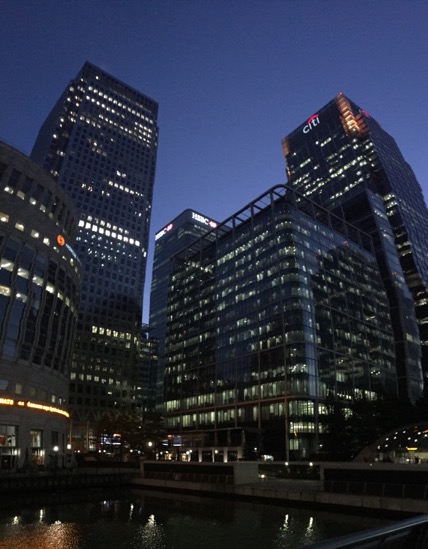
    8 Canada Square

    Imagine if you or I got caught laundering the best part of a billion dollars worth of drug money. We’d get sent to jail for a very long time, right? What if a bank got caught doing it, and there was so much evidence that there was clearly a case for criminal wrongdoing that could be prosecuted? Well, maybe you’d get given a chance to get rid of some of your dodgy customers, and nobody would go to jail. Does that sound fair?

    Let’s think about the financial crisis of 2007/08, when reckless trading meant that the whole banking sector had to be bailed out, causing austerity for ordinary hardworking people. The people who have paid the highest price – with lower wages, job insecurity and cutbacks for frontline services – would never be able to go begging for interest free loans if they behaved so irresponsibly.

    Bankruptcy is not a criminal offence. It’s OK for a private citizen to run up huge debts, find out they could never hope to possibly repay their creditors, and declare bankruptcy. You don’t go to jail for bankruptcy.

    So, arguably, what the banks did in 2007/08 wasn’t that bad. It wasn’t criminal. They had their risk underwritten by governments, so why wouldn’t they take huge risks with public money? They were economically incentivised to take those risks, because the precedent of the “too big to fail” bailouts meant that there was no downside risk.

    But what about money laundering? What about facilitating payments for drug gangs, dealers, traffickers? If you or I were involved in any of that as a private citizen, the courts would throw the book at us. They’d lock us up and throw away the key. It’s criminal.

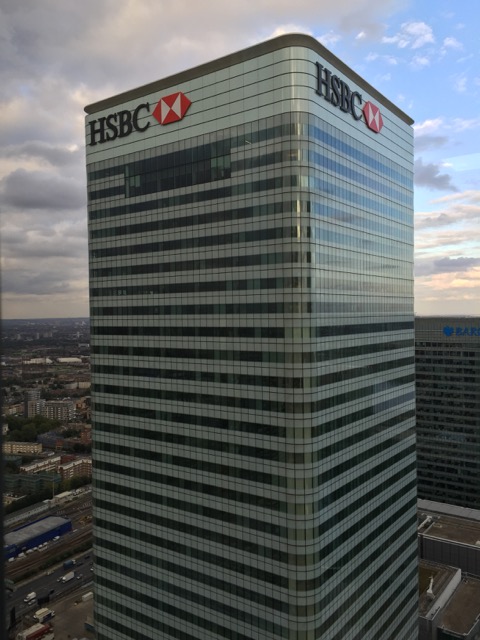
    So, what about the banks? If the biggest bank in Europe – HSBC – was well known to authorities for helping a couple of major drug gangs to launder the best part of a billion dollars in dirty money, wouldn’t that be criminal too? Wouldn’t people go to jail?

    Well, no. Enter the concept of “too big to jail“. Just like the financial bailouts that the banks received, banks can also receive Deferred Prosecution Agreements. That is to say, even though you got caught doing criminal stuff, you’ll get let off so long as you take some steps to stop doing it in future.

    And how long would you have to get rid of your dodgy customers? Well, say the US Department of Justice were thinking about prosecuting you in 2012, you might still be botching the IT project that is apparently ‘essential’ to get rid of your dodgy customers 4 years later… in 2016.

    How much do HSBC really know about their customers anyway? Well, from their electronic records that they already have on file, they know about 6% of what they need to know. So basically, they don’t know 94% of what they need to know.

    Now, you might not be an IT project management expert, but you’d have thought that it’s more important to find out the missing 94% of what you don’t know, than even to bother with the 6% that you do know. Sure, it’s pretty embarrassing to have to ask your customers where they live again, but what you really need to know is this: where did you get your fucking money?

    In Customer Due Diligence terms, this is called Source of Wealth. You might have inherited the money (legit), you might have won the lottery (legit), you might have sold a priceless artwork (legit) and you might have trafficked vast quantities of illegal narcotics (not legit). Basically, HSBC had 4 years to ask all their customers “is your source of wealth drug money?“. Did they manage this? No.

    I’m quite spectacularly offended by just how badly they botched a simple project to ask all their customers to fess up: are you in the illegal drugs business?

    Sure, it’s true that HSBC had to cough up a couple of billion dollars in fines, but for them that’s just the cost of doing business. Their profitability was barely affected.

    Arguments were made to the US to defer prosecution, and to allow HSBC to keep its banking charter and continue to do business in the United States. These arguments were made on the basis of maintaining stability in the financial markets. The Deferred Prosecution Agreement came with stringent terms, that a court would appoint a Monitor to make sure that HSBC actually cleaned up their act. I can tell you now, Michael Cherkasky, that the project to clean up HSBC’s customer base was a total sham. A shambolic waste of time & money, mismanaged to the point that the whole thing was laughable.

    Do you think that message that is sent to “too big to fail” organisations, that they’re above the law and they can never go bankrupt because they’ll always be bailed out, is looking like the right one, today, now, in 2016?

    The argument that has been made is that we need to prop up the share prices so that the pension funds are protected, and we need to maintain financial stability. Isn’t that just utter bullshit, in the face of austerity and extreme volatility in the markets? We’ve had round after round of Quantitative Easing (QE) and other attempts to breathe life into markets that have lost their minds. There is nothing at all rational or efficient about the global markets that we see today.

    And to round it all off, it’s corrupt as hell. To allow banks to ride roughshod over the rule of law is the final step in handing over the nations of the world to the multinational corporations who have driven us into a position of financial ruin, much to the pain of the vast majority of ordinary working people. It stinks of the worst corruption ever perpetrated on Western civilisation, does it not?

    Somebody has to call time on the lack of ethics and accountability for the too big to fail organisations, and their board members who are too big to jail.

    When we allow the likes of Stuart Gulliver to be the CEO of HSBC, when he doesn’t even keep his wealth in the bank he manages, but instead keeps it hidden in the Cayman Islands and Switzerland, clearly we have corruption right from the top down.

    David Cameron, outgoing Prime Minister of the United Kingdom said, as recently as April, that “[I] can’t point to every source of every bit of [my] money” but yet we would have the likes of you or I have to prove that our filthy lucre was not ill-gotten gains from some criminal enterprise. The corruption comes from the very top of both Government and organisations. It stinks.

    Who is going to grasp the nettle and hold Government and large enterprise to account for having run us into economic ruin, while busily siphoning wealth offshore?

    There needs to be accountability. There needs to be jail time for corrupt executives and government ministers.


    Tags:

  • Doomsday

    This is a story about premonitions…

    Plane crash

    Our perception of reality is subjective, and it is coloured by our state of mind. I’m deeply depressed, so I tend to see everything as negative, hostile, and doomed to failure.

    Yesterday, I was writing a piece about how I thought the markets had over-corrected, and how I expected to see another rout in the FX and equities markets, of Sterling and the FTSE. Little did I know, that as I was writing, a terrorist attack was occurring in Istanbul, Turkey.

    When your mental health is suffering, sometimes you can start making too many connections, seeing too many co-incidences. Last year I started to misinterpret events as significant in my life somehow. I started to feel overly connected to things happening around me – because I was unwell – and thought I was at the epicentre of a seismic event again, like during the Credit Crunch, when I felt at the very heart of the derivatives market and Credit Default Swaps, with JPMorgan.

    Michael Cherkasky, the monitor from the US Department of Justice, still isn’t happy with HSBC’s customer due diligence, but nobody seems to give a shit. The share price might have dropped almost 20%, but so far as I know, nobody’s going to prison for not warning the shareholders, which would be a violation of the Sarbanes-Oxley Act, which has tried to force public corporations to be honest and open when things are going wrong.

    The thing is, the show must go on, and everybody has a vested interest to some extent. Bear Stearns couldn’t fail, because the markets were already spooked by Lehman Brothers. Greece couldn’t default, because the entire stability of the European single currency and the stability of global markets was at stake.

    Even now, with Britain prompting a disorderly rush for the door, and the potential for systemic collapse, as a domino-like chain of events is set off, we are still seeing a surprising amount of stability.

    Market economics is supposed to weed out the weak and the reckless. The companies and governments that have gone beyond their means are supposed to be punished by the market, but actually what we have all demanded is stability, not a free market.

    Really, Bear Stearns should have been allowed to fail, AIG should not have been bailed out, Greece should have been allowed to default on its debts, the UK should be allowed to precipitate the collapse of the Eurozone and the inevitable failure of the Euro and debt defaults across Southern Europe.

    What people seem to be voting for is the free market that we supposedly have. Where would we be, if we had bitten the bullet in 2007/2008 and not simply propped everything up? Aren’t we going to have to suffer a global recession that is many, many times worse than it might have been if we’d allowed reckless companies and governments to fail earlier?

    However, the politicians and the banks believe that they’ve been tasked with economic stability. Certainly, the Bank of England’s brief is to try and maintain inflation in a certain range. It certainly runs contrary to our Keynesian understanding of economics, when central banks are actually used to prop everything up, to maintain the status quo.

    Gordon Brown famously declared that we had seen the end of boom & bust, but haven’t we simply made a farce of the idea that debts ever have to be repaid, and there isn’t an endless supply of money?

    Civilisations normally fall when the burden of debt is unmanageable, but creditors refuse to forgive debts.

    The world needs to deleverage, to have a debt haircut, for debts to be forgiven. The system has failed. There’s no moral hazard. Everything is too big to fail. There is no market economics anymore.

    I think that what people want is either inflation, to inflate away their debts, or debt forgiveness, because they are over-burdened with huge mortgages, student loans etc. etc. People feel that they’ve been hurt in the pocket, and they really don’t care about the stability of stock portfolios and the value of Sterling.

    I see the Brexit decision as almost a vote to accept a devaluation, in the hope of stoking up domestic inflation. It’s a vote to accept volatility and chaos in the financial markets, that we supposedly wanted to avoid during the Credit Crunch, but people were never asked if they were OK with a whole heap of bad banks going bankrupt.

    Yes, people are probably naïve about how upset they’d be about their life savings being wiped out, and having to use a barrowload of pound notes to pay for a loaf of bread, but perhaps it’s better than their lives of quiet desperation, while the rich get richer and the poor get poorer?

    I’m incredibly impressed to see stability in the markets today, but I don’t think that’s what anybody wants. People are looking for a shake-up in the pecking order. People are rocking the boat, because they’re unhappy, and they literally don’t care about the global economic impact and systemic risk. Perhaps propping it all up, and forcing a very long period of austerity onto everybody wasn’t such a smart move.

    The next question is: how far are the wealthy prepared to go, in order to get their pound of flesh?


    Tags:

  • Black Wednesday

    This is a story about volatility…

    Lights out

    Most people don’t like Mondays. I don’t like Wednesdays. I refer to them in my own mind as “whacky Wednesdays” and try and make a mental note not to be travelling anywhere on that midweek hump day. The world always seems to be going bezerk on a Wednesday.

    I woke up early this morning to check what the Nikkei – the top 225 shares traded on Tokyo’s stock market – was trading at. Money has to go somewhere. When money takes flight, it can run to save-haven currencies, like the Swiss Franc, or it can flow into to other global markets: heading East or West in a follow-the-sun tidal wave. 3 trillion dollars are currently on the move.

    Capital can move into scarce commodities like gold when stuff is really turning sour, like it did in the lead-up to the credit crunch. Finally, there are the bond and gilt markets, for the mugs who believe in the power of governments and corporations. Built on top of all these securities are quadrillions of dollars worth of derivatives, but it’s very hard to get any sense of what the value of these ‘assets‘ are, and where they’re held.

    Derivatives are a bet on an underlying security’s value. Futures and options are the classic instruments, that allow you to bet that the share price of a company is going to rise or plummet more than the market expects.

    The thing about placing a bet is that it manipulates the market. George Soros was famously given so much leverage by the investment banks backing him, that he was able to exhaust Britain’s foreign currency reserves and force the UK out of the European Exchange Rate Mechanism, causing the value of Sterling to plummet.

    Laughably, people were able to speculate on the outcome of the EU referendum in very much the same way… including George Soros! The amount of commission earned by investment banks on trades last Friday will pay for some pretty good bonuses this year, I expect. The result of the referendum was obvious: speculators had placed such big bets that there was a vested interest in the result.

    When a jockey jumps off a horse, or a goalkeeper throws a game, are we surprised? An entire baseball team fixed the world series, for fucks sake. It’s basic economics: people respond to financial incentives.

    If you want to know what’s going to happen, just follow the money.

    Vast sums of money flooded out of Kuwait before Saddam’s invasion. Loose lips sink ships, but loose lips also make the whole capitalist system go round. How do you think hedge funds know what to bet on? They’ve got a fucktonne of bent lawyers, who tell them what’s happening with every merger & acquisition… that’s how!

    You can somewhat regulate share dealing: it’s obvious when somebody has bought or sold a big stake in a company. But with spread betting, derivatives and FX, there’s no record of who was clearly ‘insider dealing‘.

    Opinion polls and equity markets mean jack squat. If you want to know what’s going to happen in the global markets, have a look at which way the betting is going.

    When it comes to bookmaking, the favourite is the one that’s likely to win, right? Well, err, not exactly. A bookmaker’s job is to price things according to sentiment not probability. If you want to sell anything, it has to be at an attractive price to your buyer.

    So, when we came close to the referendum, there were very generous odds on backing Brexit. What does that say to me and George Soros? We’re both speculators. Neither of us hold a position. We’ve got a big purse of money, and we’re going to back a particular outcome, and the bookmakers have baited their hook, looking for a buyer with deep pockets.

    In a year where the 5,000 to 1 shot, Leicester, win the Premier League, surely people could see that the generous odds were pointing to something? In a 1 in 20 horse race, odds of 1 in 5,000 are generous. In a 2 horse race, the odds that we would remain in the EU peaked at 86%. Don’t you feel just a little dumb, if you think that everybody is playing fair? There’s so much money at stake, why would they?

    Why do the rich keep getting richer, and the poor keep getting poorer?

    Well… the game is rigged you stupid c**ts. From sharp-elbowed parents getting their kids the best places in school, to executives making sure they get a big pay-rise and bonus while holding down the wage inflation of their underlings. This isn’t some illuminati conspiracy-theory bullshit. The hard data is right there in front of your eyes.

    So, tomorrow, your pension fund gets trimmed still further and your currency takes another hammering. More wealth leaves your pocket and enters the pockets of the guys who know what’s going to happen next before it’s even happened, because money talks.

    I also fear that there is going to be some terrible event soon, because of the forces of hell that have been unleashed by this jingoistic rhetoric, hateful language and right-wing empowerment. I have this feeling of dread that a mosque is going to be desecrated, or another person like Omar Mateen or Thomas Mair is going to commit an atrocity. The tinderbox of hatred has been set alight by those who seek to profit from instability and volatility.

    Anybody who thinks that bankers are suffering from the Brexit vote is an idiot. The markets love volatility, and trading floors are making a killing.

    Tomorrow is business as usual in the City and with the hedge funds, and the idiotic British public have played into the hands of speculators like George Soros spectacularly, yet again.


    Tags:

  • Winners

    This is a story about body shopping…

    IT Contractor

    What’s the difference between a temp, a freelancer, a self-employed person, a contractor and a consultant? What’s the difference between an employee and an entrepreneur?

    Last year I was working for HSBC, along with a bunch of nice folks from several different consultancies, plus a handful of permanent members of staff. The teamwork was brilliant, but the surprising thing was that we all had different agendas.

    Given that I had gone back to HSBC as a contractor, having been a permanent member of staff there for over 4 years, it was somewhat of a mindset change. I was also homeless and still very much in the vice-like grip of drug addiction, which wasn’t a good start.

    I was exhausted, and I had somewhat induced within myself, some fairly major symptoms of mental illness, which caused me to make some rather outlandish interpretations of the reality I experienced.

    Imagine being plucked from the park, where you are living and contemplating bankruptcy and the coffin nail that will drive into your career, your business. Imagine facing up to the reality that everything you’re qualified and experienced to do, since you started IT contracting at age 20, is now going to go down the shitter, and you’re homeless, abandoned by the state – the council have sent you a one-line email saying that you’re not even worth a hostel bed to them.

    Then, imagine that almost overnight, you’re working on the number one project for the biggest bank in Europe. You’re so exhausted that you are sleeping in the toilet. Everything seems surreal, from the moment you put on your suit in the morning in a hostel dormitory paid for with a credit card you can’t afford to pay off, to the moment you turn up in the headquarters of a prestigious Tier 1 bank that you used to work for, when you were clean, sober, young, happy, ambitious, energetic, enthusiastic and respected.

    The challenge was to get through 60 days of working, without running out of credit completely. I had to get to work every day and pay for my hostel bed, for a whole month before I could submit my first invoice, which would be paid 30 days later. Obviously, it also looks rather unusual to your colleagues if you can’t afford to eat lunch or socialise. The pressure was immense.

    What does a poker player do, if they have a weak hand? They bluff, obviously.

    To compensate for my fear, and the odds that were stacked against me, I turned the dial up to 11. I tried hard. Far, far too hard. I told the team that I’d take responsibility for a critical piece of work, and deliver it in a short space of time, along with an extremely capable colleague, who actually knew that it was a monster piece of work.

    I should have been laughed out of the door. I can’t believe that nobody particularly picked up on the fact that I was shooting from the hip, out of a combination of fear, exhaustion, drug withdrawal, mental illness and a touch of arrogance.

    How on earth was my ego not going to be stoked? I had just cheated death, bankruptcy, destitution, and now I had the CIO of the number one project in the biggest bank in Europe surprising me, by naming me in person, as the team member responsible for one of the pivotal pieces of the program, in front of the entire town hall. I looked around – “is he talking about me?” – yes, it appeared he was. How surreal.

    First day

    As a drug addicted homeless person, you’re kind of invisible. People would like it if you just crawled into some dark hole and died, quietly. You’re nobody’s problem but your own, and everybody pretends not to notice you, as you drag your bags through the street, swatting at invisible flies and talking to yourself incomprehensibly.

    Suddenly, people not only seem to value you, listen to you, but also look to you for some kind of professional guidance, leadership. Is this the state that important IT projects have reached, where the hobo junkie is the one calling the shots? I realise that I wasn’t actually calling the shots, but that’s what it feels like when you’ve been scraped up from the pavement, stuffed into a suit and now you’re working in a fancy office full of glass, steel and granite.

    It embarrasses me, but also pleases me that I’m still on good terms with a few respected colleagues, and they can tease me about “the time when you said you were going to deliver X by Y“. However, not everything I said was worthless tosh.

    This is where the difference in mindsets comes in.

    As a permanent member of staff, your best shot of getting pay rises and promotions is to raise your profile. Given an hour to do some work, you might as well spend 50 minutes writing an email about what a brilliant person you are and how clever you are, and 10 minutes actually doing some work, rather than the other way around. People who just knuckle down and get on with the work they’re supposed to be doing, tend to be overlooked when it comes to the end of year review.

    As a contractor, you’re all about contract renewals. When your contract is coming up towards its end, you’re on best behaviour. You try to shine and make yourself a key-man dependency, so that you can demand a big rate increase, because you’re indispensable. Personally though, I hate making myself a key-man dependency. It’s unprofessional, however you are economically incentivised to do it, so many contractors dig themselves into little fiefdoms.

    As a consultant however, you have the worst of both worlds. You have to kiss the arse of both the client and your consultancy. There’s a huge conflict of interests. The consultancy want you to stay on your placement, and for as many headcount as possible to be working with you on the client project, if you’re working time & materials. What exactly is consulting about being a disguised employee? Where is the value-add from the consultancy, when the client wants you to be embedded in their organisation, like a permanent member of staff?

    Hospital discharge

    The reasons for using consultancy staff, contractors, temps, freelancers, is that you can get rid of them when the project is done. However, the other reason is that you don’t have all the headache of having to performance manage underperforming and difficult staff members out of your organisation. In theory, it’s a lot easier to hire & fire… with the firing being the desirable bit.

    It used to be the case that you could get a job as an IT contractor with just a 20 minute phone interview and start the next day. If you were shit, you’d just be terminated on the spot. Never happened to me, but that was the deal you struck… you’d be on immediate notice for the first week. Then you’d be on a week’s notice. Then you’d be on 4 weeks notice, just like a permie. However, I always used to get my contract renewed, because I know how to play the game, kiss ass and keep my lip buttoned at the right time.

    So, what happened? Well, stress, money, recovery from addiction, relapse, housing stresses and everything in-between conspired in my private life to mean that I was living life by the seat of my pants. I was running for my life.

    After only a week in the new job, I decided that it was an impossible mountain to climb, and that there was no way that I could live in a large hostel dormitory and work on a stressful project, plus get myself clean from drugs, plus dig myself out of near-certain bankruptcy. There were just too many problems to face, working full-time in a crisply laundered shirt and a nice suit, while hiding the crippling problems in my private life.

    You can’t just go to your boss and say “I’m sorry I didn’t mention this before, but I’m a homeless recovering drug addict, who suffers mental health problems at times of extreme stress and exhaustion, and I’m practically bankrupt as well as barely able to keep myself clean, sane, out of hospital and off the streets“. Contracting doesn’t work like that. Your personal life is nobody’s problem but your own… you’ve signed that deal with the devil. You get paid more, but you’re also expected to not get sick and not bring your personal problems with you to the office.

    I disappeared on my second week in the job, getting mixed up with the police, thrown out of the hostel where I was living, and ending up in hospital, as the pressure was simply too much to bear, I thought that my lifeline was pretty much spent. The odds of being able to get off the streets were too slim anyway. It couldn’t be done. I gave up, and relapsed.

    Do you think you can just pick up the phone and say “errr, yeah, I need two weeks off to sleep, an advance of several thousand pounds, and I’d like to come back to work part-time for a little while until I’m up to full strength, because I’ve been dragging bags all over London, living in parks and on heathland, in and out of hospitals, rehabs and crisis houses, addicted to some deadly shit and battling mental health problems. It seems silly that I didn’t mention this at the interview, as I’m sure you would have been just fine with giving me an opportunity to get myself off the street and back into the land of the living“?

    Office backpack

    You know what though? I did get a second chance. There’s no denying that certain allowances were made for me. A blind eye was turned to the fact that I was basically either shouting at people or nodding off in meetings for the first week. I went AWOL twice. Once for a whole week where I basically decided that everything was f**ked and there was no way I could ever make things work, and once for nearly a whole day, when I was swept up in the euphoria of working with nice people and got paralytically drunk with my colleagues and couldn’t face telling my boss that I was sick again.

    Through my divorce, I lost heaps of friends who were shared with me and the ex. I decided to move back to London, because I knew I could find lots of work. However most of my London friends had moved out of town, in order to start a family. Also, you don’t make many friends when you’re living in a park sniffing supercrack, and getting hospitalised for 14 weeks a year. I can tell you more about the private life of a friendly police officer that I know, than I can tell you about some other acquaintances from that turbulent period.

    Anyway, I was desperately trying to cement things – get my own flat, get some money in the bank, get into a working pattern that was sustainable – but it was too much to ask. ‘Friends’ sensed that I was recovering, and decided to come asking for favours : lend me some money, let me live with you, give me a job etc. etc.

    When you’re desperately lonely, because you’ve split up with the two loves of your life – your wife, and supercrack – you’re vulnerable to wanting to people-please. I risked my reputation, when I got a so-called friend an interview, because he pressured me. I overstretched myself, renting a flat that swallowed up all my money, which was my safety net. I didn’t even pick my flat… my friend did, and he thought he was going to get to live there rent free. I put up with a lot of shit, because I was desperate for friends, for acceptance, to be liked.

    If you think all this can be boiled down to a ‘drug problem‘ you’re wrong. In order for a person to feel whole, they need friends, they need a job, they need a place to live, they need to feel that they’re living independently : paying the rent, earning their money, able to pay for the essentials of life, and not always just hustling, on the run.

    There are quite a lot of pieces to the puzzle that is a complete life that’s worth living. Do you really think I just want to be kept alive, in a straightjacket in a padded cell. Is it unreasonable to want to work, to want to feel like I’m making a contribution, to want to feel like I’m liked, loved, to want to feel like I exist, and that I’m valued somewhere, by somebody?

    I loved the instant social connection I had with the “winners” who were a group of fellow consultants at HSBC. There was good camaraderie, and they were young and enthusiastic, not bitter and jaded like me. Their enthusiasm for their job and inclusive social circle was exactly what I needed, along with cold, hard cash, and a place to go every day that wasn’t a bush in a park, with a wrap of supercrack.

    Rarrrr

    Somewhat unwittingly – although I don’t know how much people were able to guess or find out behind my back – the Winners bootstrapped my life. Even though there were the usual commercial rules of the game, about being a disposable contractor who’s supposed to keep their mouth shut and not rock the boat, there was still bucketloads of humanity there. People were kind to me. They invited me into their lives, and in doing so, they saved mine.

    When a colleague texted me while I was in California, to say that we had to go back to work doing the shittiest possible work for a scrum manager we didn’t have a whole heap of respect for, it was pretty clear that it wasn’t sustainable. I busted my balls to get cleaned up, off the streets, into a flat of my own and to restabilise my finances. However, I’ve never been the best at buttoning my lip and allowing myself to be ‘managed‘ by somebody I have barely concealed contempt for.

    I knew that all I had to do to get my contract terminated was to send one or two fairly outspoken emails to the project’s management team who were insecure and relatively incompetent. They’d actually started to listen and change things though, so there was no purpose to the emails I sent, other than to try and elicit an email saying “don’t bother coming back to work” so that I could spend some more time with my friends in San Francisco.

    The pressure of having to try and cement the gains that I had made, while still carrying some of the burdens that had been accumulated, was too much. I was in no position to be the responsible guy, picking up the phone every time things went wrong and having to mop up messes. I was in no position to be paying 100% of my rent, with a lazy flatmate who shared none of the risk and none of the financial burden or responsibility for making sure the bills got paid and the household ran smoothly. I was in no position to face months and months more, working at the kind of breakneck pace that was inevitable on a project that I had been forced to take out of desperation.

    I had done far too many 12 or 14 hour days. I was on email around the clock. I never switched off. I had driven myself insane, pressurising myself to fix all the broken things in my life, and shore up the gains that I had made. Insecurity and fear had given way to delusions of grandeur. I wanted to do everything, for everybody, immediately. I was very, very sick, because of the enormity of the task of not only the project, but the problems I was overcoming in my personal life. A breakdown was inevitable.

    Managing things elegantly was unlikely to happen. I dropped hints about needing a holiday, but I needed to be firm, to assert myself. People expected me to manage my own personal needs, but what they didn’t realise was that my needs were conflicted: I needed a financial safety cushion just as much as I needed some time off. When the offer of overtime was wafted under my nose, and the management team wouldn’t stop phoning me up at weekends, they didn’t have to twist my arm very hard to get me to work Saturdays, Sundays, nights. I needed the money, and I needed to feel like I was important and valued again, having only just escaped being an invisible homeless bum, tossed out of civilised society, never to return.

    My experience as an IT contractor, my seniority as somebody who’s run large teams, as a Development Manager, an IT Director, a CEO… I’m no fool. I knew that I was working at an unsustainable pace, making myself sick, but what choice did I have? I had so much to fix, and money and hard work can fix most problems. I knew that I needed a holiday, but I was vulnerable to being pressured into doing things that I would never do, under normal circumstances, due to the fragility of my situation.

    My colleagues were kind enough to drop hints, and to tell me the tricks that they were employing to avoid management pressures and the general panic that was endemic on the project. They could see I was tired, and going slightly mad. They were worried, and it was kind of them to think of me, on a personal level. However, they didn’t really know just how bad things were in my private life. They didn’t know just what a journey I had been on. They didn’t know what I was running away from.

    When I snapped, I didn’t know where to run for safety. I thought the safest place would be hospital. I was desperate. I could easily have run for drugged-up oblivion again, even though I was 5 months clean at that point, and one month sober. I could easily have run for the kitchen knife, and slit my wrists in the bath. I was desperate. So close to recovery, and yet so far.

    I needed to chuck my freeloader flatmate out of my apartment. I needed to quit my contract and get something easier. I needed to not have the expectation, the weight of responsibility I had unnecessarily brought upon myself, in my desperate insecurity and desire to feel wanted, needed, useful, important, after my entire sense of self had been smashed to a pulp by the dehumanising experience of destitution.

    Hospital was a safe place to do it.

    Then, unable to grasp the nettle of what needed to be done, which could have been as simple as saying “I need another two weeks off work, to go on holiday, because I’m fucked“, I decided to just run away. I booked a flight to San Francisco, leaving myself just a few hours to pack my bags and get to the airport. What was my plan? I had no idea. Even suicide seemed preferable to continuing to live with such crushing pressure, fear and hopeless odds stacked against me.

    After a few days amongst friends, I decided that I wanted my contract terminated, immediately. I fired off a provocative email to the CIO. Jackpot! The guy who was responsible for us consultants emails me to say that he wants to see me… in Wimbledon, miles away from HSBC headquarters. I mail back to ask why, but he deftly avoids telling me my contract is terminated via email, despite me pressing him on the matter. Does nobody get the hint?

    Nick in black

    I come back to London, pissed off that nobody has had the guts to actually call me out to my face, or even by email, and that I’ve not been able to extend my stay in California. Out of spite, I decide to embarrass the consultancy and the management team, by going into HSBC HQ, blagging my way in even though my security pass has already been deactivated. I march up to the program director and ask him if he’s happy with my work, is there a problem? In front of the whole team, he says he’s happy with my work and there’s no problem, he’s pleased to have me back at work.

    I milk a few hello-goodbyes with colleagues who I like and respect, while watching the people who want me gone squirm with discomfort. I’m loving every second of watching who’s got integrity, humanity, and who’s decided that I’m no longer flavour of the month. It’s a masterclass in office politics, even though we’re all contractors, all consultants. I’m committing every exquisite detail of my final minutes in the office to memory, as I deliberately waste time having my breakfast, before making my way to Wimbledon to wind up the poor messenger whose job it is to try and help the consultancy and the management team save face, by terminating my contract.

    By this time, my access to email has been revoked, even though a colleague who accompanies me out of the building, pretends like everything is normal and like we’re just having a friendly chat – as opposed to being escorted off the premises by a security guard. I know. Do they know I know? Surely they must.

    Unable to send a goodbye email, I ask a colleague who is also called Nick Grant, but who works in Leeds, to send an email on my behalf to a mailing group that contains everybody on the project. It’s naughty as hell, but I’m enjoying twisting the knife. What is it that I’ve really done wrong, other than getting sick and having to go to hospital? What is it that I said, other than what needed to be said, the truth? But I know the game. I know that nobody wants a loose cannon. Nobody wants anybody rocking the boat. I didn’t play by the rules. Does anybody realise that this is my way of quitting with immediate effect, and without having to work my notice period?

    It might seem like sour grapes. I needed that job. I liked my colleagues. I loved that social scene. That contract saved my life.

    However, how do you reconcile your social life, your personal difficulties, your needs, with the role you’ve been forced into?

    What’s the difference between a contractor and a consultant? A contractor knows they’re a mercenary. They’re there to earn as much cash as quickly as they possibly can, and they accept that they can be terminated at the drop of a hat. A consultant just doesn’t realise they’re getting a bum deal. There’s no such thing as an IT consultant. It’s just a made-up thing now that software houses and long-term IT contractors have fallen out of favour, with the dreadful rise and rise of outsourcing and this stupid idea that software is ever going to be cheap and easy.

    So, to the Winners. Thank you for saving my life. Thank you for putting up with my rocky start, my dreadful ego, my shouting. Thank you for putting up with my arrogance, and for laughing at my over-ambitious ideas. Thank you for trying to keep me humble, and remind me of the rules of the game. Thank you for taking me into your lovely social world. Thank you for the emotional support. Thank you for treating me like a human being, not a software robot. Thank you for dealing with the fallout that I inevitably caused, when implosion happened. Thank you for not hating me, as I wandered into the territory of delusions of grandeur and heroics, and self-important jumped-up craziness.

    You might not realise this, but you saw a rather twisted, weird, screwed up version of me, as I clawed my way up a cliff face of recovery, from the bankrupt, homeless, junkie, friendless, single, lonely, unhappy, insane husk of a man that I was, in mid-June last year.

    It’s been quite a year. God knows what happened with the Customer Due Diligence project, but I’m glad the due diligence on me didn’t work, because the Winners and HSBC ended up unwittingly saving my life and getting me back on my feet. I don’t think I would have ever had that opportunity if my dark private life was known in advance.

    I’m sorry if it feels like I used you. Hopefully, it feels like a good thing happened. Hopefully you feel happy to have played a role in bringing a person back from the brink, even if I was a sneaky bastard, and somewhat underhand about the whole thing, as well as going a bit bonkers at times.

    Silver linings, eh?

    Glass lift

    The photos I’ve put up include some rather unflattering images of a rather battered and bruised body, that just about hung together with sticky tape to somehow carry me through some brutal times. My private life wasn’t exactly ‘healthy’ leading up to last June.

    Tags: