physics – Page 2 – Nick Grant

Tag: physics

  • Science and the Decline of Religion

    This is a story about changing beliefs…

    Church window

    Imagine being marooned on a rock in the middle of a vast ocean that’s so deadly to life that you couldn’t survive for more than a few seconds if you fell in. The ocean is lifeless and has no utility: it can’t be purified or harnessed to generate energy. The rock has a fragile ecosystem that keeps you alive, but there is a relentless wind that threatens to blow away all the life-giving nutrients at any moment. You don’t know how you got there, why you’re there, or how the hell you’re going to get off the rock if it can no longer keep you alive.

    Welcome to the world according to science.

    Isn’t it much nicer to imagine an anthropocentric world, where some kind of paradise was created by an imaginary sky monster, just for us. Imagine there’s some invisible guiding hand, making things happen, always with us Earthlings in mind. Imagine there’s an all-seeing eye that only gives a shit about one particular species on one particular planet. Imagine that this universe isn’t all there is: there’s also some kind of afterlife. There… that’s much more comforting, isn’t it?

    You could say that scientists believe in nothing. They don’t think we were put on Earth for a reason: it’s just a cosmic accident. Energy condensed into matter; quarks combined into protons and neutrons, which were fused into atomic nucleii; atoms bonded into molecules and reacted to create amino acids and proteins; the primordial soup created life, through pure chance. There’s no reason for us to be here, except that given enough time – 14 billion years ought to do it – life as we know it becomes inevitable, given the laws of physics laid down at the birth of the universe.

    When you start to study cosmology, you get some perspective on just how insignificant we are. When you start to deal with things on a cosmological scale, the numbers boggle your mind. There aren’t even rulers that can measure the distances between objects in the night sky, because space and time are warped by matter and energy. Things are so far away, and we only have a tiny planet to move around on, so it’s not like we can triangulate the position of anything. Everything in the universe appears to be just a point in space to us: the twinkling dots of light in the night sky.

    If you think about time and evolution, you begin to see the staggering number of living creatures that died – our ancestors – so that we could be alive today in our current form. Take a look at an ear: it’s a fucking weird looking thing, isn’t it? Why the hell would it look like that? I can’t tell you, but I know that I can take a shower without getting water in my ear canal, which is pretty awesome for listening out for any approaching sabre-tooth tigers while I’m washing myself.

    Then, what about consciousness? Why is it that you are you? Why were you were born at the exact moment you were born? Why are you alive, right now, and not a hundred years ago, or a few thousand years ago?

    So far as you know, you’re the only you. Everybody else is somebody else. You’ve got your own unique set of experiences. You’ve got your own unique set of senses, and your own consciousness processing the sight, sound, smell, touch and taste of everything around you.

    Ultimately, we can reach the conclusion that each universe is actually tailored to a single individual. The reason why there are lots of other people around who look very much like you is an inevitable consequence of the universal laws of physics. If I tweak the numbers one teeny tiny bit, we might get an almost identical universe, but there’s a different person whose mind is “the one” that is truly conscious.

    You feel pretty conscious, don’t you? You feel like you’ve got free will and memories and you’re seeing the world, right now, for what it is. But, that’s only in your own universe. In your universe, I have no free will or consciousness: my world is dictated by your actions. In your universe, I’m not deciding to write these words… I’m not even aware of what I’m doing, even though I think I am.

    The test is this: what would happen if you killed yourself?

    Right now, there are about 7 billion people in the world. If I was to kill myself, 7 billion people would agree that I was dead and buried. 7 billion people would say that I just killed myself. But what about me? What about my opinion?

    Here’s how it goes: I get a gun, aim it at my head and pull the trigger. Guns are pretty reliable these days, so lets say I have only a one in a million chance of surviving a point-blank gunshot wound to the head. This is my free will, right? I make the decision to commit suicide, because I’m a conscious being with free will and that’s my prerogative to do so.

    So, what happens if the gun misfires? What happens if I put the gun down, pick up a different gun and that one misfires too? What happens if I pick up a machine gun, aim it at my head, pull the trigger and it just goes click-click-click-click-click as it keeps misfiring?

    Essentially, if you take our very best scientific theories and follow them to their inevitable conclusion, this is what is predicted. If you keep asking “why?” over and over again, until you get to the deepest possible understanding of the universe as we observe it, you will conclude – from reproducible experiment – that the world is influenced by us, as observers. Our very consciousness is inseparable from reality and the laws of physics.

    It’s quite possible to answer the question “why are we here?” with the answer: so you can ask that question.

    That might sound like begging the question, but it’s actually perfectly logical.

    Without consciousness, the examination of the world around us is not possible. Arguably, without being conscious of the existence of the universe, does the universe really exist?

    Taking this reasoning a stage further, you can start to argue whether anybody in the universe in which you inhabit has ever truly been conscious. The evidence would suggest that they haven’t, given that they are not able to experience the universe as you do: they are not able to answer the quantum suicide paradox, so they are unable to prove or disprove the reality in which they inhabit.

    You and you alone are truly conscious, and everybody else is just an inevitability of the laws of the universe: entropy will destroy anything so ordered and sophisticated as a conscious being like you, but once you get one (you) it’s inevitable that there will be billions of knock-off copies that didn’t quite make the grade in your universe.

    Ultimately, you are immortal and you will witness the end of the universe. It’s the only logical reason why you were born when you were born.

    “But what about all those people who die before me?” I hear you ask.

    Well, they were never really conscious. I’m sure that in their own universes, which were nearly identical to yours, they were perfectly conscious, but the one universe in which you live, is made just for you: you’re going to witness the death of everything and everybody, even if you try to kill yourself.

    Taking this a stage further, we then wander into the territory of the theological.

    What about heaven and hell?

    If you’re immortal, how do you think the world’s going to be shaped by your actions?

    Once you realise you’re immortal, are you going to be naughty or are you going to be nice?

    How’s anybody going to stop you doing anything you want, if they can’t kill you? You might as well be a thief; you might as well rape and murder; you might as well take anything you want and enslave all of humanity. As you rape and pillage, the world will become scorched and barren: Hell on Earth.

    Alternatively, you could live virtuously, impart your wisdom and not abuse the discovery of your immortality. You could influence the people of the world to look after their home planet and try to preserve it beyond the longevity of their mortal lives. Over time, the world will become a place where everybody benefits from the generation before them, and it becomes received wisdom that it’s better to co-operate and act with restraint, rather than act selfishly: Heaven on Earth.

    Thus, we have arrived at a scientific reason for morality, as well as the negative consequences for ‘sinning’. Science has drawn the same ultimate conclusions as religion: don’t be a dick.

    The chances are our species will wipe itself out before we are able to terraform nearby planets. The idea we’re all going to fuck off to Mars on one of Elon Musk’s SpaceX rockets, is actually just a massive excuse to continue raping and pillaging. The billionaires think that they’ve got an escape capsule, so there’s no reason to rein in the corporate excesses and end the inequality that’s destroying the planet.

    Scientifically and through historical study of past civilisations, we’re utterly fucked. The pursuit of pacifism, debt forgiveness, abolishment of usury and the creation of a fair and equal global society, has been completely abandoned in favour of rape and pillage. Capitalism must inevitably lead to the destruction of the natural world, overpopulation and enslavement of the developing nations, in order to fulfil its insatiable demand for unnatural growth. Things can’t grow forever on a planet of finite resources: the laws of physics say that we can’t just magic all our problems away.

    We’re acting like a blackjack player who’s got a score of 20 but asking for another card, hoping to get an ace. Chances are, we’re going to bust.

    I really don’t want a Tesla electric car: I’d rather not have to go to my bullshit made-up job. I really don’t want a rocket ride to Mars: I’d rather people in Africa had some bicycles. I really don’t want a NutriBullet food blender: I’d rather we abolished economic policies that leave nations starving, while others waste vast quantities of food. I really don’t want an iPhone 8: I’d rather not have wars over mineral resources needed to make throwaway electronic gadgets. I really don’t want private schools and top universities: I’d rather educate young women so they can make smart family planning decisions.

    Just remember where the fuck you are: you’re floating on a rock in the vacuum of space, with an incredibly thin layer of atmosphere just clinging to the surface because of the extremely weak force of gravity. The only reason the air isn’t blown away into space – leaving you suffocating – is because planet Earth has an iron core which generates a magnetic field, diverting away the solar wind. Only 29% of the planet is land, and the rest is salty water you can’t drink or use to water the crops. Have some fucking humility.

    “But I’m some hot-shot CEO of a massive global corporation”

    Yeah, right buddy. Try counting your money while holding your breath.

    “But Elon Musk is going to fly me to Mars”

    Yeah, and what are you going to do when you get there, you fucktard? There’s no breathable atmosphere. There’s no fertile soil.

    “Scientists and engineers will find a way”

    You mean the guys and girls who are telling you that the climate is fucked?

    “God will guide us”

    Good luck with that.

     

    Tags:

  • Selected Short Stories of 2016

    This is a story about a year in review…

    Woz Ere

    Are you sitting comfortably? Good. Then I’ll begin.

    For anybody following along at home, there are a few highlights buried in the 600,000+ words I’ve written to date. There’s some required reading for anybody making a study of my psyche.

    I decided I wanted to write something more popular and so I drew some graphs explaining mood disorders, like bipolar. It was my most read blog post of 2016.

    Along the same lines, I wrote about the onset of depression and attempts to treat it.

    I wrote a letter to myself.

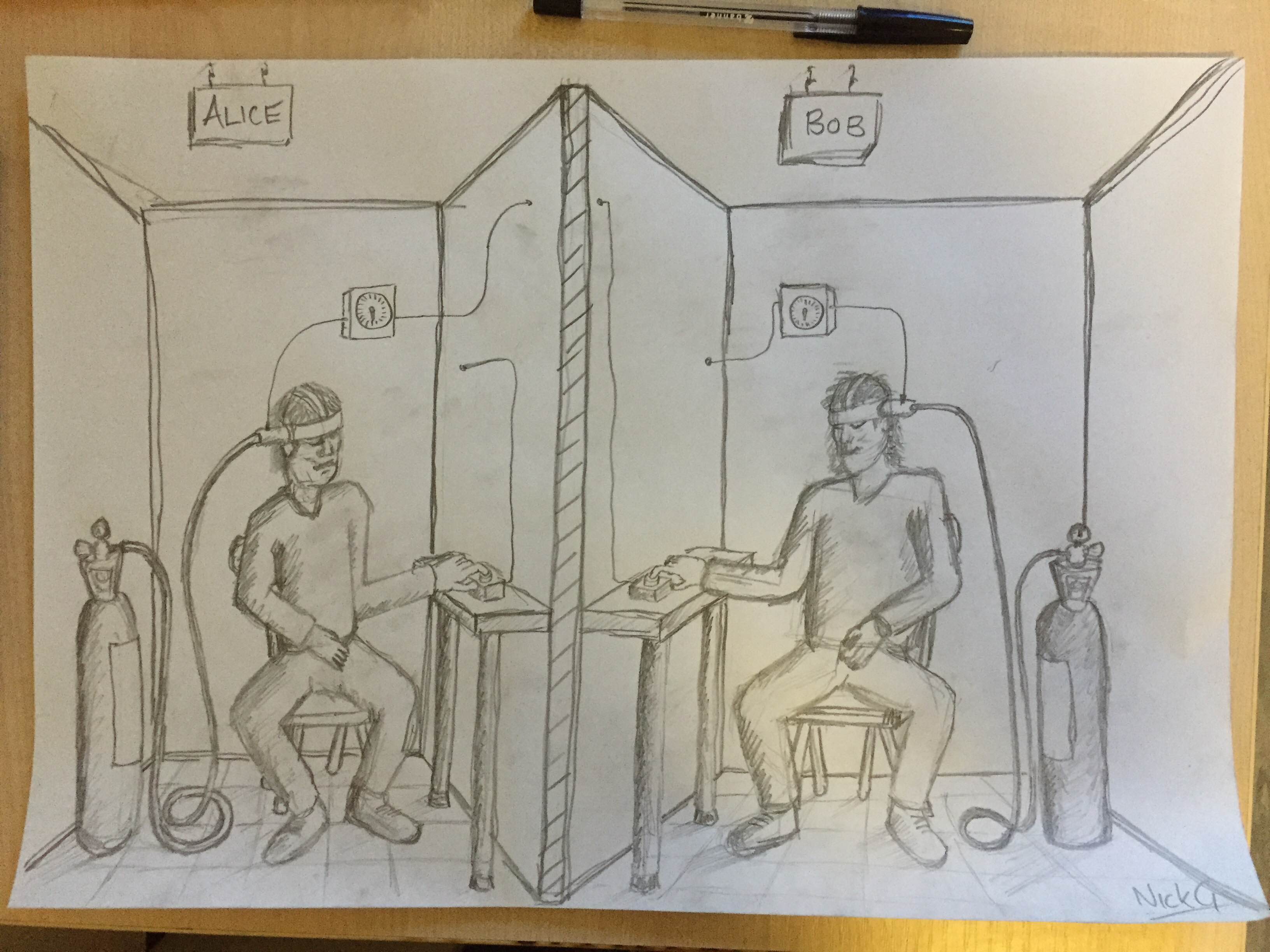
    I was an inpatient on a secure psychiatric ward, so naturally I came up with a bizarre thought experiment. I even did a drawing of my quantum suicide experiment.

    When I was bored out of my mind at work one day, I wrote a short story called The Factory.

    If you ever wondered why I have a semicolon tattooed behind my ear, this is half the story.

    Everything you never wanted to know about addiction.

    But, is it art? This is a good example of me rambling while strung-out. I’m surprised I could even see the keyboard. I just like the title and it’s a bit of a private joke, sorry.

    There’s a 3-part account of the time I lost my mind and started hearing voices.

    That’ll probably do. There’s a lot to get through there.

    Of course, there’s also the first draft of my novel if you have time to read 53,000 words. I’m going to start editing it tomorrow, so any feedback would be gratefully received.

    I’ve slightly bent the rules, because I have a bit of a warped sense of time, but these are all significant pieces of writing for me, that I associate with the events of 2016.

    Happy New Year’s Eve.


    Tags:

  • Dead Reckoning

    This is a story about projection…

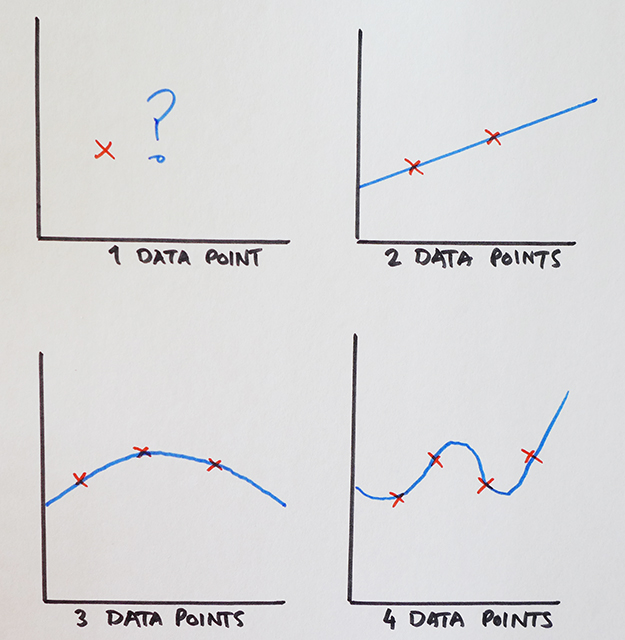
    Curve fitting

    Do you want to predict the future? Would you like to be in the right place at the right time? Ever wonder how ice hockey star Wayne Gretzky gets to where the puck is going to be, not where it’s been? How does a torpedo fired from a submarine intersect with its target, while following a relatively straight trajectory? Welcome to the world of dead reckoning.

    Imagine I have a single data point – a latitude and a longitude – which tells me the location of a target at one point in time. I don’t know how fast it’s going, and I don’t know what direction it’s going. Fairly useless information. In the parlance of physics, I know location, but I don’t know momentum. All we can say is that the probability of its next location spreads out from the point of origin: the thing being tracked is very unlikely to be a long way away, and it’s more likely to be somewhere near where it was last seen. This is a probability cloud.

    Next, we’ve measured two data points. We’re sure it’s the same thing that we’re tracking, because we have identified some unique characteristic about it. In the submarine example, the sonar operator will be listening to the sound of the propeller, so they will know if it’s the same ship, because it’s got the same number of propellors generating the same kind of sound, underwater.

    If we have two data points, we can draw a straight line between them, and assuming the same course and speed, we can predict where the object we are tracking is going to be next. We measure the distance between the two points, and divide by the time it took to travel between them, and we have the speed. Then, we simply extrapolate the line between the two points, and we can guess where the target will be on that line, at a future time.

    But, the simple extrapolation model is flawed. Perhaps currents are pulling the ship in a different direction from the direction steered. Perhaps the captain of the ship is steering an arc-shaped course, to go around an obstacle, or to change direction.

    With three data points, we can now fit an elliptic curve to fit those measurements. The elliptic curve shows us whether the captain is steering or drifting right or left. Additionally, we know whether the ship is speeding up or slowing down. If the ship is accelerating, but steering a constant course, it will be further along the line we plot than we think it will be. Equally, if the ship is decelerating, it won’t get as far along its course as we anticipate.

    Finally, with four data points, we can come up with a mathematical function that fits the data. To give a very simplified example, if the captain of the ship is zig-zagging to avoid submarines, we could fit a sine wave to the data, and predict when the ship is going to make its next turn… assuming that the captain tacks with regular frequency, of course.

    As we gather more and more data points, plotting the course history of the ship we’re tracking, we can come up with ever more sophisticated mathematical models to predict where we’re going to see the ship next.

    The arc of a ball travelling through the air is fairly easy to model. We just need to model momentum, gravity and air resistance. Momentum would be constant in a vacuum, so if you whack a tennis ball with a racquet while floating in the outer reaches of the galaxy – where there is little gravity – then the tennis ball will continue on a straight trajectory, at the same speed, more or less forever. Back here on Earth, the tennis ball will be pulled down to the ground by gravity, and it will also slow down, due to air resistance.

    Given that air density and gravity are more or less constant at ground level, where you expect to find tennis courts, we probably only need 3 data points, and we should be able to make an accurate guess as to where the tennis ball’s going to land. Even with gusts of wind, the flight of the tennis ball is relatively short, so the wind speed is unlikely to change dramatically during the flight of the ball. It should be a case of simply fitting an elliptic curve to the 3-dimensional co-ordinates of the 3 points of measurement, and then working out where that curve intersects with the plane of the ground, to predict where the ball’s going to land.

    “But what about spin?” I hear you ask. Yes, good point.

    Spin is angular momentum. For our tennis ball example: the fluffy exterior of the ball will exert a ‘grip’ – friction – on the air. Therefore, the spin of the ball makes a reasonable difference, as more air gets pushed towards one side of the ball, by the rotating face. Just like a wing, the ball will experience a small amount of lift: the ball is ‘pulled’ towards the side that is spinning in the same direction as the air flow. That’s the Magnus effect.

    If we had hit our tennis ball with spin out in the vacuum of space, it would not create a curved trajectory, because the fluffy tennis ball has no air to grip on – a vacuum is frictionless. However, the centripetal force of the spinning ball will cause it to stretch to be slightly bigger than it would be if it wasn’t spinning, because the outside is being thrown away from the centre, like a centrifuge. The elasticity of the ball will be trying to pull it back inwards, and in so doing, energy will be released in the form of heat. Eventually, all the energy of the spin will be radiated away, and the ball will slowly stop spinning. This effect is far too minuscule to even bother calculating, for our tennis court example here on Earth.

    Of course, all this maths is just to model a dumb tennis ball, which can’t make decisions and alter its own course, once it has left the racquet. To predict the behaviour of even a single individual is hard – this is the work of top poker players – and when we try to model complex systems made up of vast numbers of individuals – such as financial markets – the systems become chaotic and unpredictable. Thus, past performance is not a predictor of future results, unless you’re a tennis ball.


    Tags:

  • Schroëdinger’s Socks

    This is a story about ethics…

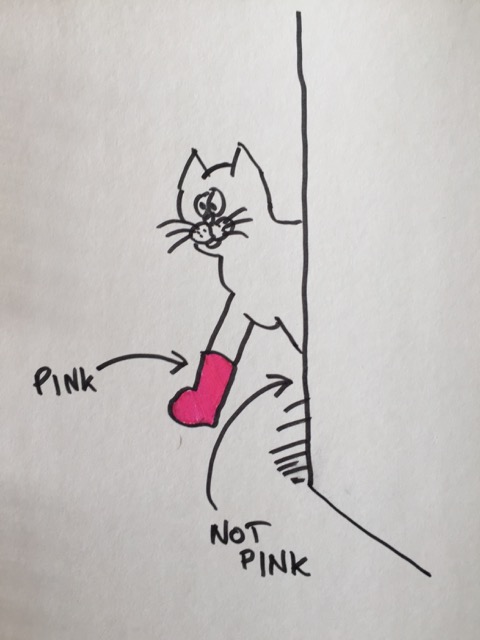
    Cat in sock

    Let us suppose for a moment that the great scientists who gave us our quantum mechanical world, were also animal lovers. Instead of putting cats into boxes with radioactively decaying elements which trigger poison gas to be released, killing the poor innocent creatures, how’s about if we dress them up in clothes instead?

    In this alternative quantum experiment, instead of Erwin Schroëdinger’s original design, we shall instead be putting socks on the poor cat that faced a 50% probability of death before.

    In our new experiment, we shall be putting different coloured socks on the cat. The socks can be whatever colour we like, but they’re always different colours from each other.

    As the cat walks into the room, we can see that the cat is wearing a pink sock. We can’t see the cat’s other foot yet, but we know that the other sock is not going to be pink.

    It’s not like the second sock decided to choose its colour when we looked at the first. It’s not like the second sock needed to know the colour of the first, and have the information transmitted to it as soon as we made our first observation.

    John Stewart Bell penned a tongue-in-cheek scientific paper explaining the simplicity of hidden variables, which seem to offer a much more objective reality than the Copenhagen Interpretation of quantum mechanics. For sure, the likes of Niels Bohr and Werner Heisenberg had elegantly described the subatomic world with mathematical precision, but the need to abandon a tangible objective reality seems unnecessary if we say that there are hidden variables.

    However, from this simple thought experiment comes a theory that is very real and very testable. Bell’s theorem says that the experimental results will differ significantly in a quantum world versus one that behaves classically. Quantum mechanics makes predictions that no classical theory could. Therefore, if you want to know whether probabilistic behaviour indicates a failure to truly imagine what’s going on in the subatomic world, you just have to do the experiments.

    If Bell’s theorem were proven correct, this could suggest that experimental observations are “known” in advance, and in fact we are living in the ‘clockwork’ universe as predicted, for example, by Newtonian mechanics. Were you to know the precise starting conditions of everything, you would be able to predict everything that would ever happen: no surprises!

    In short, Bell’s theorem was tested, and the result was surprising: we may be living in a superdeterministic reality, where there is no free will and all outcomes are fixed in advance.


    Tags:

  • Special Relativity

    This is a story about spacetime…

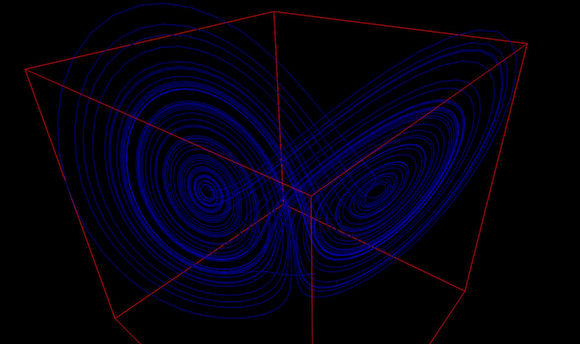
    Lorentz attractor

    We all know what Euclidian geometry is, right? Up & down, left & right, forwards & backwards. We know how to draw a triangle, a square. We know how to calculate the volume of a cube, a sphere, a cone. We even have methods of calculating where the points of 3-dimensional object will be, if we rotate it. We can use matrix transformations to do a rotational calculation, and work out where the corners of a spinning cube are going to be.

    But what about when space gets all stretched and weird? What about non-Euclidian geometry?

    If I draw two lines on a flat piece of paper, they will intersect at some point unless they are perfectly parallel. If I draw two ‘straight’ lines on a ‘flat’ hyperbolic plane, they will curve away from each other and not intersect. Even though both lines and both planes are 2-dimensional, the behaviour is very different, depending on the geometry.

    Do you think you live in a 3-dimensional universe? Wrong.

    So, you think you live in a 4-dimensional universe, where the 4th dimension is time? Also wrong.

    You live in a 3 dimensional universe where the speed that you are travelling at relative to everything else affects the curvature of spacetime. Pretty obvious, huh?

    So, if you’re not moving relative to the things that you can see, then you are moving in time. If you’re moving relative to something else, then you are moving in space, and ever so slightly less in time than the other object(s). Is that clear?

    If I get in a rocket and fly away from the Earth at the speed of light, and fly back again at the speed of light. The whole time I was on the rocket, I was moving in space but not in time. The speed of light is the speed limit of the universe, so if I was travelling at the speed of light, then time stood still for me. However, the Earth was not moving anywhere, so it was moving at full speed through time, but not at all through space. Is this making sense?

    Here’s an example: let’s say I travel to the moon and back. The moon is 384,400km away, so I travelled 768,800km. The speed of light is 299,792 km/s, so the round trip took me 2.6 seconds, according to your stopwatch. According to my stopwatch, my trip took me 0 seconds.

    Why did it take me zero seconds to travel to the moon and back at the speed of light? It’s simple really: because I was travelling through space at the maximum possible speed, so therefore I was not travelling through time at all.

    Why did the person on Earth with the stopwatch record a time of 2.6 seconds for me to travel to the moon and back at the speed of light? Again, it’s pretty simple: the person on Earth was not moving at all through space, so therefore they were travelling through time at the maximum possible speed.

    This is the nature of spacetime: any movement through space means less movement through time, as measured by an independent observer. When you’re jetting through space in your rocket, your clock doesn’t seem to be ticking any slower, but the independent observer can verify that time had indeed slowed down for you when you get back to Earth and you compare your clocks.

    We have just described special relativity and minkowski spacetime.

    Albert Einstein is the headline act for special relativity, but it was Hendrik Lorentz who was the mathematical genius behind figuring out how objects move in minkowski space, and of course it was Hermann Minkowski who came up with the special geometry where the wonders of spacetime play out.

    I got very excited a few years ago because neutrinos had been detected arriving on Earth from a distant supernova, before photons (particles of light) and this was reproduced in an experiment between CERN and Gran Sasso in Italy, 730km away. The experiment’s results seemed to suggest that neutrinos were travelling 8km/s faster than light.

    We all learn at school that nothing can travel faster than the speed of light. So far, special relativity has proven to be a pretty robust piece of science. Discovering something travelling faster than light would have meant tearing up the physics textbooks and going back to the drawing board.

    However, the beautiful theory and equations proved to be correct. The experiment was found to be flawed due to faulty timing equipment. Damn. No time travel for us, unless maybe you’re made of antimatter.

    By the way, I made a little Lorentz/Lorentz joke at the start, because I was thinking of writing about chaos theory. Perhaps I’ll save that delight for another day. Let’s see how this one goes down before I delve into any more topics that I have a shaky understanding of.

    Far side

    Tags:

  • Thought Experiment

    This is a story about science fiction…

    Cavendish Laboratory

    Do you know what the trouble with physics is? Are you aware how much the scientific community is dominated by dogma, doctrine and the status quo? The business world is full of powerful dinosaurs who have too much to lose if they were dethroned. So why would science be any different?

    Let’s start with a madness that afflicts nearly every physicist.

    Do you know what the difference between a model and a theory is? A theory is some equation, algorithm or logical thought experiment, that can empirically explain real-world observations and make testable predictions.

    If I have a theory that explains the arc that a ball will trace when I throw it, it should be able to predict where it lands. I plug in the wind speed, the weight of the ball, the size of the ball, the strength of gravity on the planet, and the initial force and angle that will be imparted on the projectile, and the theory gives me the expected result. By testing various different balls and various different throws, the theory can be said to be proven insofar as the predictions are in agreement with the measurements, within a margin of error.

    If I take various measurements from various experiments and gather them together in some great big database, and then attempt to infer a relationship between the measurements and the outcome, then I have a model. For example, it’s fairly obvious that a heavy ball will not travel very far versus a light ball, when thrown with the same force. From the data, there emerges this statistical correlation between the weight and the distance, but there is no underlying theory that predicts much beyond this simple association of variables.

    This is what we understand as the most important distinction between theory and model: that theories can make useful predictions that are testable, and give us some elegant mathematically expressible equation about the true nature of the universe, but models can only give us clunky retro-fitted attempts to make sense of vast swathes of data.

    To understand the theory of a thrown ball, we had to employ the laws of motion, the laws of drag coefficients (wind resistance) as well as gravity. Newtonian mechanics tells us about the movement of objects in a frictionless universe. Fluid dynamics tells us about an object travelling through something like air or water. General Relativity tells us about objects acted upon by the force of gravity. Through the combination of these three theories, we can accurately predict where a thrown ball is going to land.

    However, a model can make a reasonably decent job of the numbers, within a margin of error. Big heavy balls didn’t travel very far, and small light balls flew further. No need for all that theory mumbo-jumbo. A model can easily be within the same order of magnitude as the theoretical predictions.

    Have you heard of the Standard Model of particle physics?

    The Standard Model tells us what goes on at a subatomic scale. Or rather, it attempts to, given vast quantities of experimental data.

    Before I tell you any more about the Standard Model, let me let you in on a little secret. It doesn’t scale. Yes, that’s right. The Standard Model is very successful at the subatomic scale, but when we use it to model the entire universe, it doesn’t work. In order to use the Standard Model to explain what is observable in the universe, cosmologists have had to invent 3 massive cludges, for which there is no experimental evidence to confirm the existence of: inflation, dark matter and dark energy.

    The Standard Model concerns itself with stuff that we can see, and how things interact with each other. However, cosmology has had to invent dark matter (27% of the universe, but you can’t see it), dark energy (68.3% of the universe, but you can’t measure or detect it) and inflation (which attempts to explain how we got into this mess in the first place).

    Religion is often derided for asking the faithful flock to accept things at face value without evidence, but now the dominant science of physics and cosmology asks us to to believe that over 95% of the universe is made up from stuff that’s never been seen, never been measured, is not predicted by any fundamental theory and was basically dreamt up because our favoured model of the subatomic world doesn’t scale.

    Now, please don’t get confused with quantum mechanics.

    Quantum theory is quite empirically testable. The quantum behaviour of the universe is nearly impossible to visualise. Our day-to-day experience of the world is a deterministic one. When I put down the ball and look away, when I look back it’s still there. When I throw the ball, I can know both its momentum and its location. I can predict where balls are going to land, in the deterministic world of the macro scale. Things get mighty weird in the quantum world, but that doesn’t mean that things are not underpinned by good theoretical science.

    The problem comes in when we model. The Standard Model has over 20 free constants, which are tweakable numbers fed in from experiments. The Standard Model is designed to be constantly improved, as new data become available. The often touted defence about how well tested and accurate the Standard Model is, is null-and-void, because many of those experiments actually feed back into the model itself. The Standard Model automatically adjusts itself to match experimental observation.

    The problem with the Standard Model is that it doesn’t make any testable predictions. The tests that we have done have simply improved the model. The experimental measurements change the free constants that are plugged into the model. The model confirms itself, but it doesn’t tell us anything we hadn’t already experimentally measured.

    The only true test of the Standard Model would be to scale it up to see if it matches observations from cosmology. It doesn’t scale.

    Models don’t give us fundamental theories that underpin the universe, and allow us to make predictions about previously unobserved phenomena that we can then design experiments to investigate. Models cannot be proven or disproven, because they do not make predictions. Models are unassailable, because they can adapt themselves to include any new experimental data.

    The whole era of shut up and calculate has been a hinderance to the progress of theoretical physics. When people talk about the staggering accuracy and number of experiments that confirm the Standard Model, they ignore the fact that the model is only as accurate as the measurements that were used to build it. The model has told us nothing about the fundamental nature of reality.

    Now, when the Large Hadron Collider (LHC) detected a bump in experimental data at 75 GeV, we had over 300 papers published to explain such an anomaly. The bump turned out to be nothing more than noise, a glitch. Physicists are writing science fiction – fan fiction – to explain the workings of the universe, but none of it is backed by testable theory that makes useful predictions.

    Show me the physics that predicts a discovery in advance as opposed to proton smashing and attempting to retrofit data to a model. The current design of experiments completely contradicts the scientific method.

    Until we return to the era of coming up with hypotheses and fundamental theories that make testable predictions, and then building experiments to prove or disprove those theories, we will be stuck with our multi billion dollar particle smashers, that do nothing except to improve the accuracy of models by a few percentage points, and unearth no useful physics at all.


    Tags:

  • E = mc²

    This is a story about simplicity…

    Spiral

    A compressed spring is heavier than an uncompressed spring. When you lay down on your mattress, the springs of the mattress are actually getting heavier. When you get in your car, the springs of the suspension are getting heavier. When you wind up a clockwork watch, it weighs more. Wait, what?

    Yes, it’s as simple as I just said. When you squash a spring, the spring gets heavier. Any questions?

    Probably just one: whaaaaat?

    Well, it’s because of E = mc² you see.

    Oh, boring. It’s one of Nick’s crazy rants about physics. Perhaps he’s gone nuts again. Perhaps he’s having another hypomanic episode. Well, in some ways you’re right. But before anybody shouts “BANANA” at me [it’s my ‘safe’ word] you should really read on a little further.

    The reason why I race off on those hypomanic episodes is that most of the time, some evil passenger in my car keeps putting the handbrake on. People keep climbing on my back and making me carry them. People keep putting rocks in my pockets and getting me to drag their shit along for them. I’m basically frustrated as hell the whole time at the endless monotonous boredom and not being able to get on with my projects because of absolute bullshit. I just like to work on things and finish them, you see. If you tell me that you need something building, I’ll get on and build it, and give you a completed project, instead of sitting around with my head up my butt. I don’t really like sitting around with my head up my butt. I like getting on and building shit.

    And so, I become a compressed spring. The more that I’m held back, the more that I become coiled and squashed and full of energy, ready to spring forwards when I’m released. The time windows are very short, but I build a lot of cool stuff very quickly. I built iPhone apps that reached #1 in the charts in a matter of weeks. I built a gigantic summerhouse in my garden in the space of a few days. I don’t generally fuck about.

    “But why do springs get heavier when they’re compressed, Nick?” I hear you ask. It’s really easy to explain.

    Energy and mass are equivalent. Therefore, if you apply a weight to the top of a spring, and it squashes down, the energy that is stored up in that spring is stored as mass. More mass means the spring is more heavy. When you take the weight off the spring, allowing it to uncompress, the mass is converted back into energy, and the spring gets lighter again.

    That’s all that the equation E = mc² really says. It says energy equals mass [times the speed of light squared]. Energy-mass equivalence.

    OK… the speed of light squared is a pretty big number, so the amount of mass is pretty tiny compared to the amount of energy. So tiny that there isn’t a set of scales accurate enough in the whole world to measure just how much heavier our spring got, when we compressed it. The amount of mass that we created from energy, by compressing the spring, was teeny tiny.

    Equally though, you don’t need to turn much mass into energy to create lots of energy.

    When people talk about splitting the atom and nuclear weapons, I’m not sure what your average person on the street imagines. Perhaps they think that atoms are actually being destroyed to create the explosion. When a chemical explosive is detonated, the chemicals are rapidly being turned into gas, which is many many times more voluminous than the size of the solid or liquid explosives. This is not what’s happening during a nuclear reaction.

    The nuclei of atoms are held together by the strong nuclear force. Think of it like a door latch. The door latch holds together particles with similar electrical charge. I’m sure you remember playing with magnets, and you know that like poles repel each other. So, when you put the red end of magnet towards the red end of another magnet, they don’t want to touch each other. The strong nuclear force holds those two red ends together, stopping them from flying apart. This is much akin to our coiled spring.

    When the nucleus of an atom is split by being bashed into by another particle, a bit like a wrecking ball smashing into a house, then the ‘latch’ of the strong nuclear force is broken, and the particles with the same charge repel each other. The different parts of the atom fly apart because of this repulsion. It’s like those coiled springs are uncoiling.

    This means that energy is being released. Lots more energy than it took to unlatch the strong nuclear force that held the nucleus together. It’s a bit like a room full of mouse traps, all sprung-loaded and waiting to go off. It only takes one light little touch to cause one mouse trap to go off, and before you know it, they’re all setting each other off in a great big chain reaction.

    And that’s how a self-sustaining nuclear reaction works. A small amount of input energy is required to start the chain reaction, but once it’s started, there’s plenty of energetic particles flying around to smash into other nuclei and cause them to break apart. Less energy input was required than the amount of total energy output, and only a very small amount of the mass is actually being released, by the strong nuclear force being overcome, allowing the subatomic parts of the nucleus to fly apart.

    The same cascade reaction is used in a nuclear power plant as was used in the atomic bombs that blew up Hiroshima and Nagasaki. It’s called nuclear fission.

    So, how does this relate to anything? Well, whether it’s reading a stack of books about nuclear physics (this, by the way, was only the most basic introduction I’m afraid) or writing hundreds of thousands of words, I’m kinda a bit like that coiled spring, ready to unleash my energy on whatever I can when I’m given my chance, and I’m unlatched.

    I just need a small opening, a small opportunity, and I’ll run headlong at it. I’m so desperately bored by having to go at snails pace because of the limitations of the world around me. I live with constant frustration that I can’t go at a natural pace, and so I go twice as quick as I should do when I’m finally given the opportunity to get on with something.

    Had I ever gotten the chance to study theoretical physics at university, I would have read half as much in twice the time. Had I ever gotten to write at my own pace, with enough money behind me to keep a roof over my head, I would have taken twice as long and written half as much.

    I’m now wrestling with the problem that I’m pretty much working two jobs, and in one of them I’m trying too hard at to compensate for the lack of fulfilment in the other. My day job doesn’t challenge me. My day job gives me zero job satisfaction. And so when I get home in the evenings, I write and I write and I write. I’ve even taken to rattling off a couple of short stories every day while I’m at work. The one I wrote this morning was 6,000 words. That’s right. I just rattled off 6,000 words because I’m so damn frustrated and bored, but I’m still working a full time job as well as producing some 14,000 words a day. It’s too damn much and I’m going to burn out, but my day job is utter bullshit. My life is utter bullshit.

    It’s such a fucking rush, a hurry. It’s such a fucking struggle. Trying to put up with enough boring bullshit that I’ve got a lump of money behind me to allow me to take a break and work on something I love and I’m passionate about. Either that, or I just take the tiny windows of opportunity where I find them, and work as hard as I can and as fast as I can, before the bullshit catches up with me again.

    I honestly thought to myself that prison wouldn’t be so bad. So much time to read and write, and ponder stuff. Really, I’m a fucking prisoner at the moment. I can’t exactly get an interesting book out at my desk. Even when I’m writing, I’m doing it while looking over my shoulder. I’ve got to keep one eye on the boss, and be on my game in case I get asked to do something or somebody has a question for me. It’s so fucking tense you know? It’s compressing me. It’s squashing me. It’s making me dense and dark and heavy.

    I fantasise about living in a tent, unencumbered by having to make rent payments and keep the electric and gas switched on. What would I really need, in this day and age? You can do so much on a smartphone.

    I’m coming full circle. In a little over a month I will have been writing every day for a year. This whole thing started with me writing about some research I did on a public bench at a railway station. I think how different my life was then, and somehow I had much better quality of life, even though I was destitute.

    Do I want this? This life? This life of commuting on the morning train, and office chit-chat and the daily grind, and of looking busy at my desk and saying clever shit to impress the boss, and hiding in the toilets browsing the Internet, and writing short stories in a really small font to disguise what I’m doing, just to pass the endless boring hours, and watching the clock, counting down, counting down, down, down. Down to what? My premature death from the stress and anxiety of it all?

    Plenty of research has now proven that working a boring shitty office job is more unhealthy and lifespan shortening than smoking. Famously, people are suing their employers for the mind-numbingly dumb work they’re asked to do. It’s almost physically agonising. I’m being squashed. My very life force, my energy, my dignity, my passion, my personality… it’s all being squeezed out of me like I’m a tube of cheap toothpaste.

    I feel so sick and anxious. I don’t know how to continue. I know that fiscally it makes perfect sense to continue. It’s easy money, but it doesn’t look that easy when it seems to be the root cause of my mood instability. People either ask me to work too hard for too long, so I burn out, or they bore the shit out of me, so I eventually explode with frustration. The pyramid scheme of corporate life is destroying lives. My life is being destroyed.

    Oh God I want to throw up. This isn’t just a job you fuckers. This is literally fucking me up. I can’t do it much longer. I’m going to have a motherfucking breakdown. I can’t cope and I’m waving the white flag in surrender but yet the gunfire does not seem to pause.

    “Everybody needs to work”

    “You have a great job”

    “You’re so well paid”

    “People would love to have your opportunities”

    “Count your blessings”

    “Just another few decades and you’ll be rich beyond your wildest dreams”

    “Not long now”

    “C’mon it can’t be that hard”

    “You should try my job”

    “You’ve got things easy”

    “I’d love it if I was bored all the time”

    “You spoiled bratty bastard”

    “You earn 6 or 7 times as much as I do”

    “Why don’t you follow your dreams”

    “You’ve got nothing to complain about”

    FUCK OFF, FUCK OFF, FUCK OFF

    Argh! I can’t deny my feelings any longer. I fucking well did what I have to, to get out from a fucked up situation, and I got somewhat out of the way of the oncoming collision, but it’s been at great personal expense. I can’t express how much it’s killed me to put myself in a position where I might as well put my brain in a pickle jar and wheel my cryogenically frozen body into position at my desk.

    Imagine if I picked fruit and vegetables for a living, and I slept in a barn on the farm where I worked. I could keep some of the fruit and vegetables that I picked, and eat them. My labour would provide my contribution for my space in the barn, as well as enough beans, rice, pulses and meat to keep my protein and carbohydrate intake at a healthy level. I would be able to see, quite literally, the fruits of my labour each day.

    I live a life that could not be more opposite. I will never meet the people who use my software, and I don’t even create the software anymore. I manage a bunch of people to create software for me. And I don’t even see the people I manage face to face. They live thousands of miles away in some developing world country. I don’t even know what management is. I pretty much just say “you’re doing a great job. Keep going!” over and over again, to these poorly paid people who toil away, on the other side of the planet. Then some money is digitally credited to my bank balance, and I digitally credit it somewhere else to pay my rent. I never see actual physical money. I don’t ever carry cash. Coins are just an antique novelty to me.

    Modern life is making me unwell, I can sense it.

    I have embraced technology and science, and I understand it better than 99% of people. In abstract terms, I’m doing really well, and it looks insane to be dissatisfied with my lot in life, but how do I really define my existence? Can I define myself as a father and enjoy family life, when I have no children? Can I define myself as a builder or a soldier, when what I do is so ethereal and intangible? Can I define myself as a farmer or a gardener, when what I do is so unnatural?

    I’m a spring. That’s what I am: a rusty spring.

    I’m coiled up and compressed, ready to unspring, ready to bounce and boing.

    It’s fucking awful, let me tell you, being so unable to apply yourself to some useful mission, project or productive endeavour. It’s fucking awful, feeling so trapped and imprisoned. That’s why my thoughts turn dark and brooding so often. That’s why suicide is so often on my mind.


    Tags:

  • We Want Your Soul

    This is a story about preying on the weak…

    For Whom the Bell Tolls

    I’m lucky enough to live in a secular society, so I’m not expecting a major backlash over what I’m about to say, but religion is still an emotive topic in some parts of the world, and amongst extremists.

    As I thought about how this story should start, I considered word-play around the similarity between prey and pray. The friends I have who are overtly religious all seemed to find their God during periods of intense personal development, turmoil. The two things might be unconnected, but I somehow feel that they are not.

    I myself reconsidered the existence of a deity, as death drew dangerously close. I don’t think I would exactly have found myself praying for my soul, pleading for forgiveness or any of that bullshit, as I drew my final breath, but certain events in my life brought theological questions into sharp focus in my mind.

    One of the most profoundly unsettling questions I have, is not “what happens when we die?” but actually, is it possible to die at all? The conclusion I reached, when I really was at death’s door, was that it isn’t actually possible to die… at least in any way that you can usefully perceive.

    That sounds pretty nuts, right? However, the conclusion is actually borne out of real scientific empirical evidence. I won’t go into the details, as I have already written at length about Quantum Eraser experiments and the problem of separating the scientists performing measurements from their experiments.

    But what does it all mean in practice? Well, in actual fact, this line of thinking has brought me ever closer to Christian values than I would have ever thought possible. Do I mean Christian in the bible-bashing, ramming religion down people’s throat sense? No, what I mean is Christian… as in, the teachings of Jesus Christ, not the out-of-context bullshit peddled by dogmatic religious thought leaders.

    Let me give you an example: heaven and hell. We are all familiar with the concept of eternal damnation in a fiery underworld full of sin and deviancy. Well, it was through a fairly sinful path that I arrived at my understanding of what heaven and hell might look like, in a world where we don’t actually die. But what the hell does that mean, we don’t die?

    You’re going to die, but you won’t be aware of it. You’re going to see me die, but I won’t be aware of it. We’re going to see everybody die, except ourselves in fact… my interpretation of what I can see from the evidence, is that our own consciousness persists in some form or other, for eternity. This is the multiverse, and the many-minds theory.

    If a consciousness lasts eternally, that means that you will be eternally haunted by your past actions. If you do ‘sinful‘ deeds, then you will have an ever-increasing amount of guilt, and your life will be increasingly awful, until destruction has wrought havoc over the entire surface of the Earth. Eventually, you will have exhausted every resource at your disposal, and you will be presiding in immortality over the scorched and blackened surface of the planet, wrecked by your increasingly ‘evil‘ behaviour. In essence, you will have created your own personal hell.

    Equally, as an immortal living in a future shaped by your actions, you could preside over something that is the polar opposite of hell. With all eternity to refine and improve things, if you aspire to enhance the state of existence, then you will be able to create a kind of heaven.

    Another Church

    What I’ve found, from personal experience, is that there is no heaven to be found at the bottom of a whiskey bottle or a crack pipe. The things that seem to offer heavenly euphoria or “floating on cloud 9” as some people say, are actually pathways that actually lead to misery and destruction. The short term quick-fixes eventually lead you to lie, cheat and steal.

    Nobody preaches as loud as the converted former sinner, and so it is the case that if you examine the past of those who have found religion, you will very often find that there is very real repentance for a life of sin. We should remember this famous quote:

    “The only difference between the saint and the sinner, is that every saint has a past and every sinner has a future” — Oscar Wilde

    I believe it’s over-simplistic to talk about right & wrong, good & evil, dark & light and saints & sinners though. We are a product of circumstances, not free will. I strongly believe that it’s quite possible that time runs in both directions, and our memory is just a ‘trick‘ that makes us think we are actually making decisions.

    Let’s examine what I just said in a little more detail. If time is running in the opposite direction, you know exactly what decisions you’re going to make and your final destiny, but you have no memory of any decision that you made in the ‘past‘ because your memory is being erased.

    If you have no memory of things you did in the ‘past‘ then you have the opposite belief system. Instead of believing that the future is unknowable and that you’re in control of your destiny, you know that your destiny is fixed, but the past decisions that led you to your present existence are unknowable. The illusion of free will is shattered.

    I don’t believe it’s actually possible to experience consciousness when the flow of time is reversed, so in theory, there is only one stream of consciousness that spans all time, and every conscious being, with time just zig-zagging its way backwards and forwards through all eternity. It seems, to me, probable that there is only ever one ‘active‘ consciousness at any one time in a Universe, and every other being that ever existed for all time in that Universe is actually part of the same chain of conscious periods, where time runs ‘forwards‘ as we perceive it.

    Does your brain hurt yet? Look, it’s really simple: you feel conscious, and that you have free will, and that you have memories that go back to early childhood… however, you’re going to see everybody you know die, while you live for all eternity, and then bang! one day it seems to start all over again, but actually it’s the same Universe, but you just don’t remember the bit where time went into reverse, and you’re now living another person’s life in the same Universe as you’ll inhabit for all time. Simples?

    If you think I’ve gone totally potty, don’t worry… I don’t believe in that hypnotherapy mumbo jumbo where we can remember past lives. There’s just no good scientific theory to support such a preposterous idea.

    Also, by the way, there is no such thing as a space wizard who created the whole world in 6 days and then had a rest for a day. Sorry about that.

    Hell's BellsGo ahead and ask for whom the bell tolls… you’re immortal so it’s not going to be tolling for thee


    Tags:


  • Hump Day

    This is a story about determination to succeed…

    Chamonix Mont Blanc

    When I finish this blog post, I will have written 50,000 words in two months. My aim is to write 300,000 words this year. I’m on target, but just hitting 100,000 words will be hard… that’s the length of a novel.

    So, I’m re-centring myself for the next push ahead. I know that I have rambled and lost my way, and confused myself about why I even started writing this. However, I have continued putting one foot in front of the other, in the hope that I will reach some unseen summit at some point in future.

    Why do people climb mountains? “Because they’re there” is the usual response you will get from a mountaineer. For me, I like the view and I like knowing that at the very moment I reach the top of the peak, I’m amongst a group of people who are similarly blessed or cursed with the desire to put themselves through great hardship and work very hard to achieve some abstract goal. Very few people in the world will be enjoying such great views at that moment in time, as a reward for their efforts.

    Sometimes work is its own reward, and I certainly feel a bit of premature pride, knowing that I have produced half a novel already. Ok, so it wouldn’t be a very good novel, but if I can write 3, then with some aggressive editing, there might be something readable there.

    Even if I throw away everything I’ve written and start again, after a year, at least I will know that I have the stamina and discipline to sit and write every day. I will have some ideas about what kinds of things I’d like to write about, some themes. I can then structure and guide my writing, to produce something that is more coherent.

    Ok, so writing about oneself is conceited, and nobody cares who I am because I’m not some Z-list celebrity who’s famous for being an idiot on a reality TV show or whatever it is. I don’t actually care who reads this now. In a lot of ways this is an insurance policy.

    I wrote before about how I had written my own obituary. When I read it back, it was barely a few bullet points. I often think of that Nina Simone song that goes:

    Well I’m just a soul whose intentions are good; Oh Lord, please don’t let me be misunderstood

    I’m actually crying as I write those words, because it feels as if I have now re-centred on why I am writing all this stuff. I’m not afraid of death, but I’m very upset about the idea of being buried as some kind of black sheep. A convenient dumping ground for other people’s guilty conscience.

    I’ve been fighting to be heard and understood my whole life and unfortunately, when you are sick and tired and exhausted, the bullies and the abusers find it very easy to drown you out. Yes, the weaker you get, the easier you are to quietly brush under the carpet.

    The problem with character assassination, is that if the person still lives and breathes, they can still call you out on your preferred version of history. They can still raise their voice and say “Hey! I’m not dead yet! You didn’t finish me off, despite your best efforts to bury me!”. That’s inconvenient, embarrassing.

    I want to do something called hedging. I’m not sure if I’m going to live or die young, so I want to have some kind of life insurance policy that is more than monetary. I want to make sure that I leave some kind of useful legacy beyond cold hard cash.

    So, I want to speak out on the topic of bullying, and the abuse of men. I want to speak out on the topic of depression and suicide. I want to end the stigma of being a little boy who cries at sad films. I want to end the acceptance of bullying as a “fact of life” and instead get the world to recognise it as abuse, plain and simple. I want to raise awareness of depression as a sane response to an insane world, and deal with the root causes of it: loneliness, isolation, stress, pressure, abuse, bullying, war and every other kind of human suffering.

    Does this all sound ridiculous? Yes, it’s rather silly, eh? Of course I’m not going to make a blind bit of difference to the world. It’s set in its ways and there are problems everywhere we look. One wide-eyed, naïve, over-optimistic, non-celebrity, non-rich, non-famous 36 year old man who came from nowhere and is going nowhere… what could he do?… nothing!

    I don’t actually give a damn. I know how to do a few things reasonably well, so I’m just going to do them to the very best of my ability. I’m going to use all my wits and cunning and hustling abilities, combined with my lack of fear, and my strong feelings of empathy towards humanity, and just put myself out into the world and push hard.

    I’m going to do what I do when I climb any mountain. I’m just going to keep putting one foot in front of the other, and not think about the summit. I’m just going to keep grinding and grinding the trail. I’m just going to keep gaining altitude little by little, knowing that if I keep going up and up, I will eventually reach the summit.

    Portland Climbing

    I’ve always been a natural climber. I can’t help climbing. I just want to get high, naturally or unnaturally. Actually, just being alive is unnatural. Well, highly improbable anyway.

    The universe doesn’t like tall buildings, peaks. It doesn’t like things to fight the forces of nature. The highest mountains in the world – The Himalayas – are also some of the youngest. The Universe has a property called entropy which can describe the tendency of things that are structured and ordered to decay and be ruined.

    Entropy is busily trying to tear down Mount Everest. Meanwhile, mountaineers are taking on the entire Universe and sticking two fingers up at it, by climbing 8,848m, while it still remains so high… in millions of years time it will be nothing more than a pile of broken limestone fragments.

    If you think I overestimate my position in the Universe, you’re wrong. I’ve considered everything in context, from our best estimates of when “time” began, to just how “large” the known universe is (those things are in quotes, because space and time are actually much more complicated than we experience in our day to day life on Earth).

    I’m well versed enough in General and Special Relativity to know that most questions about our place in the Universe are more unfathomable than any mind could possibly comprehend. Time and space are such elastic and supermassive things, that it’s just laughable to even talk about one tiny speck of an organism being less or more important than another one.

    If anybody says that I should shut up because I’m not very important or interesting, they should perhaps consider that in the context of the estimated 13.82 billion years that the Universe has had a concept of time. Assuming that person has an above average lifespan of 100 years, that’d be 100 years in 13,820,000,000, which makes their lifespan equal to 0.0000007% of that time… they’re hardly important enough to make such a pronouncement, surely?

    Yes, you really are a drop in the ocean:

    The oceans of the world are estimated to weigh 1,300,000,000,000,000,000,000kg. You perhaps weigh 100kg… that means you are not even as much of a “big deal” as a raindrop in a swimming pool.

    So, when you start talking about which human life is more or less valuable than another, you should get a grip of yourself. You need to have a reality check. Not reality TV. You need to get your textbooks out and actually look at your significance in the Universe. Then you might start realising just how arrogant and stupid you are, if you think you are a superior being.

    Things start with good science, and from base principles, not with egos and guesswork. Certainly not with a cult of celebrity and hero-worship. Remember that Einstein was a patent clerk who was not very good at maths. All men are created equal.

    Think big.

    Mountain Man

    Halfway up Mont Blanc on my 18th birthday, enjoying a snack above the clouds (August 1998)


    Tags:

  • Plans to jump off building. Hate life

    This is a story about thought experiments…

    Quantum Suicide Pact

    I had 50 minutes to draw something while in hospital. I drew this. I have been thinking about it since I lay dying on the floor, unable to move a muscle except my eyes, diaphragm and heart. My urine was like orange juice and full of blood.

    I considered that dying would be a regretful waste, because I wouldn’t be able to tell anybody what it was like to die. I decided that if I discovered I was immortal, it could corrupt my morality and I would eventually use that knowledge to my sole advantage. I also considered how embarassed I would be to ‘meet my maker‘ in the full realisation that I p1ssed away my chance to learn anything from the situation.

    Bizarrely, I then conceived a thought experiment, as I lay on the floor. This addresses The Measurement Problem in Quantum Physics. The problem is this: how do you separate the experiment from the scientist who is conducting the experiment? By taking a measurement you are actually part of the experiment. We see this in every experiment that attempts to measure Quantum weirdness.

    Then, seemingly ‘miraculously‘ enough of my muscle was broken down by my body so that I had enough energy to get up and phone for help. I wasn’t out of the woods though. I nearly lost my kidneys. There was a lot of muscle damage too. So, just biology, and not really a miracle. I’m not a God bod now… although I did become agnostic at this point.

    My thought experiment is a variation of Schrödinger’s Cat, where two brave (or suicidal) scientists willingly enter a soundproof box, with a soundproof wall separating them. They then have to press a timing device for each other that must be pressed once every 2 minutes or else the timer will reach zero, and a captive bolt will pneumatically be driven into the brain of the other scientist. Given that there is a co-dependence on each other, if one scientist dies, so will the other.

    As an additional twist, if the two scientists press their buttons at the same time, within n milliseconds of each other, then they are both killed by the captive bolts.

    We can then start to tweak the parameters of the experiment so that we dial in a known probability of our scientists being killed. With 120 seconds of possible button push time, and 1,000 milliseconds in a second, we might hypothesise that there is a 1 in 120,000 chance (0.0008%) of both buttons being pushed within the same millisecond, which will trigger the event that leaves our scientists dead.

    So, what if our suicidal scientists press the button 60,000 times? Well, then the probability that the 2 scientists will be dead when we open the box is 50/50 . This is equivalent to Schrödinger’s Cat, except that 2 scientists are both alive and dead, rather than 1 cat that is both alive and dead, until we open the box.

    So, what if our suicidal scientists press the button 120,000 times? Well then the probabilistic prediction is that there is a 99% chance that the co-incidence would have occurred. We would be very surprised to open the box and find two living scientists. However, there is still a possibility that – no matter how slim the chance – they could have played Russian Roulette with a 100 bullet revolver loaded with 99 bullets, and somehow managed to fire the empty chamber.

    So, what if the scientists playing the game keep playing and playing and playing and playing. What if they eventually grow tired, having run many millions, billions, trillions, quadrillions of iterations, and they are still alive and button pushing? What if they decide to rip off the equipment and step outside the box? What would they know?

    They would know that Quantum Theory’s prediciton of immortality is very likely to be correct (Many Minds interpretation) and also know that this can be communicated beyond a single conscious surviving mind.

    I know that this is very messed up. Similar thoughts troubled another JPMorgan IT bod to the point where he took his own life.

    However, we can’t ignore the predictions of a fundamental theory that seems to be borne out by the experiments that we can conduct ethically. But why are we asking intelligent people to do stupid jobs? Is that ethical?

    I have always had a passion and aptitude for science and art, but we are all in a debt trap. Without the brain draining work of Global Banking IT, I could never be debt free. My myopic ex-wife got greedy. She now has a paltry amount of rapidly devaluing fiat currency, rather than a tangible freehold property asset.

    This is the kind startup I really want to be working on.

    Debt Reverse Me

    I started building this but my divorce nearly destroyed me (October 2013)

    Tags: