This is a story about observation…
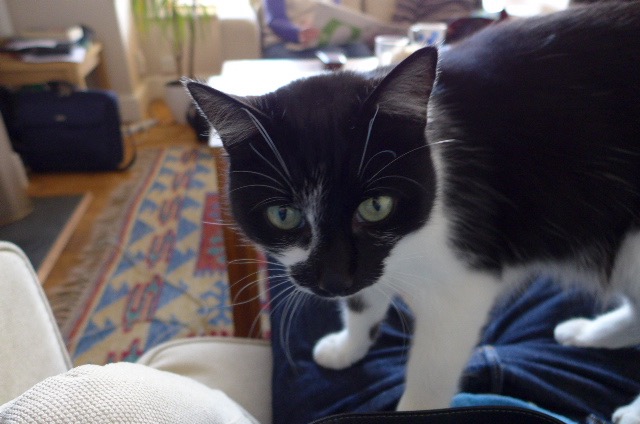
Frankie is a people cat. He needs company. When we went away to France for a couple of days, he was lonely and wouldn’t leave our neighbour alone. He invited himself into her lounge and wouldn’t leave. When we got home, he yawned, stretched and padded over to greet us. He let us all know how much he missed his humans.
It would be rather sinister to say that I had been observing my fellow patients in hospital, but it was kind unavoidable. I don’t really watch TV and I find humans much more interesting than most other things. I also bonded with my companions, and the staff.
It was a locked ward, but I was there voluntairily so I guess I could have asked to be discharged whenever I wanted. But I went there to be safe, so it seemed crazy to ask to leave when it took me 13 hours to be admitted, and I was in a place of safety.
It’s a bit of a strange compromise though: safety under lock & key. I wasn’t sectioned but, scarily, the consultant did consider it, which was a little ridiculous considering I had been safe for 6 days by that point. A section can be 72 hours, 28 days or even 6 months… terrifying, considering all I did was go to my GP one afternoon.
Anyway, hospital was brilliantly therepeutic. I managed to tackle a bunch of stressors in my life, with the help & support of the NHS team. My treatment was very holistic: drawing, sculpture, drama, cooking, socialising, plus non-judgemental chatting to mental health professionals, of course.
Medication plays a role too, but it’s very unclear whether it helps or it hinders, in the long term. Sure, if I was having a psychotic episode – seeing and hearing things – and was a real danger to myself or others, pharmacological intervention might be unavoidable, but is it really necessary to medicate a functional, articulate, self-aware and coping individual?
When I presented to my GP, we had the briefest of chats imagineable. My GP only really needed to know one thing: I couldn’t guarantee my own safety. I had tried to keep myself safe, but plans to kill myself had formed in my head. It was only a matter of time before I acted on them. Free will is an illusion. We are controlled by circumstances. Try choosing not to be in pain next time you stub your toe.
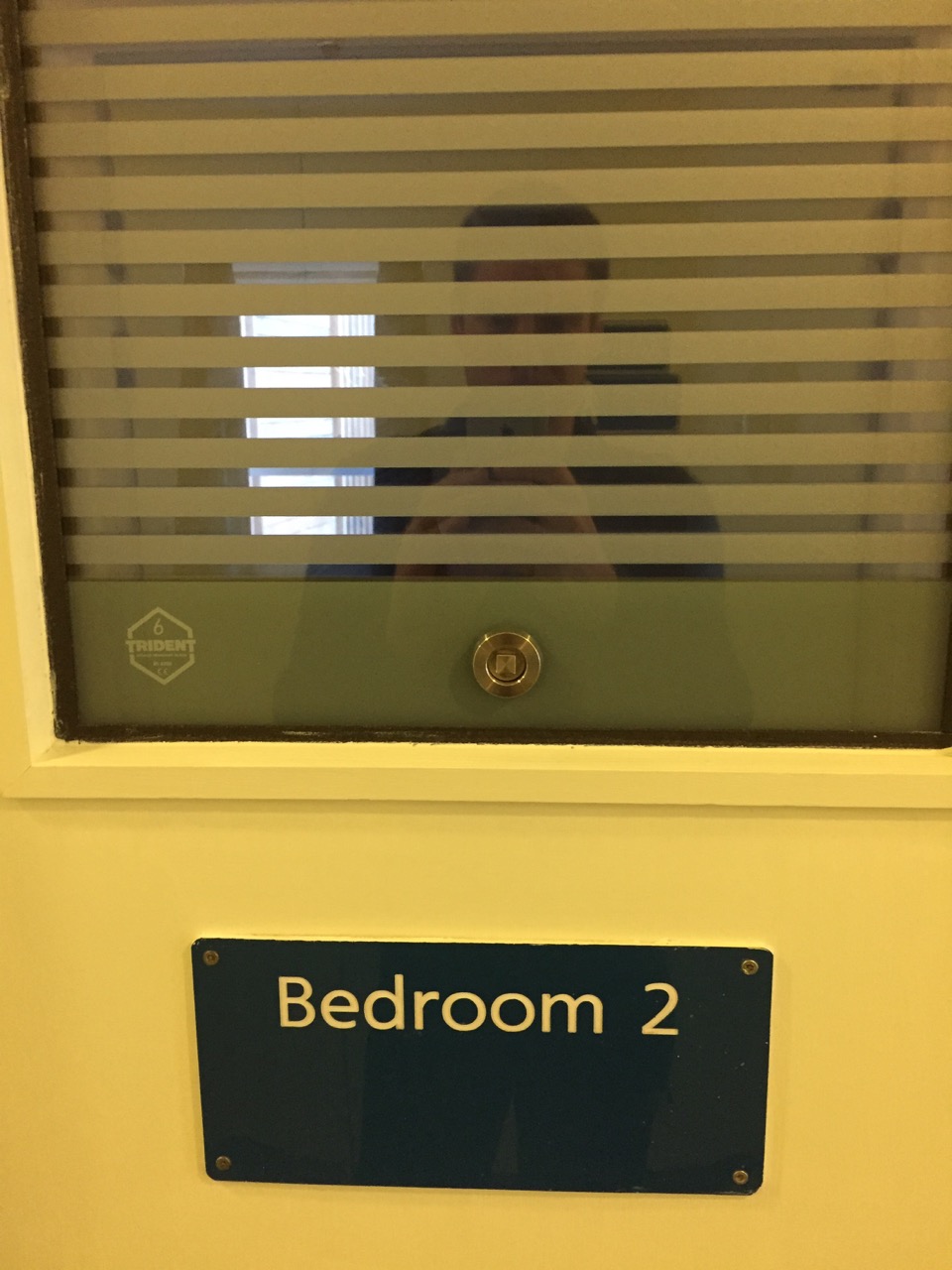
Wanting to be in hospital is a big deal. Psychiatric wards are not for the faint hearted. You will have somebody checking on you a couple of times an hour – especially at night – and people yell out randomly all night. People sing to themselves. People wash obsessively (or is it compulsively?). People shuffle. People mutter incomprehensibly. People steal your stuff. People ask you strange questions. People are aggressive. People are inappropriate. There is a lot of anger, crying, frustration, fear, boredom, confusion, despair… but there is also hope and optimism. Strangely, I find the environment to be calming. It’s supposed to be. It worked for me.
Obviously, you can’t have shoelaces, belts, razors, scissors, cables (e.g. for charging a mobile phone), curtains (including shower curtains), locks on doors, furniture that’s too tall, windows that open more than the smallest possible crack, windows or mirrors that could be shattered… there’s a fairly comprehensive list of safety considerations.
Here’s a little picture of the space where you can get some fresh air:
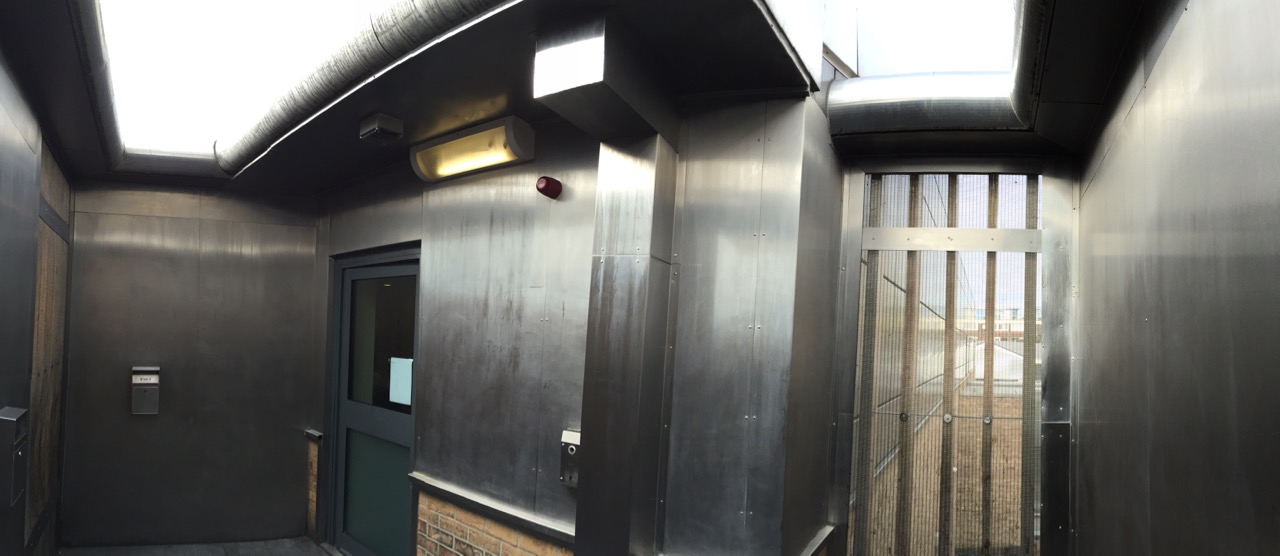
Nice, isn’t it?
Well, yes it kinda is. The fact that the NHS has gone to all the expense of designing something that is – presumably – to discourage people from climbing the walls and jumping off. I guess that most people aren’t such a good climber as me though, so it works for the majority of suicidal patients.
People also have unmet needs that are fairly obvious when you observe them for a little while. As a lifelong non-smoker, it was obvious to me just how important nicotine was in the lives of almost all the patients. The hospital has been smoke free for nearly 3 weeks, which is a huge burden on staff, who must accompany patients off the hospital premises every time they need a cigarette. Yes, that’s right, need… these people are psychologically drug dependent. Nicotine is an extremely addictive drug.
Luckily I had already eliminated alcohol from my life too, 3 weeks prior to hospital admission. I actually have a working theory that that it’s the reason why I became so deeply depressed. It happened to me in 2008 as well, when I quit drinking. It’s so hard to avoid alcohol though – it’s so socially engrained – that conducting an in-vivo study has been very hard, but I’ve gathered quite a bit of excellent quality data now (I’ve agressively managed to control other variables).
Frankly, I’m a bit of an oddity. I’m completely unmedicated, abstinent from caffeine and all drugs and alcohol. I have been for a long time. I’m about as clean living as they come. A perfect test subject for an unethical experiement into whether mental health issues come about due to environment, genetics, diet, social factors, stressors etc. etc.
Why unethical? Well… quite simply, if my mood sinks too low, I will take my own life. It’s really not a choice. I don’t want to die – at the moment – but when those dark times come, I feel quite differently. You feel differently too, and that’s why you’re thinking “why?” or some version of incomprehesion. You don’t know how it feels until you’ve been there, and I really do discourage a trip to the edge of the abyss.
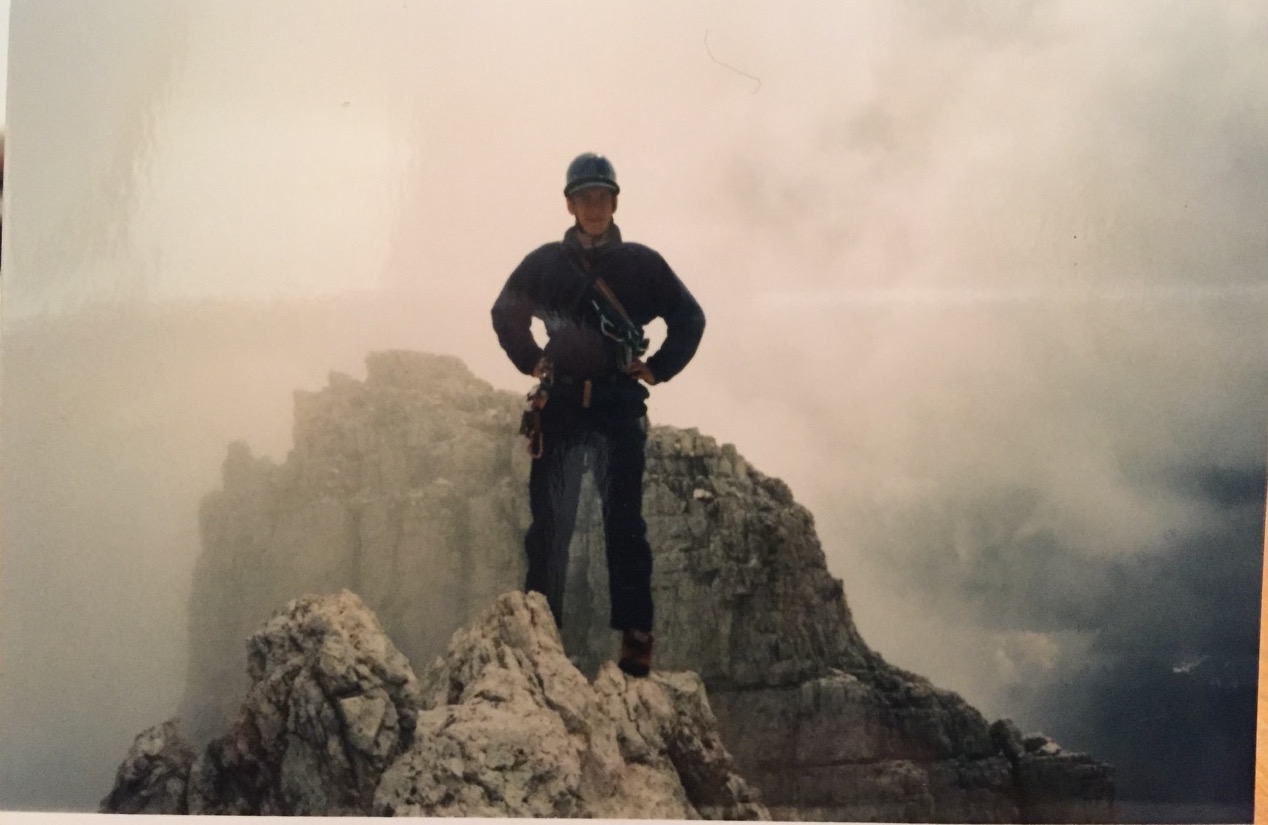
It’s ironic. I have no fear of death, but yet I am able to rationalise that it would be foolish to make an irreversible decision. I ride my bike through handlebar-width gaps between double-decker busses, I climb the tallest trees, jump out of aeroplanes, have my photo taken on perilous ledges with no ropes attached to me, and drive at the limit of control.
One of the staff in hospital suggested to me the other day that I could keep 1% in reserve, just in case of emergency. It actually didn’t sound too crazy.
Please support the Junior Doctors if they strike, and any other NHS workers. They deserve better pay & conditions (October 2015)
Tags: #suicide #depression #bipolar #NHS #mentalhealth #drugs #alcohol #caffeine #nicotine #frankie
Comments
8 responses to “Recovery: Hospital vs. Nature”
I gave up smoking during our Venezuela trip. After I got heatstroke. Once I got home, I re-read “Easy way to stop smoking” by Allen Carr which helped to frame my thinking and do a bit of ‘neural refactoring’!
I had tried to quit before and always got hung up on nicotine creeping up on me and making me think it was a long lost old friend, offering a hug and a bit of a chat, just for old times’ sake. This time I managed to watch out for the deadly 6 week, 12 week and 6 month cravings that had caught me out before. I’m still an ex-smoker and I can’t stand the smell of smoke now. I’ve had a couple of (drunken) puffs on a ciggy/spliff/havana cigar, but have never felt the need to go back to smoking, thankfully!
In the past, after a skinful, I often get the beer-angst/beer-blues – a feeling of slight worry, worthlessness, restlessness. An un-pin-downable dread. I wonder if that’s like a hundredth of what it feels like when you’re nosediving into the abyss. It’s likely the closest approximation of my best interpretation of clinical depression, and I don’t like the feeling at all.
I think alcohol is a bit like nicotine, but way, way more addictive again. If alcohol was a friend, it would be that friend who wanted to remind you about all the good times, but try to discourage you to remember the times it had been a complete and utter shit. Last year I gave up alcohol for 100 days, two times in the same year. Always after about a week I get dreadful headaches – proper withdrawal symptoms, but I don’t think ‘the fear’ ever lasted much past the second day.
At the 100 day point, when it was ‘time’ to reintroduce alcohol to my life, I was genuinely hesitant; fearful even! Half a pint of lager was enough to make me slur my words and giggle uncontrollably. I think I was nearly at the point where I could have knocked it on the head, but it was even more pervasive and sneaky than the evil nicotine ever was!
I’m on day 26 of no booze after a booze free September interrupted by a week of tipple whilst on holiday in the Gower. Interestingly, Amy commented that when I’d had a couple of drinks (literally, half a bottle of wine or a pint of beer or two), I always woke up with a right grumpy head. I didn’t have any hangover effects, but it was enough to put me in a bad mood.
However it’s fair to say the addiction is still strong in this one – I am really looking forward to have a couple of glasses of excellent red wine! I feel I will introspect about this as I get older, think about completely abstaining from the poison.
My sister has a cat like Frankie, she’s a rescue cat who loves human company. I think we all need company, even if sometimes we think we don’t.
Good to hear you’re out of hospital. I’m a bit surprised they’re ok with you not taking any medication but I guess it’s more complicated with bipolar. I’ve been taking antidepressants for anxiety and regular depression for six years now. I gave up drinking about five years ago and the reactions I get when I tell people that I don’t drink are very telling. They look horrified and ask why. If I say it makes me ill then they want to know more about my health issues. I have realised how bad it is that we live in a society where it’s considered normal to poison yourself into unconsciousness on a Friday night. I don’t smoke or have caffeine either for the same health reasons. If any of it made me feel better, I’d be an addict, but it doesn’t.
Shhh! Nobody knows I’m not on medication! That’s why it’s unethical, what I’m doing… I’m putting my life at risk to prove a hypothesis. No physician could do that without being struck off the GMC register.
Thanks for the comments around addiction and your own experiences of being teetotal. There is so much peer pressure to drink booze. Why is it acceptable to pressure people into drinking?
Have you been prescribed medication but decided not to take it? How do you avoid taking it in hospital? Perhaps I’m thinking of One Flew Over The Cuckoo’s Nest where they get forced to take medication (I’ve never been in a mental hospital). I take four medications every day and others as required. I could stop taking them all and I wouldn’t die, I’d just be uncomfortable and probably more unhappy and anxious.
As for alcohol, people seem to equate it with fun, so “I don’t drink” comes across as “I don’t like to have fun, and I will judge you.” It’s so built in to social activities that people can’t contemplate giving it up. I like going to quiet cosy pubs but I avoid clubs these days because I get bored or anxious and I don’t cope well without sleep. I prefer my life now, I do more of what I enjoy, not what I think I ought to enjoy.
I was prescribed Olanzapine, which I asked for two Fridays ago but didn’t receive until 4 days later. I was unmedicated that whole time. When they did finally start, I thought I wouldn’t bother swallowing it on a couple of occasions, and then they just totally forgot about my meds at hospital. When I went on leave at the weekend, I didn’t take it, because I couldn’t possibly work on such a drowsy medication. I’m also prescribed Lamotrigine, which I am taking but it takes weeks and months to get to a therapeutic dose, which is longer than my mood cycle anyway… I think it’s all a bit of a con to be honest. I’m pursuing an aggressive course of abstinence from alcohol, caffeine, refined sugar and any other nasty chemicals that might upset the delicate homeostatic balance in a finely tuned body that evolved over millions of years.
I am wondering why anticonvulsant medicines are also prescribed for mental health problems. My mum is epileptic and has tried several medications over the years and they have had various side effects including tiredness, achy limbs and depression. She has had brain surgery twice though which has had effects that are difficult to separate from medication side effects.
With some physical health conditions it is clear that it is medication that keeps people alive but with mental health it is less clear cut.
Liked this post.
via Twitter
Reposted this post.
via Twitter